
10kWh Home Battery Storage: Cost and Is It Big Enough?
A 10kWh battery is the most common size in UK homes. What it covers, what it costs, and whether it is enough alongside an EV or heat pump.
- Around 9 kWh usable
- 10-20 solar panels
- Independent advice

A 10kWh home battery is the most common size in British homes, suiting a mid-sized household with around 10 to 20 solar panels, and costs roughly £2,000 to £2,500 for the hardware. It comfortably covers an evening and night. The one thing to get right is the connection: on an ordinary socket the output is capped at around 800 W, which is not enough to carry a British evening peak whatever the capacity says.
How much battery storage do you actually need?
Three figures decide almost everything: how much electricity your household uses in a year, how much surplus solar power you send back to the grid, and how much of that you actually use after sunset. If you have a smart meter, the first two are usually in your energy supplier’s app. Without one, your latest annual statement lists both.
Annual consumption
Divide it by 365 to get your average day. At 6,000 kWh a year that is roughly 16.4 kWh per day.
Exported solar energy
This is the surplus a battery could have stored. Divide the annual figure by 365 for a daily average.
Evening demand
How much you use after sunset decides how much of that stored energy you actually get back out.
The smallest of those three numbers sets the useful ceiling. There is no point storing 15 kWh of surplus if you only use 8 kWh after sunset, and no point buying capacity your panels never fill. Our guide to battery capacity works through the method in full, or run your figures through the configurator below for a capacity range and an estimate of what you would save.
What does 10kWh of battery storage cover in a real home?
Nominal capacity and usable capacity are not the same thing. Most lithium iron phosphate batteries release 90 to 95% of their nominal capacity, so a 10kWh battery gives you roughly 9.0 kWh in daily use. The table below shows what that buys you.
| Appliance | Typical use | Share of 9.0 kWh usable |
|---|---|---|
| Fridge-freezer, 24 hours | 1.0-1.5 kWh | About 14% |
| Lighting, router and standby, one evening | 0.5 kWh | About 6% |
| Cooking on induction, one meal | 0.5-0.8 kWh | About 7% |
| Washing machine, 40 °C cycle | 0.6-0.9 kWh | About 8% |
| Dishwasher, eco cycle | 0.8-1.1 kWh | About 11% |
| TV and laptop, four hours | 0.3 kWh | About 3% |
| Electric oven, one hour | 1.5-2.0 kWh | About 19% |
| Heat pump, winter day | 6-12 kWh | Most or all of the battery |
| Charging an electric car, full | 50-80 kWh | Exceeds capacity |
Add those up and a full 10kWh battery carries a mid-sized household through a normal evening and night with capacity to spare: dinner, lighting, entertainment, an appliance cycle or two and the fridge running until morning. Whether it does so in practice depends on the next section.
Capacity is sorted at 10kWh. Power is the open question
Modular batteries are typically capped at around 800 W of discharge when they run from an ordinary earthed socket, so that the battery cannot overload a circuit it shares with other appliances. That cap does not rise with capacity. A 10kWh stack on a socket discharges no faster than a 5kWh one, it simply keeps going for longer.
Connected to a dedicated circuit by a qualified electrician, the same unit commonly delivers two to three kilowatts, depending on the model. At 10kWh that difference decides whether you have bought an evening’s worth of storage you can actually use.
| Ordinary socket | Dedicated circuit | |
|---|---|---|
| Discharge power | About 800 W | Typically 2-3 kW |
| Covers a typical evening peak | No | Yes, in most homes |
| Covers kettle, oven or hob | No | Mostly |
| Time to discharge 9 kWh | Over 11 hours | 3-4 hours |
| Refill inside a cheap overnight window | Slowly | About 3 hours at 3 kW |
| Grid connection | Connect and notify | Connect and notify |
Look at the discharge row. Spreading 9 kWh over eleven hours at 800 W sounds efficient, but your evening peak does not last eleven hours; it lasts three or four, and it draws more than 800 W throughout. A socket-connected 10kWh battery therefore leaves a good part of its stored energy unused while you buy peak electricity anyway. That is the single most common way a correctly sized battery still disappoints.
A single unit on a dedicated circuit stays under the 3.68 kW single-phase threshold, so your installer connects it and notifies your network operator afterwards. No waiting for approval. Our capacity guide covers the connection rules in full.
How much does a 10kWh battery cost?
Around £2,000 to £2,500 for the hardware: a base unit with its electronics plus the expansion modules that take it to 10kWh, and the meter that lets it follow your consumption. Add £250 to £500 for an electrician to run a dedicated circuit, more if the battery sits a long way from the consumer unit or you are in London or the South East.
| Capacity | Hardware | Dedicated circuit | Grid connection |
|---|---|---|---|
| 5 kWh | £1,100 – £1,400 | £250 – £500 | Connect and notify |
| 10 kWh (this page) | £2,000 – £2,500 | £250 – £500 | Connect and notify |
| 15 kWh | £2,900 – £3,600 | £250 – £500 | Connect and notify |
| 20 kWh | £3,800 – £4,700 | £250 – £500 | Connect and notify |
| 25 kWh | £4,700 – £5,800 | £250 – £500 | Prior approval |
| 30 kWh | £5,500 – £6,900 | £250 – £500 | Prior approval |
10kWh is where this shape of pricing is at its most favourable. The circuit cost is the same as at 5kWh but spread over twice the storage, you are still comfortably inside connect-and-notify territory, and you have not yet reached the point where a second unit and prior grid approval enter the picture. It is the least complicated purchase on the ladder.
Payback depends far more on your electricity contract than on the purchase price. A household on a time-of-use tariff that charges cheaply overnight and discharges through the evening peak recovers the investment considerably faster than one on a flat tariff with a generous export rate.
Is a 10kWh home battery right for you?
Pros
- Your annual electricity use is below around 6,000 kWh
- You have roughly 10 to 20 solar panels
- You want to cover a large part of your evening electricity use
- You can put the battery on a dedicated circuit
- You occasionally charge an electric car at home
- You have a time-of-use tariff and want to shift several hours of consumption
Cons
- You use more than 6,000 kWh a year
- You have electric heating or a heat pump running through a cold winter
- You regularly charge an electric car at home
- You have more than twenty panels with substantial summer export
- You can only connect it to an ordinary socket, which caps output at 800 W
- You want whole-house backup rather than a backup socket
Our take
At 10kWh you have enough storage for most homes, so spend your attention on the output instead. Ask what the system delivers on a dedicated circuit and what the backup socket is rated at. Those two numbers decide whether the capacity you paid for ever leaves the battery.
Suitable for mid-sized homes with a larger solar array
A 10kWh battery works well with a mid-sized solar array of around 10 to 20 panels, roughly 4,000 to 7,500 W. It stores more of the daytime surplus than a 5kWh system can hold, and releases it in the evening and overnight once your own panels stop producing.
The same rule of thumb applies: 1 to 1.5 kWh of storage per 1 kWp of installed solar capacity. Above around twenty panels, the midday surplus in summer regularly exceeds what a 10kWh battery can absorb in a single day, so part of your generation is still exported. Expect the usual seasonal swing too: the battery cycles fully most days in summer, but may only charge partly in winter, which is why sizing on peak summer production alone leads to an oversized system.
Check the charge rate as well as the capacity. A system taking around 3 kW fills 9 kWh in roughly three hours, which a good summer day supplies easily but a dull winter one does not.
A 10kWh battery without solar panels
A home battery is worth having with no solar panels at all. On a time-of-use tariff the battery charges when electricity is cheap, usually overnight, and supplies the house through the expensive evening hours. At this size the sum is simple: one cycle a day, roughly 9 kWh shifted, multiplied by the gap between your cheap and peak rates.
10kWh is close to the sweet spot for this, for two reasons. 9 kWh of usable storage is about what a typical household draws between the evening peak and the following morning. And at a charge rate of around 3 kW the whole stack refills inside a three-hour cheap window, which larger stacks cannot always manage. Our guide to sizing a battery without solar panels covers what decides the benefit and what to check before switching tariff.
Is 10kWh enough alongside a heat pump or an EV?
This is the question that decides whether 10kWh is your answer or your starting point, and it is where most oversizing and undersizing happens.
With a heat pump, a 10kWh battery covers a mild winter day comfortably and the coldest ones not at all. A heat pump can draw 6 to 12 kWh in a day of real cold, which is most or all of your usable capacity before the household has cooked a meal. Its continuous draw also has to fit inside the battery’s output, which rules out a socket connection entirely. If you run a heat pump through a British winter and want the battery to carry the evening as well, 15kWh on a dedicated circuit is the more honest specification.
With an EV it depends entirely on how you charge. If you charge the car directly from a cheap overnight tariff, as most people do, the battery never needs to touch it and 10kWh remains a good fit for the rest of the house. If you want the battery itself to contribute meaningfully to charging, the arithmetic does not work: a home charger draws 3.7 to 11 kW, more than any single modular unit can supply, so the grid would be doing most of the work regardless.
Is 10kWh enough for backup power?
A 10kWh battery holds enough energy for a long run of essential loads, but what it can run at once is set by the backup output, which is a separate specification from both capacity and normal discharge power. On modular systems the backup socket commonly starts around 1 kW and rises to about 3 kW once expansion modules are fitted, which a 10kWh stack will have.
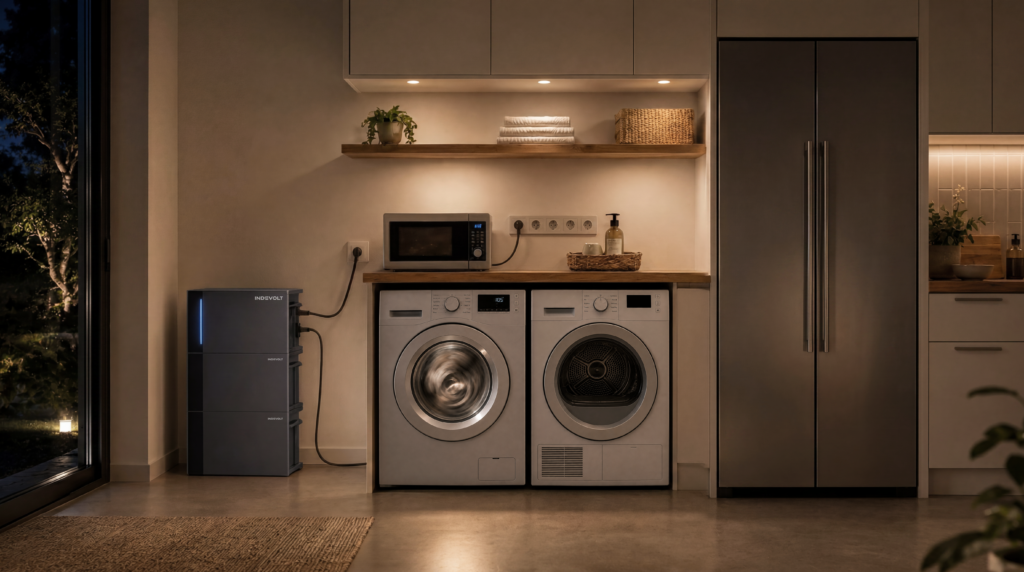
So check three figures rather than one: capacity in kWh, normal discharge power in kW, and backup output in kW. And note what a backup socket is: it powers what you plug into it, not your house circuits. Whole-house backup, where the lights stay on and the sockets keep working through a cut, is a feature of conventional installed systems with a hybrid inverter, and it is one of the main things that money buys.
| Connected load | Power | Runtime on 9.0 kWh |
|---|---|---|
| Fridge, lights, router, phone charging | 150-250 W | 36-60 hours |
| The above plus TV and a laptop | 350-450 W | 20-26 hours |
| Add a small heater or kettle in bursts | 1,000-1,500 W | 6-9 hours |
| Electric oven or induction hob | 2,000-3,000 W | 3-4 hours, at the output limit |
Discover smarter home energy with HomeBattery.com
A short introduction to how home batteries store solar energy, respond to electricity prices and fit into an ordinary household.
Can you charge an electric car from a 10kWh battery?
Charging an electric car is very different from powering a fridge or a few lights. Car batteries are many times larger than 10kWh and need high charging power. A 10kWh home battery can add a moderate amount of driving range, more than a 5kWh system, but it is still not suitable for fully charging a car.
In numbers: a typical electric car holds 50 to 80 kWh, and a home charger delivers 3.7 to 11 kW. A fully charged 10kWh battery would cover roughly 25 to 40 miles of range, and the charger draws more power than the battery can supply, so the grid would make up the difference throughout. Households that charge at home are better served by a cheap overnight tariff than by routing the car through the battery.
What to check before you buy a 10kWh battery
Capacity is only one specification. These are the figures that decide whether a system performs well in your home.
| Specification | Why it matters | Typical at 10 kWh |
|---|---|---|
| Usable capacity | What you actually get out of the battery each cycle | 8.6-9.6 kWh |
| Discharge power | Decides how much of your evening load the battery can carry | 800 W on a socket, typically 2-3 kW on a dedicated circuit |
| Charge power | Decides whether you can refill inside a cheap tariff window | Up to about 3 kW |
| Backup output | What you can run during a power cut, separate from the figures above | Up to about 3 kW with modules fitted |
| Cycle life and warranty | The real measure of lifespan, more than the number of years | 10 years or 6,000-8,000 cycles |
| Expandability | How far the same base unit grows before you need a second one | Often around 20 kWh, varies by brand |
| Metering | How the battery sees your consumption | P1 or CT meter at the consumer unit |
| Protection rating | Required for outdoor placement | IP65 for outdoor use |
At 10kWh you are still comfortably inside what one base unit handles, so the expansion path is about how much further you might go rather than whether you need a second unit yet. Our capacity guide explains how the connection type sets your output and what your network operator needs.
10kWh or 15kWh?
This is a common decision for households with a sizeable solar array. The honest test is not which battery is better, but whether you have enough surplus solar and enough evening consumption to fill the extra space every day.
| 10 kWh | 15 kWh | |
|---|---|---|
| Usable capacity | About 9.0 kWh | About 13.5 kWh |
| Hardware | £2,000 – £2,500 | £2,900 – £3,600 |
| Discharge power | Same | Same |
| Refill in a 3-hour cheap window | Yes | Not fully |
| Heat pump through winter | Partly | Yes, in most homes |
The refill row is the one people miss. Both systems charge at around the same rate, so the larger one needs a longer cheap window to fill completely. Without solar, or in winter, part of that extra 4.5 kWh may simply never be charged, which means it never earns anything either. With a heat pump the extra capacity is doing real work on the coldest days and the sum changes.
If you are hesitating and the system is modular, staying at 10kWh and adding a module later is often the safer choice: you can scale up once your real usage data confirms you need the extra capacity, and the dedicated circuit you put in today carries the larger system too.
Frequently asked questions
How long does a 10kWh home battery last?
That depends on how much electricity you use and on the output. Running lights, a fridge and a router, a full battery lasts well over a day. Discharging at its full rate on a dedicated circuit it empties in three to four hours, and at 800 W from a socket it takes over eleven. As a rule, 9.0 kWh usable divided by the connected load in kilowatts gives the runtime in hours.
How much does a 10kWh battery cost?
Around £2,000 to £2,500 for the hardware, plus £250 to £500 for an electrician to run a dedicated circuit. A conventional installation built around a hybrid inverter is a different product and costs several thousand pounds more for the same storage.
Does a 10kWh battery discharge faster than a 5kWh one?
No. Output is set by the inverter and the connection, not by the capacity, so both deliver the same kilowatts. The larger battery simply sustains that output for longer before it empties.
Do I need an electrician for a 10kWh battery?
For a dedicated circuit, yes, and at this size it is what makes the capacity usable. A new circuit is notifiable work, so it has to be done by a registered electrician or signed off by Building Control. The installer also handles the notification to your network operator, which for a single unit happens after the work rather than before.
Can you expand a 10kWh home battery later?
On a modular system, yes. The base unit takes further expansion modules up to a stated maximum, often somewhere around 20 kWh in total, and beyond that you add a second complete unit in parallel. Check whether new modules have to match the age, capacity or firmware of the existing ones.
What warranty do you get with a 10kWh battery?
The warranty differs by brand and model. Many manufacturers offer around 10 years or a set number of charging cycles, commonly 6,000 to 8,000. The cycle count is the more meaningful figure, because a battery in daily use completes a little under one cycle per day.
Is 10kWh a lot for a home battery?
It sits in the middle of the residential market and is the size most UK households end up with. Ceilings vary by brand, but a single modular unit tends to reach somewhere around 20 kWh and three in parallel roughly 60 kWh, so 10kWh is comfortably inside what one base unit handles.
How many solar panels do you need for a 10kWh battery?
Roughly ten to twenty panels, or about 4,000 to 7,500 W. With more panels than that, a 10kWh battery often cannot absorb the full midday surplus in summer and part of your generation is exported to the grid.
Can a 10kWh battery power a heat pump?
Partly. A heat pump typically uses 6 to 12 kWh on a cold winter day, which a 10kWh battery can often cover on a milder day but not on the coldest ones. Its continuous draw also needs more power than a socket connection allows, so a dedicated circuit is essential. For reliable coverage through a full winter, most households size up to 15kWh or more.