
Large Home Battery Storage: 30kWh and Above
Above 30kWh you are no longer buying a typical home battery. Where the ceiling actually sits, what changes in the rules and the wiring, and who genuinely needs this much.
- 30 kWh and above
- Off-grid and large property
- Independent advice

- Above 30kWh the question stops being how much you use after sunset and becomes how much you generate and what happens when the grid is not there.
- Modular platforms usually scale to three units in parallel, which puts the practical residential ceiling somewhere around 60kWh depending on the brand.
- Every system at this size needs prior approval from your network operator, and a three-phase supply changes the thresholds that apply to you.
- Very few British homes can fill this much from a roof. If there is no large generation source, more storage is unlikely to be the answer.
- If you want the lights to stay on through a power cut, that is whole-house backup, and it comes from the inverter rather than from more kilowatt-hours.
Most people who land here searching for 50kWh or 100kWh of storage are not shopping for a home battery at all. Above 30kWh the domestic sizing logic runs out, because no ordinary household uses that much between sunset and morning. What takes its place is a different set of questions about generation, grid connection and resilience, and this page is about those.
Where home battery storage actually ends
Modular home batteries are built as a base unit holding the electronics plus expansion modules. A single unit tends to top out somewhere around 20kWh depending on the brand, and most platforms support running up to three units in parallel. That puts the practical residential ceiling somewhere around 60kWh, with roughly nine kilowatts of combined output.
| Configuration | Typical capacity | Combined output | Grid connection |
|---|---|---|---|
| One unit | Up to about 20 kWh | 2-3 kW | Connect and notify |
| Two units | Up to about 40 kWh | Roughly 5-6 kW | Prior approval |
| Three units | Up to about 60 kWh | Roughly 8-9 kW | Prior approval, conditions likely |
Beyond that you are into commercial and industrial equipment, which is a different market with different suppliers, different standards and different prices. If you came here looking for 100kWh or 200kWh, that is where you are headed, and a residential installer is unlikely to be the right place to start.
Our take
Almost everyone who asks us about 50kWh is really asking one of two things: how do I stay powered when the grid goes down, or how do I run a property that has no proper mains connection. Both are good questions. Neither is answered by shopping on kilowatt-hours.
Who genuinely needs more than 30kWh
Four situations account for most legitimate cases, and none of them is an ordinary house wanting a bigger battery.
Properties off the mains
A house with no grid connection, or one where connecting would cost more than generating. Here the battery is not shifting cheap hours into expensive ones; it is the only thing standing between you and darkness on a still, overcast week. Sizing is driven by days of autonomy and by the worst week of the year rather than by an average day.
Smallholdings and workshops
A property with outbuildings, machinery, pumps or cold storage. The load profile looks commercial even though the address is residential, and the peak power matters at least as much as the capacity. Three-phase supplies are common here, which changes the connection rules.
Constrained grid connections
Rural properties and some new developments have an import or export limit that storage can work around. The battery is there to smooth what the connection cannot deliver, so the right size follows from the constraint rather than from consumption.
High-resilience households
Medical equipment, home working that cannot stop, or a long history of outages. This is a real need, but capacity is rarely the answer to it. What matters is whole-house backup and automatic changeover, which come from the inverter rather than from the number of kilowatt-hours behind it.
Storage without generation is a dead end
This is the single most useful thing to understand before spending at this level. A battery does not make energy. It moves it from a moment when it is cheap or abundant to a moment when it is expensive or scarce. Above 30kWh there has to be something filling it, every day, or the capacity is inert.
| Filling it from | What you need | Realistic in Britain? |
|---|---|---|
| Solar alone | Roughly 45 panels or more, well oriented | Only on large roofs or ground mounts, and never in winter |
| A cheap tariff window | Six hours or more at high charge power | Yes, with two or three units charging in parallel |
| Wind or hydro | A site that suits it and planning consent | Rare, but the strongest case where it exists |
| A generator | Fuel, maintenance and somewhere to put it | Common off-grid, as a backstop rather than a primary source |
If none of those rows describes your property, more storage will not help you. That is an unglamorous answer, and it is why we would rather put it on the page than let you work it out after the invoice.
What changes in the rules above 30kWh
Prior approval, every time
Combined output at this size is far above the 3.68 kW single-phase threshold, so your network operator approves the installation before it goes in. Expect an application made by your installer, a wait measured in weeks, and the real possibility of conditions attached to your connection, such as an export limit.
Single or three phase changes everything
The thresholds are set per phase, so a three-phase property is assessed differently from a single-phase one and can usually accommodate more. Establish which you have before anyone designs the system, because it affects both what is permitted and what equipment suits.
Wiring rules treat it as a serious installation
The current edition of the wiring regulations includes provisions specifically for stationary battery storage, covering placement, protection and documentation. At this size the certification matters: it is what a surveyor, an insurer or a future buyer will ask to see.
Tell your insurer
A large battery installation is a material fact. It is usually straightforward, but it is far better handled before installation than after a claim.
Our capacity guide sets out the connection rules for every size, including the simpler process that applies below this level.
Sizing an off-grid battery system
Off-grid sizing works backwards from the worst case rather than the average, which is why the numbers end up so much larger than a grid-connected home would need.
Establish your daily load honestly
Measure rather than estimate, and include the things that are easy to forget: standby loads, a well pump, a freezer in an outbuilding, heating in the shoulder seasons. Off-grid, every watt has to come from somewhere you paid for.
Choose your days of autonomy
How long the system must run with little or no generation. Two days is lean for Britain, three to four is common, five is comfortable and expensive. Multiply your daily load by that figure and you have your target usable capacity.
Size generation for the worst month, not the year
A solar array that covers your annual needs will leave you short every December. Off-grid designs are sized on December output, which is why they look oversized in July, and why a generator or another source usually sits behind them.
Run that for a modest off-grid house using 10 kWh a day with three days of autonomy and you arrive at 30 kWh of usable storage, which is roughly 33kWh nominal. That is how properties end up at this end of the range: not because they use more than a suburban home, but because nothing else is there to catch them.
If resilience is the real reason
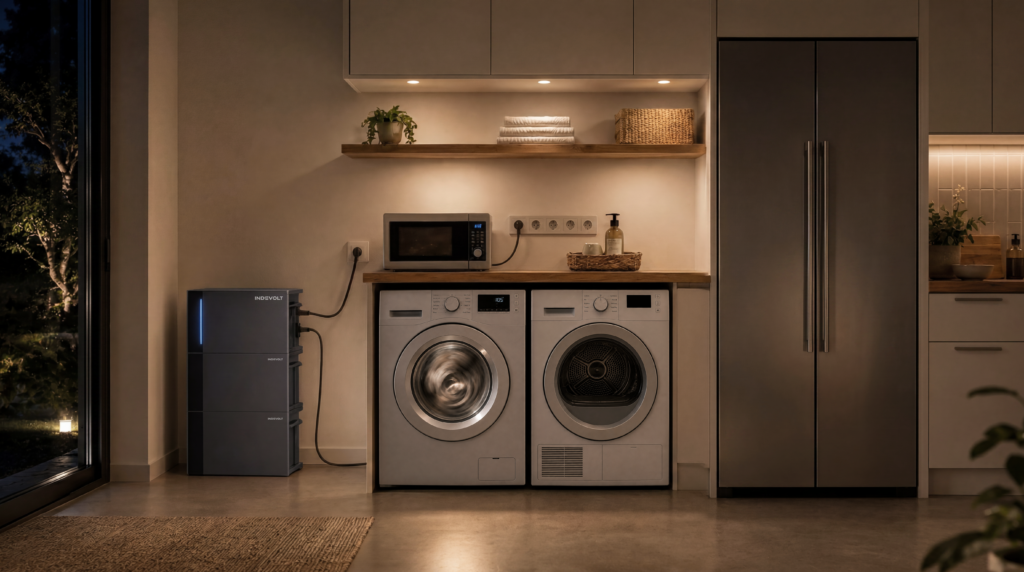
A large share of the people who ask about 50kWh want one thing: for nothing in the house to notice when the power goes off. That is a reasonable thing to want, and capacity is the wrong lever to pull.
What you actually need
- Whole-house backup rather than a backup socket
- Automatic changeover fast enough that equipment does not reset
- Enough output to start motors and heating, not just to run them
What you probably do not
- Fifty kilowatt-hours, when outages last hours rather than days
- Three stacks of modules and a grid application
- Capacity that sits idle for the other 364 days
A 15kWh system with proper whole-house backup will serve a resilience-minded household far better than a 50kWh system with a socket on the side, and cost a good deal less. Shop for the inverter and the changeover, then size the battery to the length of outage you actually experience.
Discover smarter home energy with HomeBattery.com
A short introduction to how home batteries store solar energy, respond to electricity prices and fit into an ordinary household.
What storage above 30kWh costs
Hardware continues to scale roughly in line with capacity, since you are adding modules and then complete units. The electrical work does not change much. What does change is the time, the paperwork and the likelihood of conditions on your connection.
| Capacity | Hardware | Units | Grid connection |
|---|---|---|---|
| 20 kWh | £3,800 – £4,700 | One | Connect and notify |
| 25 kWh | £4,700 – £5,800 | Two | Prior approval |
| 30 kWh | £5,500 – £6,900 | Two | Prior approval |
| 40 kWh | £7,200 – £9,000 | Two | Prior approval |
| 60 kWh | £10,500 – £13,500 | Three | Prior approval, conditions likely |
Two costs are missing from that table and both are real. An off-grid design needs generation sized for December, which is frequently a larger line item than the battery. And a conventional installation with a hybrid inverter, which is what whole-house backup usually requires, is a different product priced several thousand pounds above the modular route.
Frequently asked questions
What is the largest home battery you can buy?
For modular residential platforms, usually three units in parallel, which lands somewhere around 60kWh and roughly nine kilowatts of output depending on the brand. Above that you are into commercial and industrial equipment with different suppliers and standards.
Is a 50kWh home battery worth it?
Only if something fills it every day and something needs it every day. For a grid-connected house, no ordinary household uses that much between sunset and morning, so most of the capacity would never cycle. For an off-grid property with days of autonomy to cover, the same figure can be exactly right.
How much does a 50kWh battery cost?
Broadly in line with capacity, so roughly £9,000 to £11,000 for the hardware on a modular platform, plus electrical work. Off-grid systems cost considerably more once generation, changeover and often a generator are included.
Do I need three-phase power for a large battery?
Not necessarily, but it helps. Connection thresholds are set per phase, so a three-phase supply accommodates more output before conditions apply. Establish which supply you have before the system is designed, because it affects both the rules and the equipment.
How many days of autonomy should an off-grid battery cover?
Two days is lean for the British climate, three to four is common and five is comfortable but expensive. Multiply your honest daily load by the number of days to get target usable capacity, then size generation for December rather than for the annual average.
Will a large battery keep my whole house running in a power cut?
Only if the system is designed for it. Modular systems usually provide a backup socket, which powers what you plug into it rather than your house circuits. Whole-house backup with automatic changeover comes from the inverter, so a smaller battery with the right inverter beats a larger one without it.
Do I need to tell my insurer?
Yes. A large battery installation is a material fact, and it is far better dealt with before installation than after a claim. The installation certificate is also what a surveyor or future buyer will ask to see.
Is a 100kWh battery a home battery?
No. At that scale you are buying commercial or industrial storage, with different suppliers, different standards and a different connection process. A residential installer is unlikely to be the right starting point.