
30kWh Home Battery Storage: Cost, Sizing and Payback
30kWh covers a large all-electric home for a full day. What it takes to fill one in Britain, what it costs, and the point at which extra capacity stops paying for itself.
- Around 27 kWh usable
- Two units in parallel
- Independent advice

A 30kWh home battery covers a full day for a large all-electric household: heating, cooking, the base load and a meaningful car charge. Expect around £5,500 to £6,900 for the hardware, built as two units in parallel with prior approval from your network operator. It is also the size at which the honest question stops being how much you can store and becomes how often you will empty it.
27 kWh
Usable capacity
~13,000 kWh
Annual use it suits
~36-45
Panels to fill it from solar
Who actually needs 30kWh
This is a specific household rather than simply a wealthy one. 27 kWh of usable storage suits a property where almost everything runs on electricity and where demand is spread across the whole day rather than concentrated in the evening.
| Scenario | Typical daily use | Share of 27 kWh usable |
|---|---|---|
| Household base load, 24 hours | 5-7 kWh | About 22% |
| Cooking, laundry and dishwashing | 3-5 kWh | About 15% |
| Heat pump, cold winter day | 10-14 kWh | About 44% |
| EV, a typical weekday commute | 6-10 kWh | About 30% |
| Everything together, cold day | 24-36 kWh | Close to or over capacity |
That last row is the test. If your genuinely cold winter day looks like the figures above, 30kWh is sized correctly and will cycle most days through the heating season. If it looks more like fifteen or eighteen kilowatt-hours, you are buying a battery that spends most of the year with a third of its capacity untouched, and that third never earns anything back.
Our take
At 30kWh the summer is the problem, not the winter. From April to September a large battery in a British home has far more capacity than the house can use overnight, so you are carrying the cost of storage you only need for a few months. Look at your consumption month by month before you commit, not as an annual average.
The seasonal problem with large batteries
Battery payback is driven by cycles. Every day the battery fills and empties, it earns the difference between cheap and expensive electricity. Capacity that does not cycle earns nothing at all, and at 30kWh a large share of the stack does not cycle for much of the year.
Winter
Heating demand is high and solar production is low, so a large battery cycles fully almost every day, charged mostly from a cheap overnight tariff. This is where 30kWh earns its keep.
Spring and autumn
Mixed. Solar fills part of the stack on good days, heating demand is modest, and the battery often reaches morning with charge left over.
Summer
No heating load at all. Most households cannot use 27 kWh overnight in July, so a large part of the battery sits idle for months.
None of this makes 30kWh wrong. It does mean the payback calculation has to be done on twelve months of real data rather than on a cold January day, which is exactly what our configurator does. A battery sized to your worst week will always disappoint over a year.
How a 30kWh system is built
Two complete units in parallel, each a base unit carrying its full set of expansion modules. A single unit tends to top out somewhere around 20kWh depending on the brand, so 30kWh is comfortably inside what a pair can hold without needing a third.
Output and charging
Two units together deliver roughly five to six kilowatts and charge at roughly double the rate of one. That is enough to run heating, cooking and car charging at the same time, and to refill the full stack inside a long off-peak window. At this size the output is as much of the purchase as the storage.
Grid approval
Combined output is well above the 3.68 kW single-phase threshold, so your network operator approves the installation before it goes in. Your installer makes the application. Allow weeks, and ask whether your supply is single or three phase, because that changes the thresholds that apply to you.
Space and access
Two full stacks, each several modules tall and heavy enough to need a sound floor and clearance for airflow. Getting them into position is a real consideration: plan the route as well as the spot, and check the protection rating if they are going outdoors.
How much does a 30kWh battery cost?
Around £5,500 to £6,900 for the hardware, plus £250 to £500 for the electrical work. The cost per kilowatt-hour is the lowest on the ladder, because one set of electronics and one circuit are spread across the most storage.
| Capacity | Hardware | Electrical work | Grid connection |
|---|---|---|---|
| 5 kWh | £1,100 – £1,400 | £250 – £500 | Connect and notify |
| 10 kWh | £2,000 – £2,500 | £250 – £500 | Connect and notify |
| 15 kWh | £2,900 – £3,600 | £250 – £500 | Connect and notify |
| 20 kWh | £3,800 – £4,700 | £250 – £500 | Connect and notify |
| 25 kWh | £4,700 – £5,800 | £250 – £500 | Prior approval |
| 30 kWh (this page) | £5,500 – £6,900 | £250 – £500 | Prior approval |
Best cost per kilowatt-hour is not the same as best value, though, and this is the one place on the ladder where that distinction really bites. A kilowatt-hour that cycles three hundred times a year is worth many times one that cycles eighty. Work out what the top third of the stack will actually do between April and September before you let the per-kWh figure decide for you.
Is a 30kWh home battery right for you?
Pros
- Your annual electricity use is above about 11,000 kWh
- The property is all-electric, with a heat pump and probably an EV
- Your winter daily use genuinely approaches 25 kWh or more
- You need the output to run several heavy loads simultaneously
- You have a long off-peak window, a very large array, or both
- You have space and access for two full stacks
Cons
- Your winter daily use is closer to 15 kWh
- You are buying on cost per kilowatt-hour rather than on cycles
- You have gas heating, which removes most of the winter load
- Your off-peak window is short, so you cannot fill it
- You have not looked at your consumption month by month
- You want whole-house backup, which points towards a different kind of system
Backup power at 30kWh
27 kWh keeps essential loads running for well over a week. Capacity is not the question at this size and has not been for some time. The question is what the system can actually power during a cut.
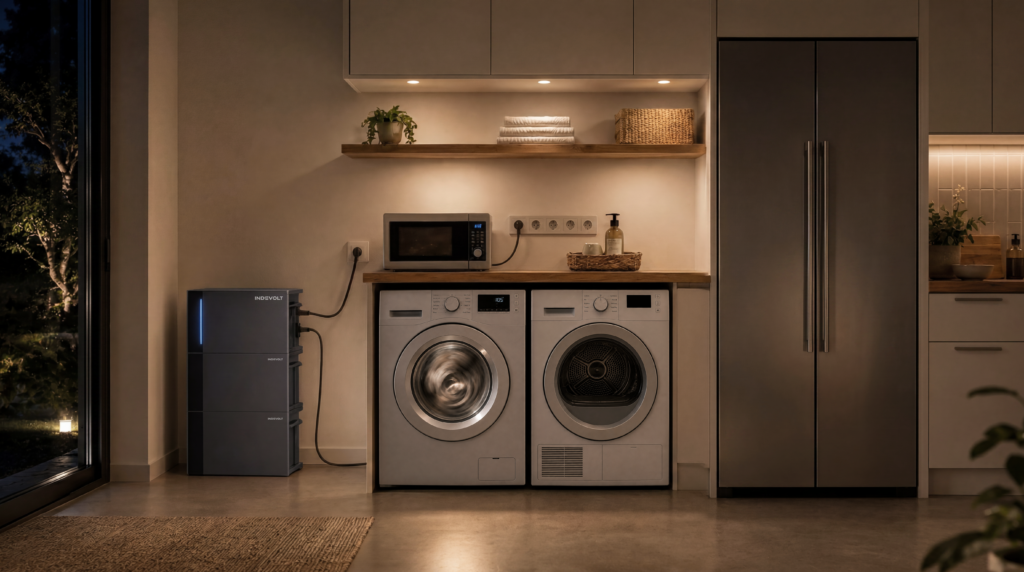
A modular system normally offers a backup socket, which powers what you plug into it rather than your house circuits. For a property of the size that justifies 30kWh, that is often not what the owner had in mind. Whole-house backup with automatic changeover, where the lights and sockets simply keep working, comes from a conventional installation with a hybrid inverter. If that capability matters to you, get quotes for both approaches rather than assuming the larger battery delivers it.
| Connected load | Power | Runtime on 27 kWh |
|---|---|---|
| Fridge, lights, router, phone charging | 150-250 W | Around 5-7 days |
| The above plus TV and a laptop | 350-450 W | 60-77 hours |
| Add a small heater or kettle in bursts | 1,000-1,500 W | 18-27 hours |
| Electric oven or induction hob | 2,000-3,000 W | 9-13 hours |
Discover smarter home energy with HomeBattery.com
A short introduction to how home batteries store solar energy, respond to electricity prices and fit into an ordinary household.
What to check before you buy a 30kWh battery
| Specification | Why it matters | Typical at 30 kWh |
|---|---|---|
| Usable capacity | What you actually get out of the battery each cycle | 26-28.5 kWh |
| Expected cycles per year | The real driver of payback, more than capacity or price | Ask for a twelve-month model, not a winter day |
| Combined output | What two units deliver together under sustained load | Roughly 5-6 kW |
| Combined charge rate | Whether the full stack fits inside your off-peak window | Roughly double a single unit |
| Grid application | Who makes it, how long it takes, what conditions may apply | Prior approval, allow weeks |
| Single or three phase | A three-phase supply changes the thresholds that apply to you | Worth checking before you design the system |
| Footprint, access and floor loading | Two full stacks have to get in and stand somewhere sound | Plan the route as well as the spot |
| Warranty across units | Whether both units carry the same terms and start date | Check before splitting the purchase |
Our capacity guide covers the connection rules and what your network operator needs in full.
30kWh or larger?
30kWh is roughly where a home battery stops being a home battery. Two units can hold more, and a third unit takes the largest residential systems higher still, but the reasons for going there are usually not domestic ones.
Beyond this point you are generally dealing with properties off the mains, smallholdings and workshops, premises with three-phase supplies, or buildings where the load profile looks more commercial than residential. The questions change accordingly, from how much you use after sunset to how much generation you have and what happens when the grid is not there at all.
Frequently asked questions
Is 30kWh too big for a house?
It depends entirely on the heating. For an all-electric property with a heat pump and an EV, where cold-day use approaches 25 kWh, it is sized correctly. For a house with gas heating, the winter load that justifies this capacity does not exist and most of the stack will sit idle.
How much does a 30kWh battery cost?
Around £5,500 to £6,900 for the hardware, plus £250 to £500 for the electrical work. That is the lowest cost per kilowatt-hour on the ladder, though cost per kilowatt-hour is a poor guide at this size because much of the capacity cycles far less often.
How is a 30kWh battery built?
As two complete units running in parallel, each a base unit carrying its full set of expansion modules. A single unit tends to reach only somewhere around 20kWh depending on the brand.
Do I need permission from my network operator?
Yes, in advance. Two units together are well above the 3.68 kW single-phase threshold, so the installation needs prior approval. Your installer normally makes the application. Allow weeks rather than days.
Will a 30kWh battery pay for itself?
That turns on how often it cycles, not on what it cost per kilowatt-hour. In winter a large battery in an all-electric home cycles daily; in summer much of it goes unused. Insist on a payback figure based on twelve months of your own data rather than a cold-day example.
Can solar fill a 30kWh battery in the UK?
Only on a very large array, roughly thirty-six to forty-five panels, and even then not in winter. Systems at this size are generally built around a time-of-use tariff, with solar contributing what it can from spring to autumn.
Does a 30kWh battery give whole-house backup?
Not by itself. Modular systems typically provide a backup socket, which powers what you plug into it rather than your house circuits. Whole-house backup with automatic changeover comes from a conventional installation with a hybrid inverter.
Would three-phase supply change anything?
Yes. The thresholds that decide whether your network operator must approve an installation in advance are set per phase, so a three-phase property is treated differently from a single-phase one. Check which you have before the system is designed.