
25kWh Home Battery Storage: Two Units, Output and Cost
25kWh is the first size that needs two units running in parallel. What that changes about output, grid approval and the installation, and when it is worth it.
- Around 22.5 kWh usable
- Two units in parallel
- Independent advice

A 25kWh home battery is the first size that will not fit in a single modular unit, so it means two systems running in parallel. Expect around £4,700 to £5,800 for the hardware. The capacity is the easy part. What really changes is the output, which roughly doubles, and the grid connection, which now needs your network operator’s approval before anything is installed.
22.5 kWh
Usable capacity
2 units
Running in parallel
~5-6 kW
Combined output
What changes when you go to two units
Everything up to around 20kWh is one base unit carrying expansion modules. 25kWh is past that ceiling, so you are buying a second complete system and running the pair together. Four things change at once, and only one of them is the capacity.
Output roughly doubles
Two units deliver around five to six kilowatts between them rather than two or three. This is the real prize, and it is why 25kWh behaves differently from 20kWh rather than simply lasting longer. Heating, cooking and car charging can run together.
Your network operator must approve it first
Combined output now exceeds the 3.68 kW single-phase threshold, so the installation needs prior approval rather than a notification afterwards. Your installer makes the application. Allow weeks rather than days, and be prepared for conditions on the connection.
Charging gets faster too
Two units charge in parallel, so the pair refills at roughly double the rate of one. That partly undoes the problem that limits 20kWh systems, where a six-hour fill does not fit an off-peak window.
You need space for two stacks
Not one larger cabinet but two complete systems, each several modules tall and heavy. Plan the location before you order, including clearance and floor loading.
Treat the approval step as part of the project rather than an afterthought. It is the main reason a 25kWh installation takes longer to arrange than a 20kWh one, and it is worth asking any installer how many of these applications they have made before.
Our take
People step up to 25kWh for the storage and then discover the output was the thing they actually needed. If your complaint about a smaller system was that it could not run the oven while the heat pump was going, two units fix that. If your complaint was that it ran out by morning, more capacity on one unit would have been cheaper and simpler.
How much battery storage do you actually need?
At this level the sizing question is less about the evening and more about the whole day. Households buying 25kWh are usually running electric heating and charging a car, which spreads demand across twenty-four hours rather than concentrating it after sunset.
| Scenario | Typical daily use | Share of 22.5 kWh usable |
|---|---|---|
| Household base load, 24 hours | 4-6 kWh | About 22% |
| Cooking, laundry and dishwashing | 3-4 kWh | About 16% |
| Heat pump, cold winter day | 8-12 kWh | About 44% |
| EV top-up, 40 miles of range | 10-12 kWh | About 49% |
| Heating plus car charging plus the house | 25-34 kWh | Exceeds capacity on the coldest days |
22.5 kWh covers heating and car charging together on an ordinary winter day, and falls short on the coldest ones. That is a reasonable place to land: sizing for the very worst day of the year means paying all year for capacity you use twice. Our guide to battery capacity works through the method, or run your own figures below.
How much does a 25kWh battery cost?
Around £4,700 to £5,800 for the hardware, plus £250 to £500 for the electrical work. Budget for a longer lead time rather than a much larger bill: the grid application itself is usually handled by your installer and the cost sits in the waiting, not the invoice.
| Capacity | Hardware | Electrical work | Grid connection |
|---|---|---|---|
| 5 kWh | £1,100 – £1,400 | £250 – £500 | Connect and notify |
| 10 kWh | £2,000 – £2,500 | £250 – £500 | Connect and notify |
| 15 kWh | £2,900 – £3,600 | £250 – £500 | Connect and notify |
| 20 kWh | £3,800 – £4,700 | £250 – £500 | Connect and notify |
| 25 kWh (this page) | £4,700 – £5,800 | £250 – £500 | Prior approval |
| 30 kWh | £5,500 – £6,900 | £250 – £500 | Prior approval |
One thing worth weighing honestly. Once you are in two-unit territory and going through a grid application anyway, a conventional installed system with a hybrid inverter becomes a fairer comparison than it was lower down the ladder. It costs considerably more, but it brings higher power and whole-house backup rather than a backup socket. At 5kWh that comparison was lopsided; at 25kWh it is a real choice, and worth getting quotes for both.
Is a 25kWh home battery right for you?
Pros
- Your annual electricity use is between about 9,000 and 11,000 kWh
- You run a heat pump and charge a car at home, and want both covered
- You need the output as much as the storage, to run several heavy loads at once
- You have the floor space and access for two separate stacks
- You have a large array, a long off-peak window, or both
- You can wait for a grid application rather than needing it installed next week
Cons
- Your reason for going larger is storage alone, not power
- You have no electric heating and no EV
- You cannot fit or do not want two separate stacks
- You want it installed quickly
- Your off-peak window is short and your roof is modest, so it will rarely fill
- You want whole-house backup, which points towards a different kind of system
Can solar realistically fill 25kWh in Britain?
Rarely, and this is worth saying plainly because few sites will. The usual guide of 1 to 1.5 kWh of storage per kWp puts 25kWh alongside an array of roughly 15,000 W, which is thirty to thirty-six panels. Very few British homes have that much roof facing the right way.
In practice a 25kWh system in the UK is a tariff system rather than a solar system. It earns its money by moving large quantities of cheap overnight electricity into expensive hours, with solar contributing what it can in summer. That is a perfectly good reason to buy one. It is just a different reason from the one most people have in mind, and it means your energy contract matters more than your roof.
The one genuine advantage two units bring here is charge rate. A pair refills at roughly double the speed of a single unit, which means 22.5 kWh can realistically be filled inside a long off-peak window, something a 20kWh single unit cannot manage.
Backup power at 25kWh
Energy stopped being the limit several sizes ago. 22.5 kWh keeps essential loads running for the best part of a week. The question at this level is whether the system backs up your house or only a socket on the side of it.
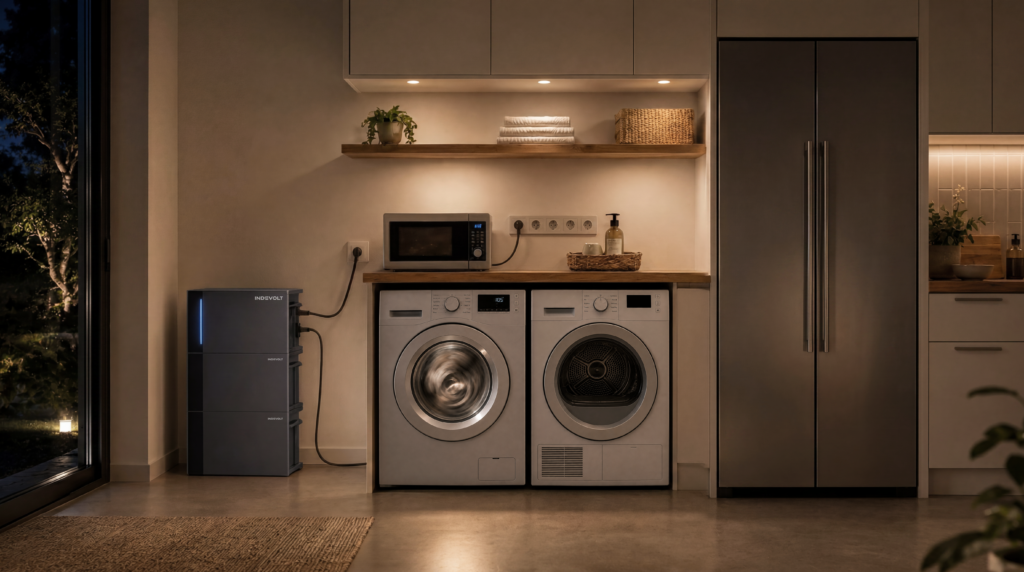
Most modular systems offer a backup socket: it powers what you plug into it, not your lighting circuits or your boiler. If the point of a large battery is that nothing in the house notices a power cut, ask specifically about whole-house backup and automatic changeover, and expect that capability to come from a different class of installation.
| Connected load | Power | Runtime on 22.5 kWh |
|---|---|---|
| Fridge, lights, router, phone charging | 150-250 W | Around 4-6 days |
| The above plus TV and a laptop | 350-450 W | 50-64 hours |
| Add a small heater or kettle in bursts | 1,000-1,500 W | 15-22 hours |
| Electric oven or induction hob | 2,000-3,000 W | 7-11 hours |
Discover smarter home energy with HomeBattery.com
A short introduction to how home batteries store solar energy, respond to electricity prices and fit into an ordinary household.
What to check before you buy a 25kWh battery
| Specification | Why it matters | Typical at 25 kWh |
|---|---|---|
| Usable capacity | What you actually get out of the battery each cycle | 21-24 kWh |
| Parallel operation | Whether the brand officially supports running units together | Commonly up to three units |
| Combined output | What the pair delivers together, and whether it is truly additive | Roughly 5-6 kW |
| Combined charge rate | Whether you can refill inside an off-peak window | Roughly double a single unit |
| Grid application | Who makes it, how long it takes, what conditions may apply | Prior approval, allow weeks |
| Single or three phase | A three-phase supply changes the thresholds that apply to you | Most homes are single phase |
| Footprint and floor loading | Two complete stacks, not one larger cabinet | Plan the location before ordering |
| Warranty across units | Whether a second unit bought later carries the same terms | Check before splitting the purchase |
That last row catches people out. Buying the second unit a year later can mean mismatched firmware, a different warranty start date, or a module that is no longer sold. Our capacity guide covers the connection rules in full.
25kWh or 30kWh?
Once you are committed to two units, this is a much smaller decision than the one before it. Both need prior approval, both take two stacks, both deliver the same output. You are simply choosing how many modules go into them.
| 25 kWh | 30 kWh | |
|---|---|---|
| Usable capacity | About 22.5 kWh | About 27 kWh |
| Hardware | £4,700 – £5,800 | £5,500 – £6,900 |
| Number of units | Two | Two |
| Grid connection | Prior approval | Prior approval |
| Heating and EV on a cold day | Mostly | Yes |
Since the expensive part of the step is already paid for, the extra modules are among the cheapest capacity on the whole ladder. If you are genuinely in two-unit territory, filling those units properly usually makes more sense than leaving them half populated.
Frequently asked questions
Why does 25kWh need two units?
Because a single modular base unit with its full complement of expansion modules tends to top out somewhere around 20kWh, varying by brand. Anything beyond that is built by running a second complete unit alongside the first.
Do I need permission from my network operator for a 25kWh battery?
Yes, in advance. Two units together exceed the 3.68 kW single-phase threshold, so the installation needs prior approval rather than a notification afterwards. Your installer normally makes the application. Allow weeks rather than days.
How much does a 25kWh battery cost?
Around £4,700 to £5,800 for the hardware, plus £250 to £500 for the electrical work. The grid application is usually handled by the installer, so the main cost of the extra step is time rather than money.
Does 25kWh charge faster than 20kWh?
Yes, which is one of the less obvious benefits. Two units charge in parallel, so the pair refills at roughly double the rate of a single unit. That makes it realistic to fill the whole stack inside a long off-peak window, which a 20kWh single unit cannot manage.
Is 25kWh enough for a heat pump and an electric car?
On an ordinary winter day, yes. On the coldest days heating alone can take 12 kWh, which leaves less than you would want for a meaningful car charge. Sizing for the very worst days of the year is rarely good value.
Can solar fill a 25kWh battery in the UK?
Rarely on its own. You would need roughly thirty to thirty-six panels to fill it regularly from the roof, which few British homes have. Most systems at this size are built around a time-of-use tariff, with solar contributing in summer.
Can I buy one unit now and the second later?
Often, but check first. A second unit bought later can bring mismatched firmware, a different warranty start date, or modules that are no longer sold. Ask the supplier how long the model will be available and whether mixed-age units are supported.
How much space do two units need?
Two complete stacks rather than one larger cabinet, each several modules tall and heavy enough to need a sound floor. Add clearance for airflow, and check the protection rating if either will be outdoors.