
15kWh Home Battery Storage: Cost, Heat Pumps and Sizing
15kWh is the size at which a home battery starts to carry a heat pump through a British winter. What it covers, what it costs, and the charging limit nobody mentions.
- Around 13.5 kWh usable
- Heat pump capable
- Independent advice

A 15kWh home battery is the first size that genuinely covers a heat pump on a cold day and still has something left for the evening. Expect around £2,900 to £3,600 for the hardware. It is also the size at which a new limit appears: at a charge rate of about 3 kW you cannot refill the whole stack inside a single cheap overnight window, which changes the sums if you have no solar.
13.5 kWh
Usable capacity
2-3 kW
Output on a dedicated circuit
~4.5 hrs
To charge from empty at 3 kW
The heat pump question, answered properly
Most people arrive at 15kWh because a smaller battery left them short on cold days. The arithmetic behind that is worth seeing.
A heat pump in a reasonably insulated British home draws something like 6 to 12 kWh across a genuinely cold day, with the heaviest demand in the early morning and the evening. A 10kWh battery gives you about 9 kWh usable, so on a mild winter day it covers the heating and little else, and on the coldest days it is empty before the household has cooked a meal. At 13.5 kWh usable you have roughly a cold day’s heating plus an ordinary evening, which is the combination people actually want.
| Winter day | Heat pump draw | Left from 13.5 kWh |
|---|---|---|
| Mild, around 10 °C | 4-6 kWh | 7.5-9.5 kWh |
| Cool, around 5 °C | 6-8 kWh | 5.5-7.5 kWh |
| Cold, around 0 °C | 8-10 kWh | 3.5-5.5 kWh |
| Severe, below freezing | 10-12 kWh | 1.5-3.5 kWh |
Two things that table does not show. A heat pump runs continuously rather than in bursts, so its draw has to fit inside the battery’s output as well as its capacity, which rules out a socket connection entirely at this size. And in the depths of winter your panels are producing least, so the battery is often charging from the grid rather than the roof. That is not a problem if you are on a time-of-use tariff, but it does mean the heating case and the solar case are different cases.
Our take
If a heat pump is the reason you are looking at 15kWh, ask about continuous output rather than peak output. A system that peaks at 3 kW but settles lower under sustained load will not carry the heating the way the spec sheet implies.
How much battery storage do you actually need?
Three figures decide almost everything: how much electricity your household uses in a year, how much surplus solar power you send back to the grid, and how much of that you actually use after sunset. If you have a smart meter, the first two are usually in your energy supplier’s app. Without one, your latest annual statement lists both.
Annual consumption
Divide it by 365 to get your average day. At 7,000 kWh a year that is roughly 19 kWh per day, and a heat pump concentrates a large share of that into the winter months rather than spreading it evenly.
Exported solar energy
This is the surplus a battery could have stored. Divide the annual figure by 365 for a daily average, then halve your expectations for December and January.
Evening and overnight demand
At this size the overnight figure matters as much as the evening one, because heating runs while you sleep.
The smallest of those three numbers sets the useful ceiling. Our guide to battery capacity works through the method in full, or run your figures through the configurator below for a capacity range and an estimate of what you would save.
The charging limit that starts to bite at 15kWh
This is the point on the capacity ladder where charge rate stops being a footnote. Modular systems commonly charge at around 3 kW, and that figure does not rise as you add storage. The battery gets bigger; the tap stays the same size.
| Capacity | Usable | Hours to fill at 3 kW | Fits a typical cheap window? |
|---|---|---|---|
| 10 kWh | 9 kWh | About 3 hours | Yes |
| 15 kWh (this page) | 13.5 kWh | About 4.5 hours | Only on a longer tariff window |
| 20 kWh | 18 kWh | About 6 hours | No |
If you have solar, this matters less, because the roof spends all day topping the battery up at whatever rate the sun allows. If you have no solar and your plan is to buy cheap overnight electricity and use it in the evening, it matters a great deal: capacity you cannot fill is capacity that never earns anything. Check the length of your tariff’s cheap window before you size the battery, not after.
What does 15kWh of battery storage cover in a real home?
Nominal capacity and usable capacity are not the same thing. Most lithium iron phosphate batteries release 90 to 95% of their nominal capacity, so a 15kWh battery gives you roughly 13.5 kWh in daily use.
| Appliance | Typical use | Share of 13.5 kWh usable |
|---|---|---|
| Fridge-freezer, 24 hours | 1.0-1.5 kWh | About 9% |
| Lighting, router and standby, one evening | 0.5 kWh | About 4% |
| Cooking on induction, one meal | 0.5-0.8 kWh | About 5% |
| Washing machine, 40 °C cycle | 0.6-0.9 kWh | About 6% |
| Dishwasher, eco cycle | 0.8-1.1 kWh | About 7% |
| Electric oven, one hour | 1.5-2.0 kWh | About 13% |
| Heat pump, cold winter day | 8-10 kWh | About 67% |
| Charging an electric car, full | 50-80 kWh | Exceeds capacity |
In practice 13.5 kWh covers a full day’s heating plus a normal evening, or two ordinary evenings back to back in a household without electric heating. That second case is worth pausing on: if you have no heat pump, 15kWh often means the battery simply does not empty, and a battery that does not empty is capacity you paid for and never cycled.
How much does a 15kWh battery cost?
Around £2,900 to £3,600 for the hardware, plus £250 to £500 for an electrician to run a dedicated circuit. At this size the circuit is not optional in any practical sense: an output capped at around 800 W cannot carry a heat pump, so a socket connection would waste the capacity entirely.
| Capacity | Hardware | Dedicated circuit | Grid connection |
|---|---|---|---|
| 5 kWh | £1,100 – £1,400 | £250 – £500 | Connect and notify |
| 10 kWh | £2,000 – £2,500 | £250 – £500 | Connect and notify |
| 15 kWh (this page) | £2,900 – £3,600 | £250 – £500 | Connect and notify |
| 20 kWh | £3,800 – £4,700 | £250 – £500 | Connect and notify |
| 25 kWh | £4,700 – £5,800 | £250 – £500 | Prior approval |
| 30 kWh | £5,500 – £6,900 | £250 – £500 | Prior approval |
15kWh still sits comfortably inside what a single unit holds, so you are buying one base unit with a full complement of expansion modules rather than a second system. That keeps you under the 3.68 kW single-phase threshold, which means your installer connects the battery and notifies your network operator afterwards rather than waiting for approval. The next size up the ladder is where that changes.
Is a 15kWh home battery right for you?
Pros
- You run a heat pump or electric heating through the winter
- Your annual electricity use is between about 5,000 and 7,000 kWh
- You have roughly 18 to 22 solar panels
- Your cheap tariff window runs four hours or longer
- You want the battery to carry a cold day and the evening after it
- You are putting it on a dedicated circuit
Cons
- You have no heat pump and no electric heating
- Your cheap tariff window is three hours and you have little solar
- You have fewer than fifteen panels, so the stack rarely fills from the roof
- A 10kWh battery is already going unused by morning
- You only wanted whole-house backup, which is a different specification
- You are hoping to charge an electric car from it
How much solar does 15kWh need?
The usual rule of thumb is 1 to 1.5 kWh of storage per kWp of installed solar, which puts 15kWh alongside an array of roughly 9,000 W, or eighteen to twenty-two panels. That is a large roof by British standards, and it is the honest reason many 15kWh systems are not really solar systems at all.
If your array is smaller than that, the battery will fill completely on good summer days and partially for much of the rest of the year. Whether that matters depends on what you are asking it to do. Paired with a time-of-use tariff, a part-filled battery still shifts the cheap hours you did manage to buy. Paired only with solar and no tariff advantage, the unfilled portion earns nothing at all.
Is 15kWh enough for backup power?
Energy is no longer the constraint at this size. 13.5 kWh runs a fridge, lights and a router for the better part of three days. What limits you is the backup output, which is a separate specification from both capacity and normal discharge power, and on modular systems it commonly reaches about 3 kW once expansion modules are fitted.
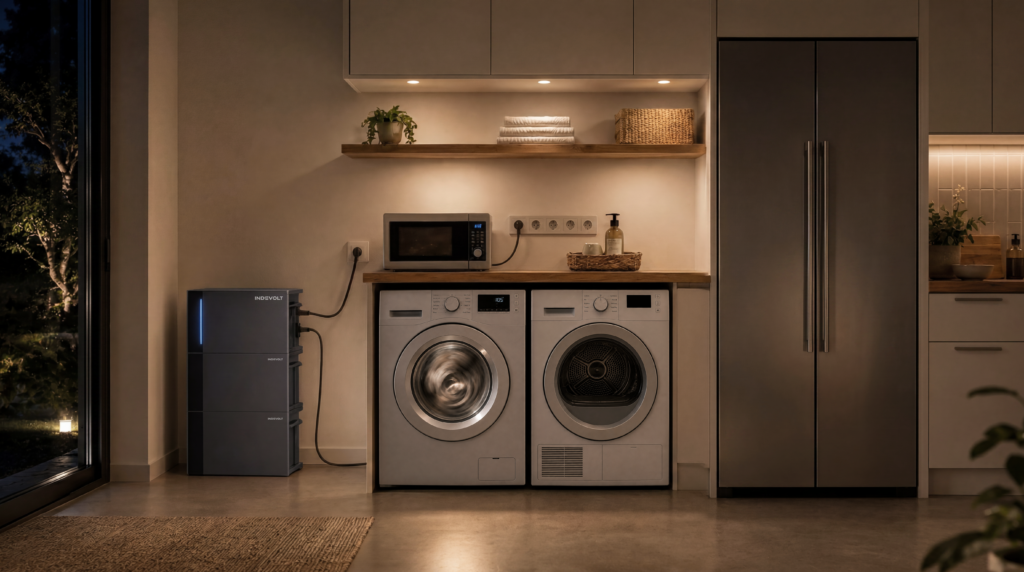
| Connected load | Power | Runtime on 13.5 kWh |
|---|---|---|
| Fridge, lights, router, phone charging | 150-250 W | 54-90 hours |
| The above plus TV and a laptop | 350-450 W | 30-38 hours |
| Add a small heater or kettle in bursts | 1,000-1,500 W | 9-13 hours |
| Electric oven or induction hob | 2,000-3,000 W | 4-6 hours, at the output limit |
Note what a backup socket is and is not: it powers what you plug into it, not your house circuits. If you want the lights and sockets to keep working through a cut, that is whole-house backup, and it comes from a conventional installation with a hybrid inverter rather than from more kilowatt-hours.
Discover smarter home energy with HomeBattery.com
A short introduction to how home batteries store solar energy, respond to electricity prices and fit into an ordinary household.
What to check before you buy a 15kWh battery
| Specification | Why it matters | Typical at 15 kWh |
|---|---|---|
| Usable capacity | What you actually get out of the battery each cycle | 13-14.3 kWh |
| Continuous discharge power | Whether it can carry a heat pump rather than just peak briefly | Typically 2-3 kW on a dedicated circuit |
| Charge power | Whether you can refill inside your cheap tariff window | Up to about 3 kW |
| Backup output | What you can run during a power cut, separate from the above | Up to about 3 kW with modules fitted |
| Cycle life and warranty | The real measure of lifespan, more than the number of years | 10 years or 6,000-8,000 cycles |
| Expandability | How far the same base unit grows before you need a second one | Often around 20 kWh, varies by brand |
| Metering | How the battery sees your consumption | P1 or CT meter at the consumer unit |
| Protection rating | Required for outdoor placement | IP65 for outdoor use |
Our capacity guide explains how the connection type sets your output and what your network operator needs.
15kWh or 20kWh?
Both are a single unit, both sit inside connect-and-notify territory, and both discharge at the same rate. The difference is how long they last and whether you can fill them.
| 15 kWh | 20 kWh | |
|---|---|---|
| Usable capacity | About 13.5 kWh | About 18 kWh |
| Hardware | £2,900 – £3,600 | £3,800 – £4,700 |
| Hours to fill at 3 kW | About 4.5 | About 6 |
| Heat pump through a cold day | Yes, with the evening after it | Yes, with room to spare |
| Solar array to fill it | 18-22 panels | 24-30 panels |
For most homes with a heat pump, 15kWh is the better buy, because 20kWh needs either a very large roof or a very long cheap window to be filled regularly. Step up to 20kWh when you have both a heat pump and an EV charging at home, or when you know your consumption is about to rise.
Frequently asked questions
Is 15kWh enough for a heat pump?
For most reasonably insulated British homes, yes. A heat pump draws roughly 6 to 12 kWh across a cold day, and 13.5 kWh of usable storage covers that with something left for the evening. On the very coldest days you will still import some electricity. Continuous output matters as much as capacity here, so a dedicated circuit is essential.
How long does a 15kWh home battery last?
Discharging at its full rate on a dedicated circuit it empties in four to six hours. Running only a fridge, lights and a router it lasts well over two days. As a rule, 13.5 kWh usable divided by the connected load in kilowatts gives the runtime in hours.
How much does a 15kWh battery cost?
Around £2,900 to £3,600 for the hardware, plus £250 to £500 for an electrician to run a dedicated circuit. A conventional installation built around a hybrid inverter is a different product and costs several thousand pounds more for the same storage.
Can I fill a 15kWh battery overnight on a cheap tariff?
Only if your cheap window is long enough. At a charge rate of around 3 kW the stack takes roughly four and a half hours to fill from empty, so a three-hour window leaves part of it uncharged. Check the length of your tariff's off-peak period before sizing at this level.
How many solar panels do you need for a 15kWh battery?
Roughly eighteen to twenty-two panels, or about 9,000 W, using the usual guide of 1 to 1.5 kWh of storage per kWp. Smaller arrays will still fill the battery on good summer days but leave it partly charged for much of the year.
Is 15kWh too big for a house without a heat pump?
Often, yes. Without electric heating most households do not empty 13.5 kWh overnight, and a battery that does not cycle earns nothing. If your evening and overnight use is under about 10 kWh, 10kWh is usually the better value.
Do I need approval from my network operator?
Not in advance. A single unit on a dedicated circuit stays under the 3.68 kW single-phase threshold, so your installer connects it and notifies the network operator afterwards. Systems beyond a single unit do need prior approval.
Can you expand a 15kWh home battery later?
Usually a little, since a single base unit often reaches somewhere around 20 kWh depending on the brand. Beyond that you add a second complete unit in parallel, which changes both the output and the grid connection process.