
Zendure vs Marstek
Two of the best-known makers of balcony and plug-in style batteries, compared in four matched pairs using only figures the makers publish.
- 4 matched pairs
- Maker data only
- Checked 12 Nov 2026

- We matched four Zendure and Marstek products by capacity and by how they are built: from the 1.92 kWh SolarFlow 800 Plus against the 2 kWh VENUS E Mini up to the 2.4 kWh SolarFlow 2400 AC+ against the 5 kWh VENUS E 4.0.
- Only 5 rows allowed a clear-cut call, a higher or lower number that is plainly better or an exact tie: Zendure leads in 0, Marstek in 0 and 5 are level. Most rows are not marked, because the makers quote power in different units or do not publish a figure.
- The bigger difference is the design. Zendure's 800 Plus, 800 Pro 2 and 2400 Pro and Marstek's JUPITER C Plus and VENUS D take solar panels on built-in inputs. Zendure's 2400 AC+ and Marstek's VENUS E Mini and VENUS E 4.0 are AC-coupled and list no panel input.
- Both sides leave figures out: 21 of 49 cells on Zendure's side read 'not stated' against 9 on Marstek's.
- In Great Britain, plug-in batteries are outside the plug-in solar rules that took effect on 27 August 2026, and several of these models are AC-coupled or output well above 800 W. We have not tested any of these products.
Not tested by us, and no prices
Every figure on this page comes from Zendure's and Marstek's own product pages, manuals and datasheets, last checked on 12 November 2026. We have not tested these products, so we do not score them or crown a winner on feel, noise in daily use or app quality. We show no prices because they change often and differ between sellers: compare the same model and bundle before you buy.
The short answer
There is no overall winner. Only 5 rows in our four pairs were clear-cut enough to mark: Zendure leads in 0, Marstek in 0 and 5 are level. That says more about how differently the two makers publish their data than about which product is better.
The biggest difference is how each product is built. Zendure's SolarFlow 800 Plus, 800 Pro 2 and 2400 Pro take solar panels directly on built-in MPPT inputs, and so do Marstek's JUPITER C Plus and VENUS D. Zendure's 2400 AC+ and Marstek's VENUS E Mini and VENUS E 4.0 are AC-coupled: they work with the solar system you already have and list no panel input of their own.
Where both publish a figure, the two are close at a similar size. Zendure states a 10-year warranty on the 2400 Pro and 2400 AC+, while Marstek states one on the VENUS D only. Marstek publishes more detail on the VENUS D (weights, dimensions, noise, temperature range and efficiency), and Zendure leaves most of those out on its 2400 pages. Use the pair tables below for the size you need, then check Which should you choose? for the situations where each fits better.
Rules matter as much as specifications. In Great Britain, plug-in solar kits of up to 800 VA have been legal since 27 August 2026, but plug-in batteries were excluded, and we could not confirm a UK version or plug for most of these models. Several here are AC-coupled or output well above 800 W, so ask an electrician before connecting one.
How we matched the models
We paired products by capacity and by type, because people choose a size and a way of connecting first. Each pair is the closest match in our catalogue, not a statement that the two products are the same price or the same age. The first pair is 1.92 kWh against 2 kWh and the second 1.92 kWh against 2.56 kWh. The third matches a 2.4 kWh base unit with a 2.56 kWh Marstek module, both with four solar inputs. The last pair is not like-for-like on capacity: Zendure's 2.4 kWh base unit (5.28 kWh with one AB3000L added) against Marstek's 5 kWh VENUS E 4.0, both AC-coupled.
Three catalogue models are not paired: Zendure's SolarFlow 800 Pro and Hyper 2000 and Marstek's VENUS E Gen 3.0. You can add them yourself in <a href="/compare-for-yourself/?p=zendure-solarflow-800-pro,marstek-venus-e">Compare For Yourself</a>.
| Specification | Zendure | Marstek |
|---|---|---|
| The small pair (about 2 kWh) | Zendure SolarFlow 800 Plus | Marstek VENUS E Mini |
| The balcony pair with built-in solar inputs (about 2 to 2.6 kWh) | Zendure SolarFlow 800 Pro 2 | Marstek JUPITER C Plus |
| The modular pair with four solar inputs (about 2.4 to 2.6 kWh per unit) | Zendure SolarFlow 2400 Pro | Marstek VENUS D |
| The larger AC-coupled pair (2.4 to 5 kWh) | Zendure SolarFlow 2400 AC+ | Marstek VENUS E 4.0 |
Zendure and Marstek at brand level
Before the model pairs, here is how the two companies differ. See our full brand guides to Zendure and Marstek.
| Specification | Zendure | Marstek |
|---|---|---|
| Models in our catalogue | 6 | 5 |
| Cell chemistry in our pairs | Stated as LiFePO4 on the 2400 AC+; not stated for the 800 Plus, 800 Pro 2 and 2400 Pro | Lithium iron phosphate on all four Marstek models in our pairs |
| Warranty in our pairs | 10 years on the 2400 Pro and 2400 AC+; not stated for the 800 Plus and 800 Pro 2 | 10 years on the VENUS D; not stated for the VENUS E Mini, VENUS E 4.0 and JUPITER C Plus |
| Solar input in our pairs | Built-in MPPT inputs on the 800 Plus, 800 Pro 2 and 2400 Pro; the 2400 AC+ is AC-coupled with no panel input | Built-in MPPT inputs on the JUPITER C Plus and VENUS D; the VENUS E Mini and VENUS E 4.0 are AC-coupled with no panel input listed |
| Models not paired in our catalogue | SolarFlow 800 Pro and SolarFlow Hyper 2000 | VENUS E Gen 3.0 |
Zendure SolarFlow 800 Plus vs Marstek VENUS E Mini
Both are about 2 kWh and aimed at a home with a small solar system. They are built differently: the Zendure takes panels directly, while the Marstek is AC-coupled and works with a solar system that is already installed.
The small pair (about 2 kWh)
| Specification |  Zendure SolarFlow 800 Plus |  Marstek VENUS E Mini |
|---|---|---|
| Capacity | 1.92 kWh | 2 kWh per unit |
| Battery chemistry | Not stated | LFP |
| Expansion | Up to 11.52 kWh | Up to two units with the SmartBox: 4 kWh |
| AC output | 800 W | 1.5 kW bidirectional |
| Solar input | Dual MPPT, 2 × 750 W | Not stated in the sources we read |
| Works with solar panels | Yes: two MPPT inputs for panels | Yes: AC-coupled, no panel input listed |
| Off-grid use | No | Partly: 1.5 kW backup in a power cut |
| Dimensions | Not stated | Only the thickness: 105 mm |
| Weight | Not stated | 22 kg |
| Protection rating | IP65 | IP65 |
| Warranty | Not stated | Not stated in the sources we read |
Green cells mark the clearly better value where a higher or lower number is better. Capacity is never marked, because more is not automatically better. Level rows and rows without a clear direction are not marked. Differences smaller than about a tenth are not marked, and neither are rows where the two makers quote a figure in different units (watts against kilowatts or kilovolt-amperes).
Our read
The two are built differently. The 800 Plus takes panels on two MPPT inputs of up to 750 W each, while the VENUS E Mini lists no panel input and works with an existing solar system. Marstek quotes 1.5 kW of bidirectional grid output and 1.5 kW of backup in a power cut, where Zendure quotes 800 W and lists no off-grid output; we do not mark that row because the figures are in different units. Both can be expanded (to 11.52 kWh for Zendure, to 4 kWh for Marstek with two units and the SmartBox) and both are IP65. Zendure's page gives no weight, size or warranty, and Marstek's gives a weight of 22 kg and a thickness of 105 mm but no warranty. We could not confirm a version or plug for Great Britain for the 800 Plus.
Full pages: Zendure SolarFlow 800 Plus · Marstek VENUS E Mini · Compare these two in the tool
Zendure SolarFlow 800 Pro 2 vs Marstek JUPITER C Plus
Both combine battery, inverter and MPPT solar inputs in one unit and feed the home at 800 W. The Marstek holds more (2.56 kWh against 1.92 kWh), and each maker publishes figures the other leaves out.
The balcony pair with built-in solar inputs (about 2 to 2.6 kWh)
| Specification | 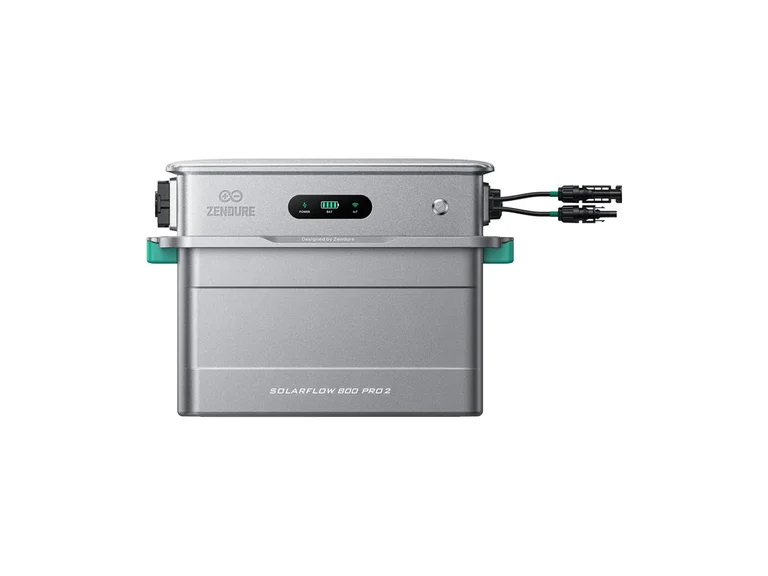 Zendure SolarFlow 800 Pro 2 |  Marstek JUPITER C Plus |
|---|---|---|
| Capacity | 1,920 Wh | 2.56 kWh in the main unit |
| Battery chemistry | Not stated in the sources we read | Lithium iron phosphate (LiFePO4) |
| Cycle life | Not stated in the sources we read | More than 6,000 cycles at 25 °C |
| Expansion | One AB2000L: 3,840 Wh in total | Up to three extension batteries |
| AC output, grid-connected | Not stated as a figure; the model name refers to 800 W | 800 VA rated; 800 W on-grid |
| Backup output | Up to 1,000 W from the AC port in off-grid mode | Not stated in the sources we read |
| Solar input | 2,640 W in total, up to 660 W per input | Up to 2,400 W in total on four inputs (a Marstek FAQ gives 2,000 W) |
| Dimensions | 392.7 × 236.3 × 276 mm (axis order not stated) | Not stated in the sources we read |
| Weight | About 22.6 kg | Not stated in the sources we read |
| Operating temperature | Not stated in the sources we read | -20 to 60 °C |
| Protection rating | IP65 | IP65 |
| Warranty | Not stated on the product page | Not stated in the sources we read |
Green cells mark the clearly better value where a higher or lower number is better. Capacity is never marked, because more is not automatically better. Level rows and rows without a clear direction are not marked. Differences smaller than about a tenth are not marked, and neither are rows where the two makers quote a figure in different units (watts against kilowatts or kilovolt-amperes).
Our read
Both take panels on built-in MPPT inputs. Zendure states 2,640 W of solar input in total (up to 660 W per input) and Marstek up to 2,400 W on four inputs, although a Marstek FAQ on the same page gives 2,000 W, so we do not mark the row. The Marstek has the larger battery (2.56 kWh against 1.92 kWh) and the longer published expansion (10.24 kWh against 3,840 Wh with one AB2000L), and it states a cycle life and an operating range. Zendure's page is the one that gives weight and dimensions, and up to 1,000 W of backup from the AC port in off-grid mode, where Marstek describes no stand-alone AC output. Both are IP65 and neither page states a warranty. We could not confirm a version or plug for Great Britain for either.
Full pages: Zendure SolarFlow 800 Pro 2 · Marstek JUPITER C Plus · Compare these two in the tool
Zendure SolarFlow 2400 Pro vs Marstek VENUS D
Both are modular systems with four MPPT solar inputs that grow by adding batteries. The 2400 Pro starts at 2.4 kWh and the VENUS D at one 2.56 kWh module.
The modular pair with four solar inputs (about 2.4 to 2.6 kWh per unit)
| Specification |  Zendure SolarFlow 2400 Pro |  Marstek VENUS D |
|---|---|---|
| Capacity | 2.4 kWh for the base unit; 5.28 kWh with one AB3000L | 2.56 kWh per battery module; 2.56 to 15.36 kWh in total |
| Battery chemistry | Not stated on the product page | Lithium iron phosphate |
| Cycle life | Not stated (10-year warranty, lifespan up to 15 years) | More than 10,000 cycles at 80% capacity retention; the datasheet lists more than 6,000 at 25 °C |
| Expansion | Up to five AB3000L batteries: 16.8 kWh in total | Up to six battery modules: 15.36 kWh in total |
| AC output, grid-connected | 2,400 W bi-directional AC | 0.8 kVA rated on-grid; the page describes a 2.5 kW bidirectional inverter |
| Backup output | Not stated | 2.5 kVA rated, 3 kVA for 10 seconds, through a European socket |
| Solar input | Up to 3,000 W DC on 4 MPPT inputs, plus up to 1,800 W through AC coupling | Four MPPT inputs, up to 4 kW in total |
| Efficiency and standby use | Not stated | More than 94.5% maximum battery-to-AC efficiency |
| Dimensions | Not stated on the product page | Main unit 480 × 320 × 105 mm; battery module 480 × 320 × 150 mm |
| Weight | Not stated on the product page | Main unit 17 kg, each battery module 24.6 kg |
| Operating temperature | Not stated (low-temperature self-heating) | -20 to 60 °C |
| Noise level | Not stated | Under 30 dB |
| Protection rating | IP65 | IP65 |
| Warranty | 10 years | 10 years |
Green cells mark the clearly better value where a higher or lower number is better. Capacity is never marked, because more is not automatically better. Level rows and rows without a clear direction are not marked. Differences smaller than about a tenth are not marked, and neither are rows where the two makers quote a figure in different units (watts against kilowatts or kilovolt-amperes).
Our read
This is the closest like-for-like pair in the comparison: both have four MPPT inputs, both are IP65 and both state 10 years of warranty. Zendure quotes up to 3,000 W of DC solar input plus up to 1,800 W through AC coupling and 2,400 W of bi-directional AC; Marstek quotes up to 4 kW on four inputs and a 2.5 kVA backup socket. The power figures are in different units and the VENUS D page itself gives both 0.8 kVA and 2.5 kW for the grid side, so we do not mark them. Zendure expands further on paper (16.8 kWh against 15.36 kWh). Marstek publishes much more detail: efficiency above 94.5%, weights, dimensions, noise under 30 dB, an operating range and a cycle rating, where the 2400 Pro page gives none of these. Check the cycle figures with care: Marstek's own datasheet says more than 6,000 where its product page says more than 10,000.
Full pages: Zendure SolarFlow 2400 Pro · Marstek VENUS D · Compare these two in the tool
Zendure SolarFlow 2400 AC+ vs Marstek VENUS E 4.0
Both connect on the AC side and work with the solar inverter you already have. They differ in size: the 2400 AC+ is 2.4 kWh as a base unit (5.28 kWh with one AB3000L), and the VENUS E 4.0 is 5 kWh in one unit.
The larger AC-coupled pair (2.4 to 5 kWh)
| Specification |  Zendure SolarFlow 2400 AC+ |  Marstek VENUS E 4.0 |
|---|---|---|
| Capacity | 2.4 kWh for the base unit; 5.28 kWh with one AB3000L | 5 kWh usable |
| Battery chemistry | LiFePO4 (LFP) | LFP, 314 Ah cells |
| Cycle life | Not stated (10-year warranty, lifespan up to 15 years) | Over 10,000 deep cycles; design life of more than 15 years |
| Expansion | Up to five AB3000L batteries: 16.8 kWh in total | Up to three units with the SmartBox: 15 kWh |
| AC output, grid-connected | 2,400 W bi-directional AC; the default setting is 800 W | 3 kW bidirectional on-grid inverter |
| Backup output | 3,200 W off-grid power, grid-assisted | 3 kW continuous, switchover under 10 ms |
| Solar input | No direct solar input listed; AC-coupled | Not stated in the sources we read |
| Weight | Not stated on the product page | Not stated in the sources we read |
| Operating temperature | Not stated (low-temperature self-heating) | -20 to 60 °C |
| Noise level | Not stated | Under 30 dB |
| Protection rating | IP65 | IP65 |
| Warranty | 10 years | Not stated in the sources we read |
Green cells mark the clearly better value where a higher or lower number is better. Capacity is never marked, because more is not automatically better. Level rows and rows without a clear direction are not marked. Differences smaller than about a tenth are not marked, and neither are rows where the two makers quote a figure in different units (watts against kilowatts or kilovolt-amperes).
Our read
Both are AC-coupled and list no panel input. The Marstek is the larger single unit (5 kWh against a 2.4 kWh base unit) and quotes 3 kW of grid power and 3 kW of backup; the Zendure quotes 2,400 W of AC and 3,200 W of grid-assisted off-grid power, with a default setting of 800 W. The power figures are in different units and are not marked. Zendure expands further on paper (16.8 kWh against 15 kWh). Zendure states LFP chemistry and a 10-year warranty, where Marstek's sources give no warranty; Marstek states a cycle life, a noise level under 30 dB and an operating range, where the 2400 AC+ gives none of these. Both are IP65. At these power levels neither is a small balcony product: in Great Britain, plug-in batteries are excluded from the plug-in solar rules, so ask an electrician before connecting either.
Full pages: Zendure SolarFlow 2400 AC+ · Marstek VENUS E 4.0 · Compare these two in the tool
Side by side in words
Numbers in a table miss the bigger picture. Here is how the two brands differ on the points that matter when you choose.
| Specification | Zendure | Marstek |
|---|---|---|
| Range and sizes | The 800 series is the balcony class (1.92 kWh, 800 W-class output). The 2400 series starts at a 2.4 kWh base unit with 2,400 W of bi-directional AC and grows with 2.88 kWh AB3000L batteries. The Hyper 2000, also in our catalogue, is sold without batteries. | The JUPITER C Plus (2.56 kWh, 800 W on-grid) is the balcony class. The VENUS E Mini holds 2 kWh and the VENUS E 4.0 holds 5 kWh in one unit, both AC-coupled. The VENUS D is modular, from 2.56 kWh to 15.36 kWh. |
| Solar input | Two MPPT inputs of up to 750 W each on the 800 Plus, 2,640 W in total on the 800 Pro 2, and up to 3,000 W DC on four inputs on the 2400 Pro (plus up to 1,800 W through AC coupling). The 2400 AC+ has no panel input. | Up to 2,400 W on four inputs on the JUPITER C Plus (a Marstek FAQ gives 2,000 W) and up to 4 kW on four inputs on the VENUS D. The VENUS E Mini and VENUS E 4.0 list no panel input. |
| Grid output | 800 W on the 800 Plus. The 800 Pro 2 page gives no figure, only a model name that refers to 800 W. The 2400 Pro and 2400 AC+ quote 2,400 W bi-directional, with a default of 800 W on the 2400 AC+. | 800 VA on the JUPITER C Plus, 1.5 kW on the VENUS E Mini and 3 kW on the VENUS E 4.0. The VENUS D lists 0.8 kVA rated, while its page also describes a 2.5 kW bidirectional inverter. |
| Backup in a power cut | Up to 1,000 W from the AC port on the 800 Pro 2 and up to 3,200 W of grid-assisted off-grid power on the 2400 AC+. The 800 Plus lists no off-grid output, and the 2400 Pro page gives no backup figure. | 1.5 kW on the VENUS E Mini, 3 kW on the VENUS E 4.0 (switchover under 10 ms) and 2.5 kVA on the VENUS D. Marstek describes no stand-alone AC output for the JUPITER C Plus. |
| Warranty | 10 years on the 2400 Pro and 2400 AC+. Not stated on the pages we read for the 800 Plus and 800 Pro 2. | 10 years on the VENUS D. Not stated in the sources we read for the VENUS E Mini, VENUS E 4.0 and JUPITER C Plus. |
| Published detail | Weight and dimensions are given for the 800 Pro 2 only among the models in our pairs; the 800 Plus, 2400 Pro and 2400 AC+ pages leave them out. Noise is not stated on the three pages that have a noise row. | The VENUS D gives dimensions, weights, noise, temperature range and efficiency. The VENUS E Mini gives weight and thickness. The JUPITER C Plus and VENUS E 4.0 give no weight or dimensions. |
| Rules in Great Britain | The pages for the models in our pairs do not say whether a UK version or plug exists. | We could not confirm a UK version or plug for the Marstek models in our pairs. |
Which should you choose?
Neither brand is the right answer for everyone. These are the situations where each one fits better, based on the published figures above.
Choose Zendure if
- You want a stated 10-year warranty on a 2.4 kWh unit: Zendure states it on the 2400 Pro and 2400 AC+, while the VENUS D is the only Marstek model in our pairs with a stated warranty.
- You want the longest published expansion: up to 16.8 kWh on the 2400 series, against 15 kWh for the VENUS E 4.0 and 15.36 kWh for the VENUS D.
- You want weight and size published for a balcony-class unit: Zendure gives about 22.6 kg and dimensions for the 800 Pro 2, where Marstek's JUPITER C Plus page gives neither.
- You want panels and an existing solar system on one unit: the 2400 Pro quotes up to 3,000 W DC on four inputs plus up to 1,800 W through AC coupling.
Choose Marstek if
- You want the fullest published sheet on a modular system: the VENUS D gives dimensions, weights, noise under 30 dB, a temperature range, efficiency above 94.5% and a 10-year warranty.
- You want more solar input on a modular system: the VENUS D takes up to 4 kW on four inputs, alongside a 2.5 kVA backup socket.
- You want a thin, light AC-coupled unit: the VENUS E Mini is 22 kg and 105 mm thick, with 1.5 kW of backup power.
- You want 5 kWh in one unit with 3 kW of bidirectional power and 3 kW of backup: the VENUS E 4.0 quotes all three.
What we could not compare
A comparison is only as good as its data. Here is where the published information ran out, so you know what the tables cannot tell you.
- Several cells show 'Not stated': 21 of 49 on Zendure's side and 9 on Marstek's. That means the page text we read gives no figure, not that the product lacks the feature.
- The 800 Plus page has no specification table, and the 2400 Pro and 2400 AC+ pages give no weight, dimensions, noise or temperature range. The VENUS E 4.0, VENUS E Mini and JUPITER C Plus pages give no warranty.
- Power is often quoted in different units (W against kW or kVA), so we do not mark those rows. Marstek's JUPITER C Plus page gives 2,400 W of solar input in the specifications and 2,000 W in an FAQ, and the VENUS D page gives both 0.8 kVA and 2.5 kW for the grid side.
- We did not compare price, real-world run time, noise in daily use, app quality or after-sales support. These matter and we have not tested them.
- Whether a model may be connected as a plug-in battery depends on your country, and we could not confirm a UK version or plug for most of them. See our <a href="/country-guides/">country guides</a>.
Common questions about Zendure vs Marstek
Is Zendure or Marstek better?
Neither is better across the board. In our four matched pairs only a few rows were clear-cut, and most of those were ties. Zendure states a 10-year warranty on the 2400 series, while Marstek publishes more detail on the VENUS D and a larger single unit in the VENUS E 4.0. Pick by the size and the way of connecting that you need, not by brand.
Which has more solar input, Zendure or Marstek?
It depends on the pair. Zendure's 800 Pro 2 states 2,640 W against up to 2,400 W for Marstek's JUPITER C Plus (a Marstek FAQ gives 2,000 W). The 2400 Pro quotes up to 3,000 W DC on four inputs, plus up to 1,800 W through AC coupling, and the VENUS D up to 4 kW on four inputs. The 2400 AC+, VENUS E Mini and VENUS E 4.0 list no panel input.
Which brand has the longer warranty?
Among the models in our pairs, Zendure states 10 years on the 2400 Pro and 2400 AC+, and Marstek states 10 years on the VENUS D. The other models do not state a warranty on the pages we read.
What is the difference between AC-coupled and DC-coupled batteries?
A DC-coupled battery takes solar panels directly on its own inputs, like the SolarFlow 800 Pro 2 or the VENUS D. An AC-coupled battery connects on the AC side and works with the solar inverter you already have, like the SolarFlow 2400 AC+ or the VENUS E 4.0, and lists no panel input of its own.
Can I use these as plug-in batteries in Great Britain?
In Great Britain, plug-in solar kits of up to 800 VA have been legal since 27 August 2026, but plug-in batteries were excluded. We could not confirm a UK version or plug for most of these models, and several are AC-coupled or output well above 800 W. Check the rules where you live in our country guides.
Why these four pairs?
We matched each product to the closest one from the other brand in capacity and type, from the models in our catalogue. If you would like a different pairing, build your own with Compare For Yourself.
Related guides
Want to size a battery for your own home?
Our calculator uses your own usage and tariff to estimate what a home battery could save, with conservative assumptions.