
EcoFlow vs Jackery
Two of the best-known portable power station brands, compared in five matched pairs from 256 Wh to home backup, using only figures the makers publish.
- 5 matched pairs
- Maker data only
- Checked 12 Nov 2026

- We matched five EcoFlow and Jackery power stations by capacity, from 256 Wh up to home backup, and compared them using only figures the makers publish.
- In the 13 rows where a higher or lower number is clearly better or exactly level, EcoFlow leads in 7 and Jackery in 4; 2 are level.
- EcoFlow publishes more of the figures that decide a purchase, such as surge output, charging power and noise: 6 cells on its side read 'not stated' against 8 on Jackery's.
- Jackery's units are lighter in the three larger pairs and quote a faster switchover; EcoFlow offers more output and solar input in the larger pairs.
- We have not tested any of these units. Where a maker does not publish a figure, we say so instead of guessing.
Not tested by us, and no prices
Every figure on this page comes from EcoFlow's and Jackery's own product pages and manuals, last checked on 12 November 2026. We have not tested these units, so we do not score them or crown a winner on feel, noise in daily use or app quality. We show no prices because they change often and differ between sellers: compare the same model and bundle before you buy.
The short answer
There is no overall winner here either, and a fair answer has to start with what the makers publish. Across our five pairs, 7 of the 13 clear-cut rows go to EcoFlow and 4 to Jackery, with 2 level.
The pattern is about size and about openness. In the larger pairs EcoFlow's published solar input and output are higher, and it states a 5-year warranty on every model we paired, where Jackery's is 3 years plus 2 more. Jackery's units are lighter in the two pairs where the weight difference is clear, and its pages quote a faster backup switchover. At 256 and 512 Wh the two brands are close on paper, partly because Jackery does not publish several figures for its smaller models.
Do not read the row count as a score. Solar input matters a lot if you plan to charge from panels and not at all if you charge from the mains. Use the pair tables below for the size you need, then check Which should you choose? for the situations where each fits better.
How we matched the models
We paired models by capacity, because that is how people shop: they pick a size, then compare brands. Each pair is the closest match in our catalogue, not a statement that the two products are the same price or the same age. The last pair is the least even: the DELTA Pro 3 holds 4,096 Wh and the Explorer 3000 v2 holds 3,072 Wh, because Jackery's largest standalone unit in our catalogue is smaller. We used the current Explorer v2 models and the EcoFlow RIVER 2 and DELTA 2 generations that are in our catalogue.
| Specification | EcoFlow | Jackery |
|---|---|---|
| The small pair (256 Wh) | EcoFlow RIVER 2 | Jackery Explorer 240 v2 |
| The compact pair (512 Wh) | EcoFlow RIVER 2 Max | Jackery Explorer 500 v2 |
| The popular mid-size pair (1,024 Wh) | EcoFlow DELTA 2 | Jackery Explorer 1000 v2 |
| The larger portable pair (2,048 Wh) | EcoFlow DELTA 2 Max | Jackery Explorer 2000 v2 |
| The home backup pair (3 to 4 kWh) | EcoFlow DELTA Pro 3 | Jackery Explorer 3000 v2 |
EcoFlow and Jackery at brand level
Before the model pairs, here is how the two companies differ. See our full brand guides to EcoFlow and Jackery.
| Specification | EcoFlow | Jackery |
|---|---|---|
| Models in our catalogue | 20 | 11 |
| Cell chemistry in our pairs | LFP (lithium iron phosphate) in all five | LFP in all five; the Explorer 240 v2 is described as upgraded from NCM |
| Warranty in our pairs | 5 years on all five | 3+2 years on all five (3 years, plus 2 more; Jackery's pages do not give the conditions for the extra years) |
| Fixed and plug-in range in our catalogue | STREAM range (Ultra, Pro, AC, Max and others) and the DELTA Pro Ultra home battery | SolarVault 3 Pro and SolarVault 3 Pro Max |
| Warranty on the fixed and plug-in range | 10 years on the STREAM Ultra, Pro and AC | 10 years on both SolarVault models |
| Expandable portable models | DELTA 2, DELTA 2 Max and DELTA Pro 3 take extra batteries | The Explorer Plus v2 series takes extra batteries; the v2 models in our pairs are standalone |
EcoFlow RIVER 2 vs Jackery Explorer 240 v2
Both hold 256 Wh and both are small enough to carry in one hand, for phones, laptops and short backup. They are the closest match in the catalogue on capacity, and the two makers publish very different amounts of detail for them.
The small pair (256 Wh)
| Specification | 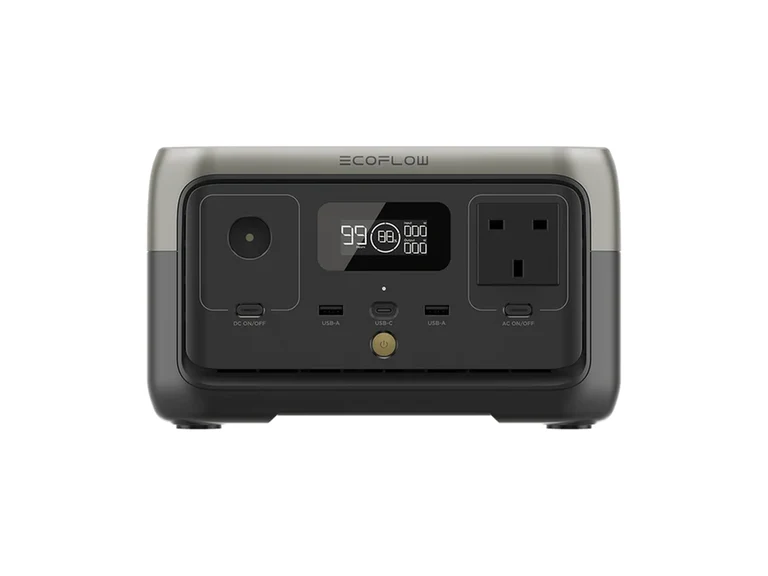 EcoFlow RIVER 2 |  Jackery Explorer 240 v2 |
|---|---|---|
| Capacity | 256 Wh | 256 Wh |
| AC output (continuous) | 300 W in total | 300 W recommended maximum, 1 outlet |
| AC output (surge) | 600 W | Not stated |
| AC charging | 360 W max | Not stated |
| Mains charging time | 0-100% in 60 minutes | 2 hours from the wall; 1 hour in emergency charging mode |
| Solar input | 110 W max | Maximum not stated (a 100 W panel takes about 3.3 hours) |
| Weight | Approximately 3.5 kg | About 3.6 kg (7.94 lbs) |
| Backup switchover (EPS) | Under 30 ms, automatic | 20 ms or less |
| Noise level | Not stated | 42 dB |
| Cycle life | 80%+ capacity after 3,000 cycles | 3,000 life cycles; capacity left at the end not stated |
| Expansion | Not stated | Not stated |
| Warranty | 5 years | 3+2 years (3 years, plus 2 more after registration) |
Green cells mark the clearly better value where a higher or lower number is better. Capacity is never marked, because more is not automatically better. Level rows and rows without a clear direction are not marked. Differences smaller than about a tenth are not marked.
Our read
On the figures that are published, the two are level: the same capacity, the same 300 W, almost the same weight. The difference is in what you can check. EcoFlow gives surge output, a mains charging power and a solar input limit, while Jackery's page text leaves all three out; its page does state a quieter switchover time (20 ms or less against under 30 ms) and a noise figure of 42 dB. EcoFlow states a plain 5-year warranty, Jackery 3+2 years where the extra 2 years follow registration and the page does not give the conditions.
Full pages: EcoFlow RIVER 2 · Jackery Explorer 240 v2 · Compare these two in the tool
EcoFlow RIVER 2 Max vs Jackery Explorer 500 v2
Both hold 512 Wh and deliver 500 W, which puts them in the range of a laptop, a small cooler or a CPAP for a night. They are the two clearest like-for-like models in this comparison.
The compact pair (512 Wh)
| Specification |  EcoFlow RIVER 2 Max |  Jackery Explorer 500 v2 |
|---|---|---|
| Capacity | 512 Wh | 512 Wh (20 Ah at 25.6 V) |
| AC output (continuous) | 500 W in total | 500 W |
| AC output (surge) | 1,000 W | Not published by Jackery |
| AC charging | 660 W max | Not stated as watts (10 A maximum) |
| Mains charging time | 0-100% in 60 minutes | 1.3 hours |
| Solar input | 220 W max (better value) | 200 W maximum |
| Weight | Approximately 6 kg | 5.7 kg (12.57 lb) |
| Backup switchover (EPS) | Not stated | Under 10 ms |
| Noise level | Up to 62 dB at high wattage | 28 dB discharging, 36 dB charging |
| Cycle life | 80%+ capacity after 3,000 cycles | 6,000 cycles to 70% or more of original capacity |
| Expansion | Not stated | No |
| Warranty | 5 years | 3+2 years |
Green cells mark the clearly better value where a higher or lower number is better. Capacity is never marked, because more is not automatically better. Level rows and rows without a clear direction are not marked. Differences smaller than about a tenth are not marked.
Our read
The numbers that overlap are level or close: 512 Wh, 500 W, a mains charge in about an hour and a bit, and a slightly higher solar limit for EcoFlow (220 W against 200 W). The brands differ in what they quote. Jackery rates its cycle life higher (6,000 cycles, though to 70% rather than 80%), states a switchover of under 10 ms and a noise figure of 28 dB when discharging, while EcoFlow gives the surge rating (1,000 W) and a charging power that Jackery leaves out. EcoFlow's noise figure is a worst case, up to 62 dB at high wattage, so the two noise figures are not like for like.
Full pages: EcoFlow RIVER 2 Max · Jackery Explorer 500 v2 · Compare these two in the tool
EcoFlow DELTA 2 vs Jackery Explorer 1000 v2
This is the size most people search for: about 1 kWh, enough for a fridge for some hours or for camping with a few devices. The two share the same capacity but make different trade-offs between output, weight and noise.
The popular mid-size pair (1,024 Wh)
| Specification | 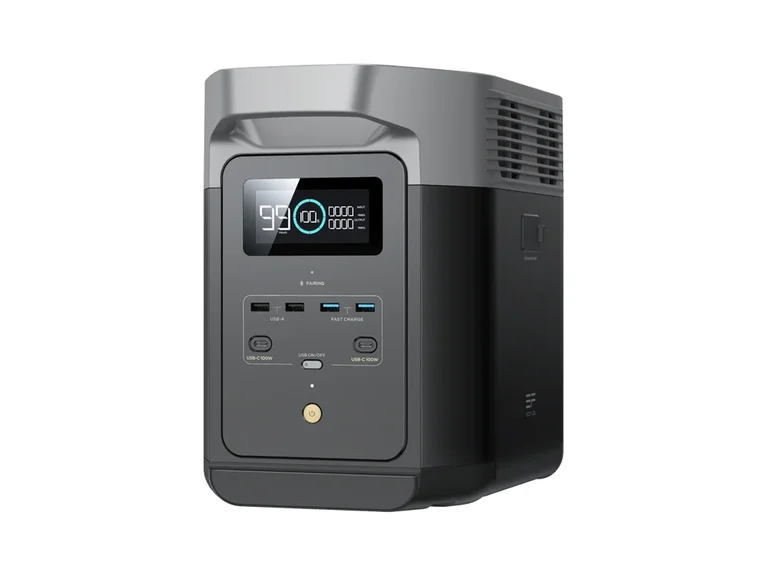 EcoFlow DELTA 2 | 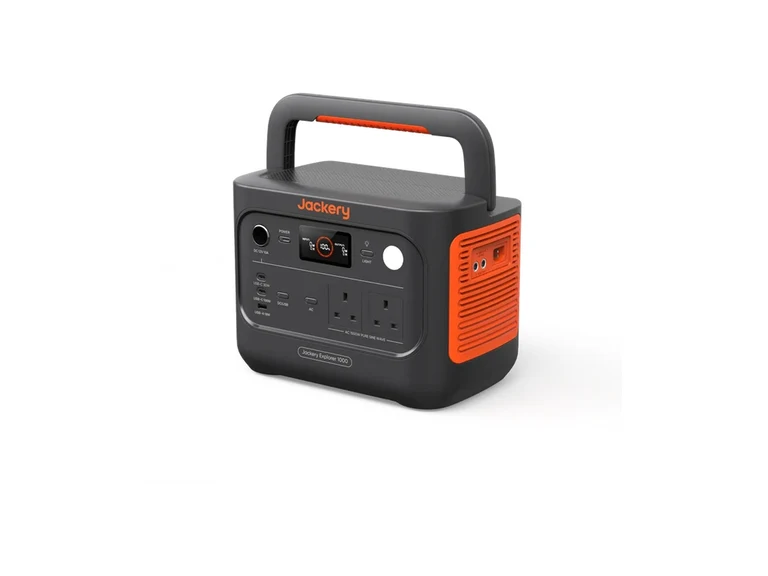 Jackery Explorer 1000 v2 |
|---|---|---|
| Capacity | 1,024 Wh | 1,024 Wh |
| AC output (continuous) | 1,800 W in total, 4 outlets (better value) | 1,500 W rated, 2 AC ports |
| AC output (surge) | 2,700 W | 3,000 W peak (better value) |
| AC charging | 1,200 W | 10 A maximum (about 2,200 W at 220 V; Jackery gives the current, not the watts) |
| Mains charging time | 0-100% in 80 minutes | 77 minutes (50 minutes in Emergency Charging mode) |
| Solar input | 500 W max (better value) | 400 W maximum |
| Weight | 12 kg | 10.6 kg (23.4 lb) (better value) |
| Backup switchover (EPS) | Within 30 ms, a basic UPS function and not 0 ms | 10 ms or less (the description says under 20 ms) |
| Noise level | Not stated | Under 22 dB |
| Cycle life | 3,000 cycles to 80+% capacity | 4,000 cycles to 70% or more of capacity |
| Expansion | Up to 3,040 Wh with a DELTA Max extra battery | No |
| Warranty | 5 years | 3+2 years |
Green cells mark the clearly better value where a higher or lower number is better. Capacity is never marked, because more is not automatically better. Level rows and rows without a clear direction are not marked. Differences smaller than about a tenth are not marked.
Our read
EcoFlow gives more continuous output (1,800 W against 1,500 W), more solar input (500 W against 400 W), four AC outlets against two, and a battery you can add to, up to 3,040 Wh with a DELTA Max extra battery. Jackery's unit is lighter (10.6 kg against 12 kg), has a higher peak rating (3,000 W against 2,700 W), states a lower noise figure (under 22 dB) and a faster switchover, and its mains charging works out similar or faster by the clock. Jackery's 'about 2,200 W at 220 V' charging is our reading of its 10 A rating, not a figure it prints as watts. The Explorer 1000 v2 cannot be expanded.
Full pages: EcoFlow DELTA 2 · Jackery Explorer 1000 v2 · Compare these two in the tool
EcoFlow DELTA 2 Max vs Jackery Explorer 2000 v2
At 2,048 Wh both can run several appliances at once, which is where output limits start to matter more than capacity. The Explorer 2000 v2 and the DELTA 2 Max are close in size on paper and far apart in weight.
The larger portable pair (2,048 Wh)
| Specification | 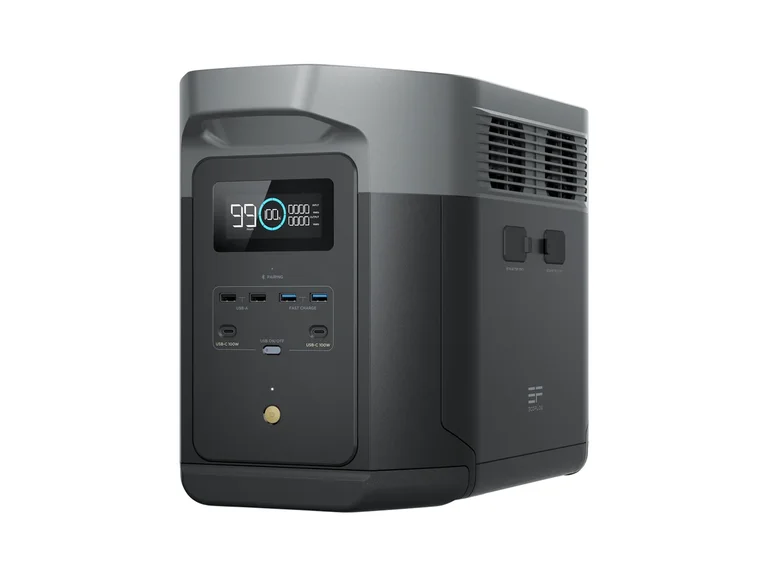 EcoFlow DELTA 2 Max | 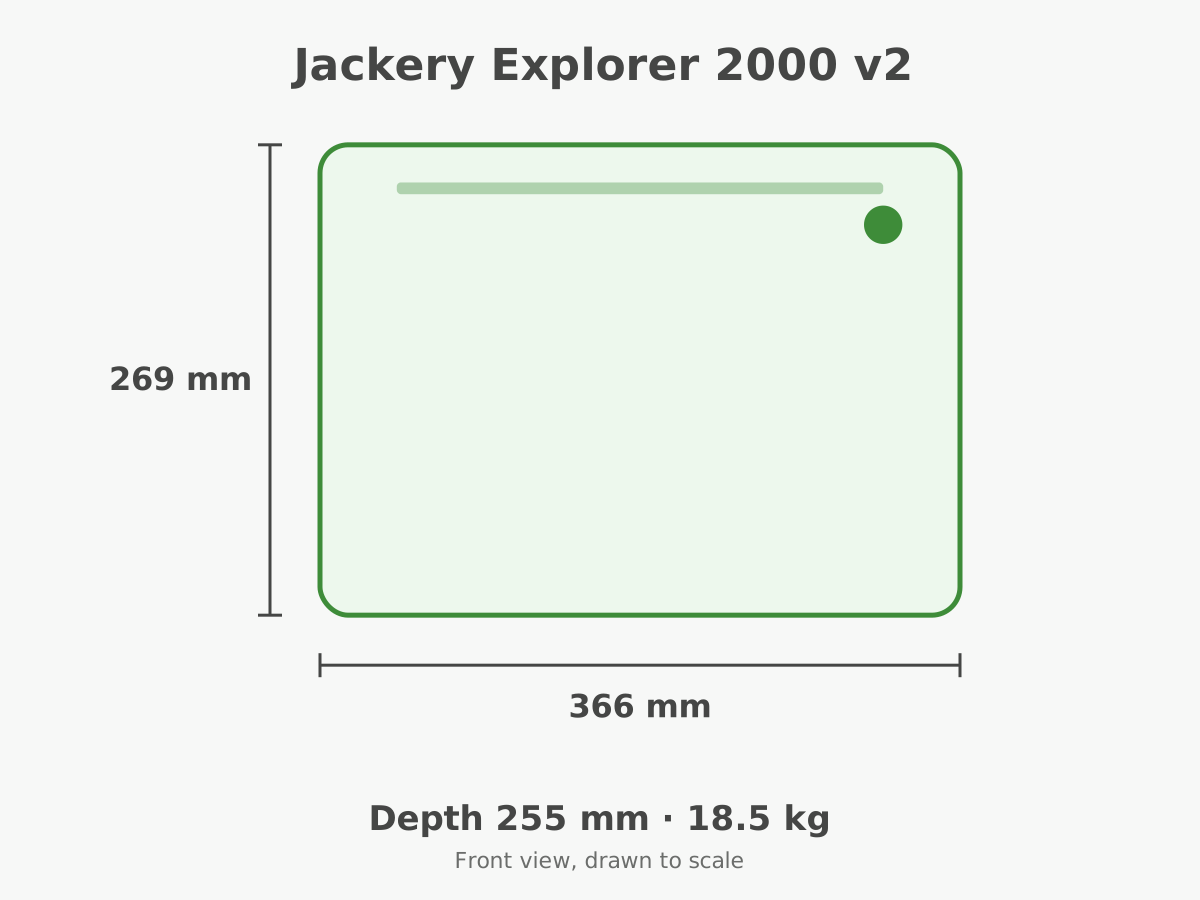 Jackery Explorer 2000 v2 |
|---|---|---|
| Capacity | 2,048 Wh | 2,048 Wh |
| AC output (continuous) | 2,400 W in total, 4 outlets | 2,200 W rated |
| AC output (surge) | 4,800 W | 4,400 W peak |
| AC charging | 2,300 W (X-Stream), 10 A | Not stated (10 A maximum) |
| Mains charging time | 80% in 53 minutes on AC alone | 77 minutes for a full charge; 69 minutes in emergency charging |
| Solar input | 500 W on one port, 1,000 W on dual ports (better value) | 400 W maximum |
| Weight | 23 kg | 18.5 kg (better value) |
| Backup switchover (EPS) | Not stated | 10 ms or less (UPS function) |
| Noise level | 30 dB at low input and 500 W output | 30 dB or less while charging in Quiet Charging Mode; discharging not stated |
| Cycle life | 3,000 cycles to over 80% capacity | 4,000 cycles to 70% or more of original capacity |
| Expansion | Up to 6,144 Wh with two Smart Extra Batteries | Not stated for this model |
| Warranty | 5 years | 3+2 years (3 years standard, plus 2 years extended) |
Green cells mark the clearly better value where a higher or lower number is better. Capacity is never marked, because more is not automatically better. Level rows and rows without a clear direction are not marked. Differences smaller than about a tenth are not marked.
Our read
EcoFlow's published solar input is 2.5 times Jackery's when both ports are used (1,000 W against 400 W), it has a slightly higher output and surge rating, a mains charging power on the page and room to expand to 6,144 Wh. Jackery's unit is clearly lighter, 18.5 kg against 23 kg, quotes a 10 ms switchover and a charging time of 77 minutes for a full charge. The output gap (2,400 W against 2,200 W) is below the line we mark. Check the AC outlet count on Jackery's page before buying: the specification table says 2 and the feature text says 3.
Full pages: EcoFlow DELTA 2 Max · Jackery Explorer 2000 v2 · Compare these two in the tool
EcoFlow DELTA Pro 3 vs Jackery Explorer 3000 v2
These are the largest standalone units each brand offers in our catalogue, pitched for outages and off-grid cabins. They are not an even match on capacity: the DELTA Pro 3 holds a third more, so the comparison favours it on energy and output by design.
The home backup pair (3 to 4 kWh)
| Specification | 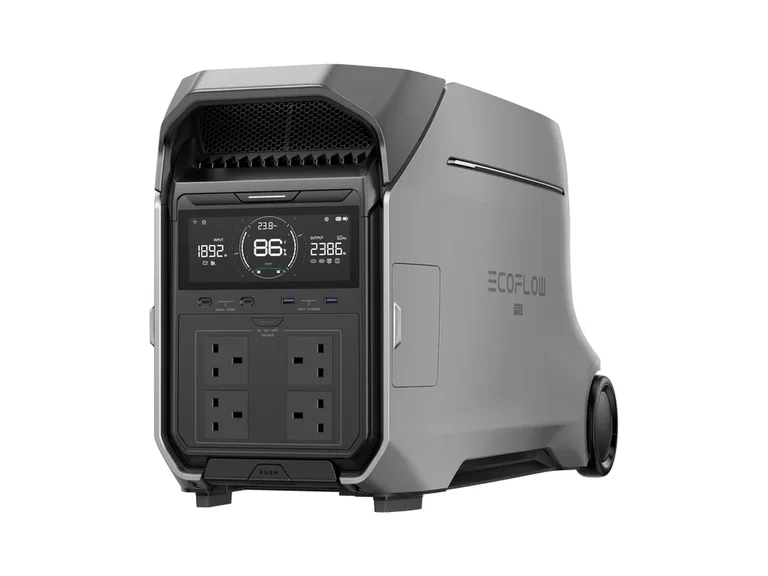 EcoFlow DELTA Pro 3 |  Jackery Explorer 3000 v2 |
|---|---|---|
| Capacity | 4,096 Wh | 3,072 Wh |
| AC output (continuous) | 5 outlets, 4,000 W max (better value) | 3,600 W, three 230 V 13 A sockets |
| AC output (surge) | 8,000 W (better value) | 7,200 W |
| AC charging | 2,900 W max | Not stated as watts (0-100% in 1.8 hours) |
| Mains charging time | 0-80% in one hour | 0-100% in 1.8 hours; 1.4 hours with AC and 54 V DC together |
| Solar input | 2,600 W across two ports (better value) | 1,000 W maximum |
| Weight | 51.5 kg (main unit) | About 27 kg (59.5 lbs) (better value) |
| Backup switchover (EPS) | 10 ms | Under 20 ms (0.02 seconds or less) |
| Noise level | 30 dB at 2,000 W | As low as 27 dB at 25 °C and a 20% load, in silent charging mode |
| Cycle life | 4,000 cycles to 80% capacity | Up to 4,000 cycles; capacity left not published |
| Expansion | Up to 12 kWh with two Smart Extra Batteries (4,096 Wh each) | No: a standalone system |
| Warranty | 5 years | 3+2 years |
Green cells mark the clearly better value where a higher or lower number is better. Capacity is never marked, because more is not automatically better. Level rows and rows without a clear direction are not marked. Differences smaller than about a tenth are not marked.
Our read
The DELTA Pro 3 is the bigger machine in every published number that matters for home backup: 4,096 Wh against 3,072 Wh, 4,000 W against 3,600 W, a surge rating of 8,000 W and a solar input 2.6 times higher (2,600 W against 1,000 W), and it expands to 12 kWh where the Explorer 3000 v2 is a standalone unit. What you pay for that is weight: 51.5 kg for the main unit against about 27 kg. EcoFlow quotes a 10 ms switchover and a mains charging power of 2,900 W; Jackery does not publish a charging wattage. Both are portable power stations, not fixed home batteries: feeding house circuits from either is electrical work for a qualified electrician.
Full pages: EcoFlow DELTA Pro 3 · Jackery Explorer 3000 v2 · Compare these two in the tool
Side by side in words
Numbers in a table miss the bigger picture. Here is how the two brands differ on the points that matter when you choose.
| Specification | EcoFlow | Jackery |
|---|---|---|
| Range and sizes | RIVER models start around 245 Wh. DELTA models run up to 4,096 Wh in the DELTA Pro 3, with extra batteries for the larger ones. A separate range of STREAM plug-in batteries and the DELTA Pro Ultra home battery sits alongside. | The range starts at 256 Wh with the Explorer 240 v2 and runs through 512, 1,024 and 2,048 Wh models up to the 3,072 Wh Explorer 3000 v2. The Plus v2 series is the expandable line, and the SolarVault 3 Pro models are fixed home batteries. |
| Warranty | 5 years on the five models in our pairs, stated as a plain figure on the product page text we read. | 3+2 years on all five models: 3 years standard plus 2 more. The Explorer 240 v2 page says the extra 2 years follow registration and does not give the conditions. |
| Fast charging | EcoFlow calls its fast mains charging X-Stream: the DELTA 2 Max charges at 2,300 W and the DELTA Pro 3 at up to 2,900 W, and each page gives a time to 80%. | Jackery offers an Emergency Charging mode, switched on in its app, which shortens the charge on several models: 50 minutes on the Explorer 1000 v2 against 77 in standard mode. Jackery gives the current rather than the watts for mains charging on most models. |
| Solar input | From 110 W on the RIVER 2 to 500 W on the DELTA 2, 1,000 W on the DELTA 2 Max (two ports) and 2,600 W on the DELTA Pro 3 (two ports). | From a 100 W panel on the Explorer 240 v2 (maximum not stated) to 200 W on the 500 v2, 400 W on the 1000 v2 and 2000 v2 and 1,000 W on the 3000 v2. |
| Surge and boost modes | EcoFlow publishes surge ratings (600 W on the RIVER 2, 2,700 W on the DELTA 2, 4,800 W on the DELTA 2 Max, 8,000 W on the DELTA Pro 3) and an X-Boost mode that runs some devices above the continuous rating. | Jackery publishes a peak rating on the larger models (3,000 W on the 1000 v2, 4,400 W on the 2000 v2, 7,200 W on the 3000 v2) but not on the 240 v2 or 500 v2. |
| App and smart features | The EcoFlow app over Wi-Fi and Bluetooth on the models that list it. | The Jackery app controls features such as Emergency Charging mode and silent charging, per the product pages. |
| Beyond power stations | The STREAM range is plug-in solar-and-battery equipment for balcony and home use. In Great Britain, plug-in batteries were excluded from the August 2026 plug-in solar rules, so check the rules for your country first. | The SolarVault 3 Pro and Pro Max are home batteries that give backup power in a cut; Jackery describes them as grid-connected systems. |
Which should you choose?
Neither brand is the right answer for everyone. These are the situations where each one fits better, based on the published figures above.
Choose EcoFlow if
- You plan to charge from solar: EcoFlow's published solar input is higher in four of the five pairs and level in none.
- You want a warranty length stated as a plain figure on every model in the pairs: 5 years, against 3+2 years for Jackery.
- You want more published detail before you buy: surge output, charging power and expansion limits are on EcoFlow's pages where Jackery's are often silent.
- You may want to add batteries later: the DELTA 2, DELTA 2 Max and DELTA Pro 3 all take extra batteries.
Choose Jackery if
- You carry it often: Jackery's units are lighter in the three pairs where the weight difference is clear.
- You want a quiet unit and a fast switchover: Jackery's pages quote noise as low as 22 dB and a switchover of 10 ms or less on several models.
- You prefer a long cycle rating on paper: Jackery quotes 4,000 to 6,000 cycles, though to 70% rather than 80% of capacity.
- You want the shorter mains charge by the clock at 1 kWh: the Explorer 1000 v2 states 77 minutes for a full charge, against 80 minutes for the DELTA 2.
What we could not compare
A comparison is only as good as its data. Here is where the published information ran out, so you know what the tables cannot tell you.
- Several cells show 'Not stated': 6 of 60 on EcoFlow's side and 8 on Jackery's. That means the maker's page text we read gives no figure, not that the product lacks the feature.
- Jackery's page for the Explorer 240 v2 shows its specification table as an image, so we could not read its dimensions, protection rating or temperature range. We show them as not stated.
- Cycle life is quoted to different end points: EcoFlow to 80% of capacity, Jackery mostly to 70%. A higher cycle number to 70% is not the same as a longer life to 80%.
- Noise figures use different test conditions from maker to maker (a worst case at high wattage, a quiet charging mode, a low load), so we show them but do not rank them.
- We did not compare price, real-world run time, noise in daily use, app quality or after-sales support. These matter and we have not tested them.
Common questions about EcoFlow vs Jackery
Is EcoFlow or Jackery better?
Neither is better across the board. In our five matched pairs EcoFlow's published solar input is higher in most pairs and it states a 5-year warranty on every model, while Jackery's units are lighter in the larger pairs and quote quieter, faster-switching backup. Pick by the size you need and what you will use it for, not by brand.
Which brand has the longer warranty?
On the five pairs, EcoFlow states 5 years and Jackery states 3+2 years: 3 years standard plus 2 more. The extra 2 years follow registration on the Explorer 240 v2, and Jackery's page does not give the conditions. Check the seller's listing for the terms that apply where you live.
Which is lighter at the same capacity?
In the 1,024 Wh, 2,048 Wh and 3,072 to 4,096 Wh pairs Jackery's unit is clearly lighter. At 256 Wh and 512 Wh the weights are within about 5% of each other, so we do not mark them.
Which charges faster from the mains?
It depends on the size. EcoFlow publishes the charging power (2,300 W on the DELTA 2 Max, 2,900 W on the DELTA Pro 3), while Jackery mostly gives the time. By the clock, the two are within a few minutes at 1,024 Wh and Jackery's emergency mode shortens the charge on several models. These are the makers' own figures under their own test conditions.
Can an EcoFlow or Jackery power station run my whole home?
Both brands pitch their largest units for home backup, but they are portable power stations, not fixed home batteries. Connecting either to house circuits is electrical work for a qualified electrician, and the rules differ by country: see our country guides.
Why these five pairs?
We matched each EcoFlow model to the closest Jackery model in capacity from the models in our catalogue, because people shop by size first. If you would like a different pairing, build your own with Compare For Yourself.
Related guides
Want to size a battery for your own home?
Our calculator uses your own usage and tariff to estimate what a home battery could save, with conservative assumptions.