
BYD vs Pylontech
Two names that installers meet constantly in modular home batteries, compared in four matched pairs using only figures the makers publish.
- 4 matched pairs
- Maker data only
- Checked 12 Nov 2026

- We matched BYD's Battery-Box Premium LVS, HVS and HVM with Pylontech's US5000, Fidus and Force H3 in four pairs: two low-voltage (about 48 to 51 V) and two high-voltage, using only figures the makers publish.
- Only 6 rows allowed a clear-cut call, a higher or lower number that is plainly better or an exact tie: BYD leads in 1, Pylontech in 5 and 0 are level. Most rows are not marked because the two sides quote different units or configurations.
- BYD states a 10-year warranty and a round-trip efficiency on all three models. Pylontech's pages give neither, but they do give cycle ratings (more than 8,000 cycles on the US5000 and Fidus), where BYD quotes a throughput limit instead.
- Pylontech's Fidus and Force H3 are rated IP65, against IP55 for all three BYD models. Pylontech's US5000 is IP20, for indoor use.
- All six are battery modules only and need a compatible inverter, so none is a plug-in battery. Ask your installer to confirm inverter compatibility. We have not tested any of these products.
Not tested by us, and no prices
Every figure on this page comes from BYD's and Pylontech's own product pages, datasheets and warranty letters, last checked on 12 November 2026. We have not tested these products, so we do not score them or crown a winner. We show no prices because they depend on the installer's quote and the inverter you pair them with.
The short answer
There is no overall winner. Only 6 rows in our four pairs were clear-cut enough to mark: BYD leads in 1, Pylontech in 5 and 0 are level. The split says more about which numbers each maker publishes than about which battery is better.
The two companies publish different things. BYD states a 10-year warranty (with conditions) and a round-trip efficiency of 95% or 96% on all three models, and it quotes a throughput limit in its warranty rather than a cycle number. Pylontech's pages give no warranty period and no efficiency, but they give cycle ratings: more than 8,000 cycles on the US5000 and Fidus, and more than 10,000 on the Force H3 product page (the Force H3 datasheet says more than 8,000).
On the hardware, Pylontech's newer units pack more into a similar space. In the high-voltage pair, a two-module Force H3 stack holds 10.24 kWh at 92 kg, while a two-module BYD HVS 5.1 stack holds 5.12 kWh at 91 kg. At low voltage, the Fidus (45 kg, 5.12 kWh nominal) is lighter than a one-module BYD LVS 4.0 (64 kg, 4 kWh usable). Do not read the row count as a score: capacity is measured differently by the two makers, and the inverter you pair a battery with matters at least as much. See Which should you choose? for the situations where each fits better.
How we matched the models
We paired products by voltage class and by capacity, because that decides which inverter a battery works with. Each pair is the closest match in our catalogue, not a statement that the two products are the same price or the same age. BYD's only low-voltage model, the LVS, appears twice, against Pylontech's older US5000 and its newer Fidus, and Pylontech's Force H3 appears twice, against BYD's HVS and HVM. The capacities differ within each pair: for example, 4 kWh usable per BYD LVS module against 4.8 kWh nominal for the US5000. BYD quotes usable energy, while Pylontech quotes nominal and usable figures, so read capacity rows with care.
| Specification | BYD | Pylontech |
|---|---|---|
| The low-voltage pair (about 4 to 4.8 kWh per module) | BYD Battery-Box Premium LVS | Pylontech US5000 Battery |
| The low-voltage pair with an outdoor-rated newer module (4 to 5.12 kWh per module) | BYD Battery-Box Premium LVS | Pylontech Fidus Battery |
| The high-voltage pair (about 5 to 36 kWh) | BYD Battery-Box Premium HVS | Pylontech Force H3 |
| The large high-voltage pair (about 8 to 36 kWh) | BYD Battery-Box Premium HVM | Pylontech Force H3 |
BYD and Pylontech at brand level
Before the model pairs, here is how the two companies differ. See our full brand guides to BYD and Pylontech.
| Specification | BYD | Pylontech |
|---|---|---|
| Models in our catalogue | 3 | 3 |
| Cell chemistry in our pairs | LiFePO4 on all three models | LFP on the US5000; not stated on the Force H3 and Fidus |
| Warranty in our pairs | 10 years on all three, with conditions | Not stated on the pages we read for any of the three |
| Cycle life in our pairs | No cycle number; the warranty uses a throughput limit | More than 8,000 cycles on the US5000 and Fidus; more than 10,000 on the Force H3 product page (8,000 in its datasheet) |
| Round-trip efficiency in our pairs | 95% or more on the LVS; 96% or more on the HVS and HVM | Not stated on any of the three |
| Voltage classes in our pairs | Low voltage (LVS, 51.2 V) and high voltage (HVS and HVM) | Low voltage (US5000, 48 V; Fidus, 51.2 V) and high voltage (Force H3) |
| Inverter | Battery only; BYD says it works with leading single- and three-phase inverters and refers to a compatibility list | Battery only; the pages do not list inverters (the Fidus page says 50+ popular brands without naming them) |
BYD Battery-Box Premium LVS vs Pylontech US5000
Both are 48 V class modules that stack on the DC side of a hybrid inverter. The LVS is BYD's low-voltage line, and the US5000 is Pylontech's long-running rack module, rated for indoor use only.
The low-voltage pair (about 4 to 4.8 kWh per module)
| Specification | 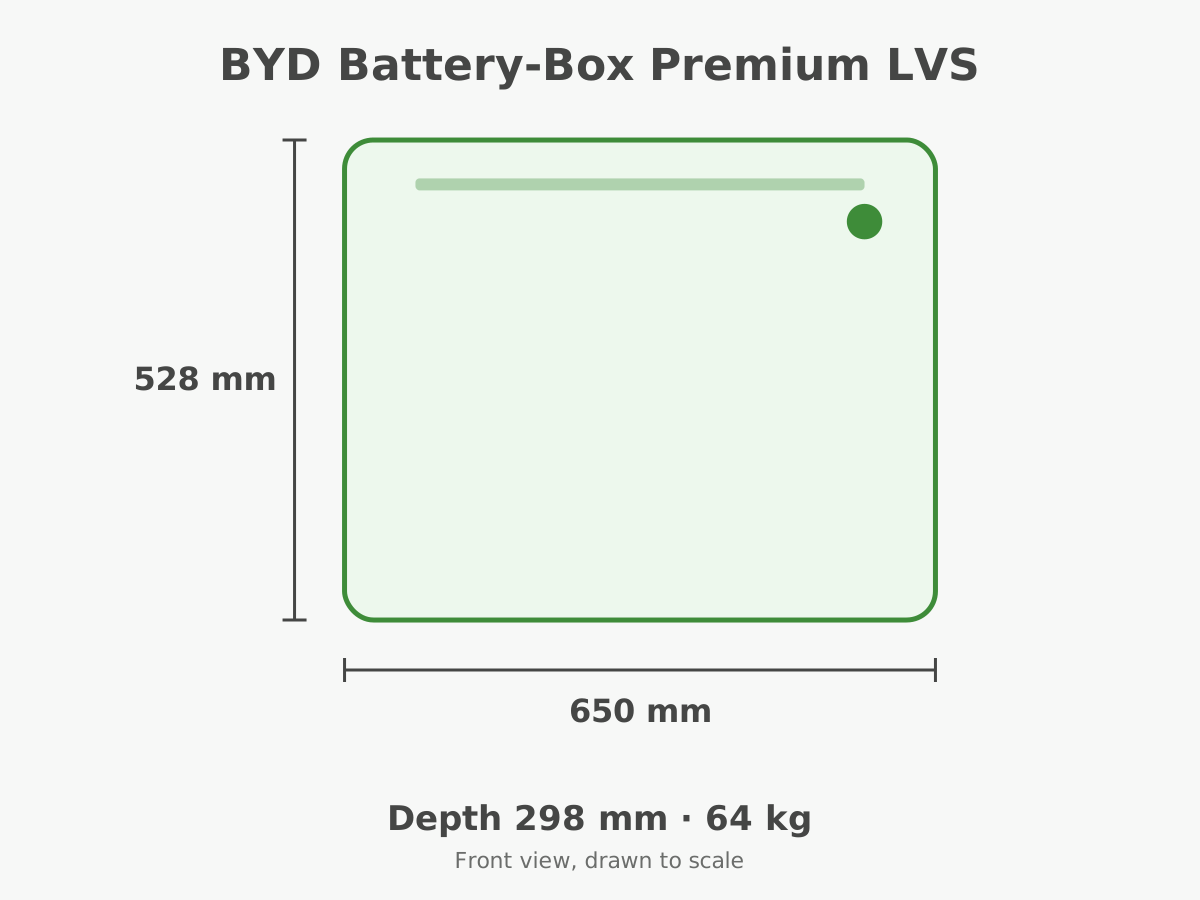 BYD Battery-Box Premium LVS | 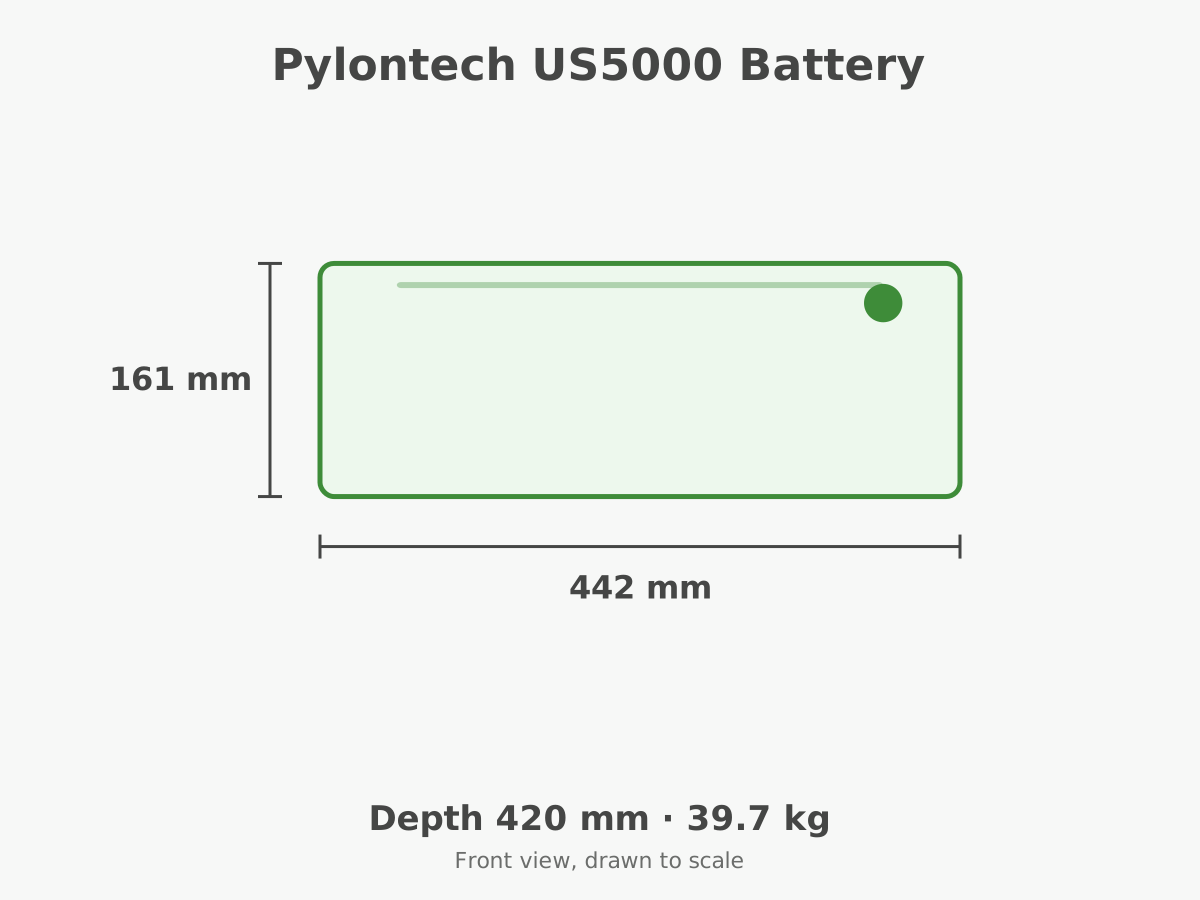 Pylontech US5000 Battery |
|---|---|---|
| Capacity | 4 kWh usable per module (1 to 6 modules) | 4.8 kWh nominal (48 V) |
| Usable capacity | 4 to 24 kWh | 4.56 kWh |
| Depth of discharge | 100% (test condition for the usable energy) | 95% |
| Battery chemistry | Lithium iron phosphate (LiFePO4) | LFP |
| Cycle life | No cycle number; warranty throughput limit of 11.88 MWh (LVS 4.0) | More than 8,000 cycles at 25 °C; design life 15+ years |
| Expansion | Up to 64 modules in parallel (256 kWh) | Up to 16 modules in a single string (about 76.8 kWh nominal) |
| Charge and discharge power | Up to 250 A continuous (4 to 6 modules); 65 A on one module | 100 A normal; maximum 101-120 A for 15 minutes |
| Round-trip efficiency | 95% or more | Not stated in the sources we read |
| Solar input | None: battery only, no solar input of its own | None: battery only, no solar input of its own |
| Dimensions | 528 × 650 × 298 mm (1 module, H × W × D) | 442 × 420 × 161 mm |
| Weight | 64 kg (LVS 4.0, 1 module) | 39.7 kg (better value) |
| Protection rating | IP55, indoor or outdoor (better value) | IP20: indoor installation only |
| Operating temperature | -10 to +50 °C | Charging 0 to 55 °C; discharging -10 to 55 °C |
| Warranty | 10 years; conditions apply | Not stated in the sources we read |
Green cells mark the clearly better value where a higher or lower number is better. Capacity is never marked, because more is not automatically better. Level rows and rows without a clear direction are not marked. Differences smaller than about a tenth are not marked. Protection ratings are marked only where both digits are at least as high.
Our read
BYD's LVS publishes more and has the higher protection rating: IP55 against IP20, a 95% round-trip efficiency and a 10-year warranty (conditions apply), none of which Pylontech's page gives. Pylontech's US5000 is lighter (39.7 kg against 64 kg for a one-module LVS 4.0, which also holds less) and states a cycle life of more than 8,000 cycles, where BYD gives a throughput limit instead. Capacities are not measured the same way: 4 kWh usable per LVS module against 4.8 kWh nominal (4.56 kWh usable) for the US5000, so the usable gap is small. Both makers quote power in amps, so we do not rank the power row.
Full pages: BYD Battery-Box Premium LVS · Pylontech US5000 Battery · Compare these two in the tool
BYD Battery-Box Premium LVS vs Pylontech Fidus
The Fidus is the newer Pylontech low-voltage module, rated IP65 and designed for wall, ground or rack mounting. It is the closer match to the LVS in how and where it can be installed.
The low-voltage pair with an outdoor-rated newer module (4 to 5.12 kWh per module)
| Specification | BYD Battery-Box Premium LVS | 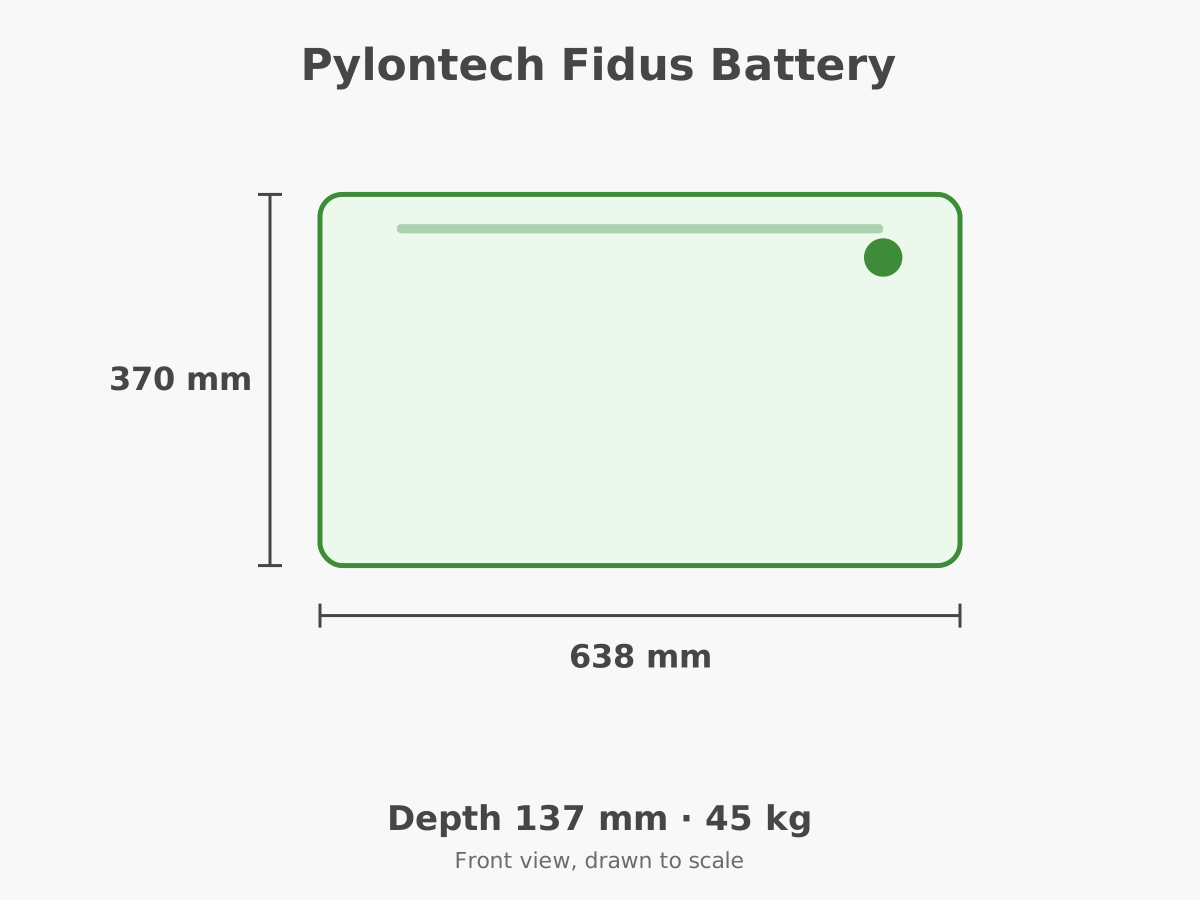 Pylontech Fidus Battery |
|---|---|---|
| Capacity | 4 kWh usable per module (1 to 6 modules) | 5.12 kWh nominal per module (the page text says 4.8 kWh) |
| Usable capacity | 4 to 24 kWh | 4.97 kWh per module |
| Depth of discharge | 100% (test condition for the usable energy) | 97% in the specification table (the page text says 95%) |
| Battery chemistry | Lithium iron phosphate (LiFePO4) | Not stated on the product page |
| Cycle life | No cycle number; warranty throughput limit of 11.88 MWh (LVS 4.0) | 8,000+ cycles at 25 °C; design life 15 years |
| Expansion | Up to 64 modules in parallel (256 kWh) | Up to 20 modules in one group, up to 6 strings |
| Charge and discharge power | Up to 250 A continuous (4 to 6 modules); 65 A on one module | 100 A normal and maximum; 121 to 200 A peak for 15 seconds |
| Round-trip efficiency | 95% or more | Not stated on the product page |
| Solar input | None: battery only, no solar input of its own | None: battery only, no solar input of its own |
| Dimensions | 528 × 650 × 298 mm (1 module, H × W × D) | 638 × 137 × 370 mm |
| Weight | 64 kg (LVS 4.0, 1 module) | 45 kg (better value) |
| Protection rating | IP55, indoor or outdoor | IP65 (better value) |
| Operating temperature | -10 to +50 °C | Charging -10 to 55 °C; discharging -10 to 55 °C |
| Warranty | 10 years; conditions apply | Not stated on the product page |
Green cells mark the clearly better value where a higher or lower number is better. Capacity is never marked, because more is not automatically better. Level rows and rows without a clear direction are not marked. Differences smaller than about a tenth are not marked. Protection ratings are marked only where both digits are at least as high.
Our read
On the hardware the Fidus has the edge in what is published: IP65 against IP55, 45 kg against 64 kg for a one-module LVS 4.0 (which holds less: 4 kWh usable against 5.12 kWh nominal) and a stated cycle life of 8,000+ cycles. BYD gives the warranty (10 years, conditions apply), the round-trip efficiency (95% or more) and the chemistry, where Pylontech's product page gives none of them. Pylontech's page also contradicts itself in places: 5.12 against 4.8 kWh and 97% against 95% depth of discharge. Both quote current in amps, so the power row is not ranked.
Full pages: BYD Battery-Box Premium LVS · Pylontech Fidus Battery · Compare these two in the tool
BYD Battery-Box Premium HVS vs Pylontech Force H3
Both are high-voltage stacks that connect to a hybrid inverter at several hundred volts. The HVS grows in 2.56 kWh modules, and the Force H3 in 5.12 kWh modules, so the Pylontech starts larger.
The high-voltage pair (about 5 to 36 kWh)
| Specification | 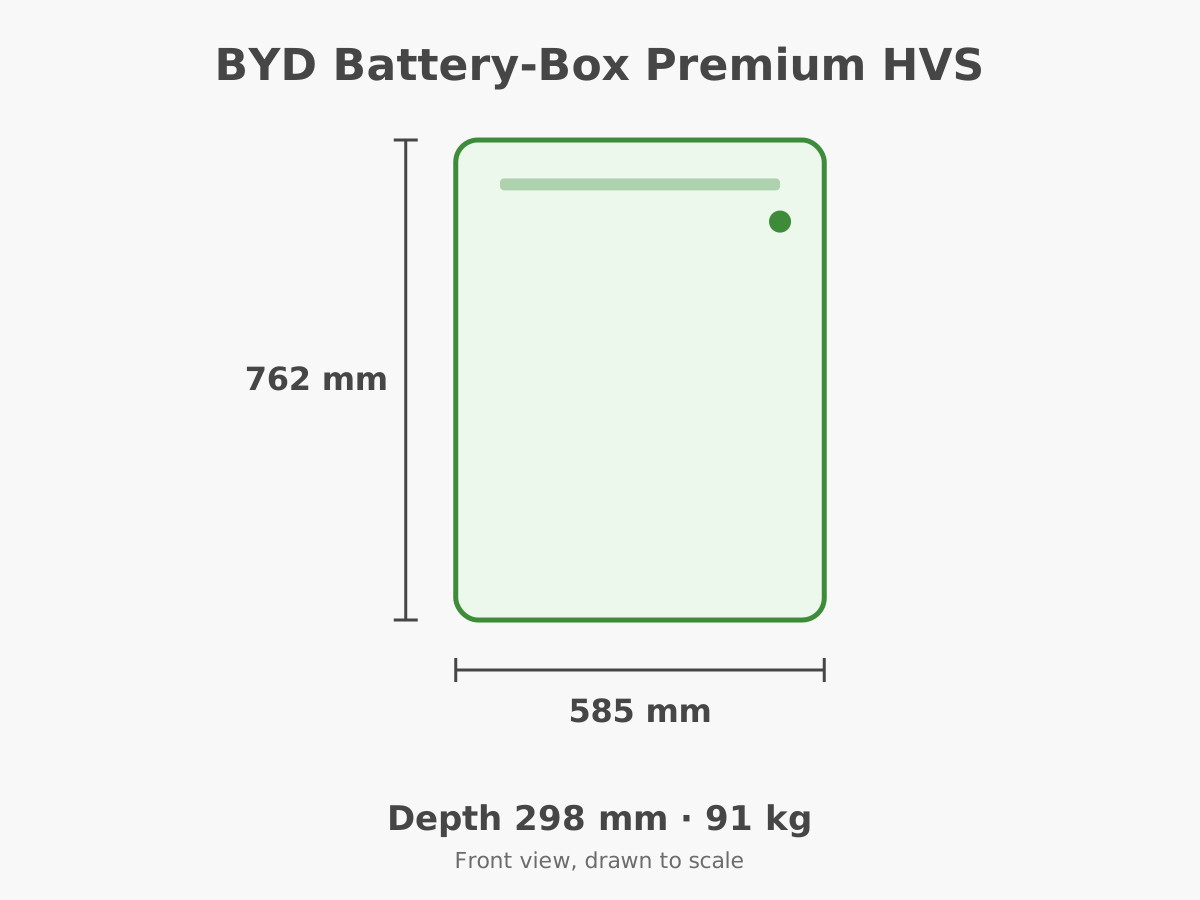 BYD Battery-Box Premium HVS | 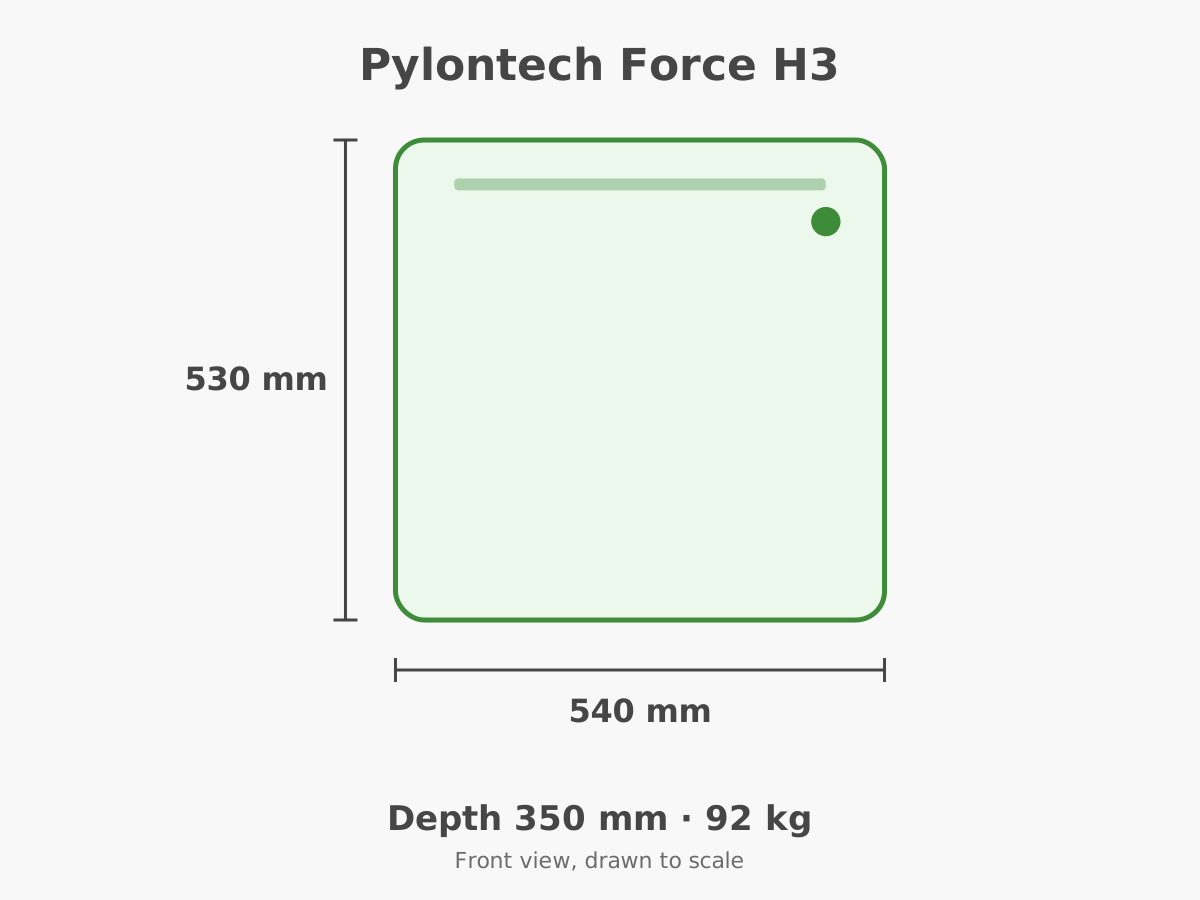 Pylontech Force H3 |
|---|---|---|
| Capacity | Usable 5.12 to 12.8 kWh for 2 to 5 modules | 10.24 to 35.84 kWh for 2 to 7 modules of 5.12 kWh |
| Usable capacity | 5.12 to 12.8 kWh (2.56 kWh per module) | 9.69 to 34.01 kWh for 2 to 7 modules |
| Depth of discharge | 100% (test condition for the usable energy) | 95% |
| Battery chemistry | Lithium iron phosphate (LiFePO4) | Not stated in the sources we read |
| Cycle life | No cycle number; warranty throughput limit of 15.41 MWh (HVS 5.1) | More than 10,000 cycles on the product page; the datasheet says more than 8,000 |
| Expansion | 2 to 5 modules in series; up to three identical stacks in parallel (38.4 kWh maximum) | 2 to 7 modules per stack; up to 6 groups in parallel |
| Charge and discharge power | Maximum 25 A, peak 50 A for 3 seconds; about 5.1 kW (HVS 5.1) to 12.8 kW (HVS 12.8) | Normal 50 A, maximum 55 A for 15 minutes; about 10 kW at 204.8 V |
| Round-trip efficiency | 96% or more | Not stated in the sources we read |
| Backup in a power cut | Listed for on-grid, on-grid with backup and off-grid use; the backup comes from the inverter | Not stated in the sources we read |
| Solar input | None: battery only, no solar input of its own | None: battery only, no solar input of its own |
| Dimensions | 762 × 585 × 298 mm for 2 modules (H × W × D) | 540 × 350 × 530 mm for 2 modules (W × D × H) |
| Weight | 91 kg (HVS 5.1, 2 modules) | 92 kg (2 modules) |
| Protection rating | IP55, indoor or outdoor | IP65 (better value) |
| Operating temperature | -10 to +50 °C | Charging from -10 to 55 °C; storage -20 to 45 °C |
| Warranty | 10 years; conditions apply | Not stated in the sources we read |
Green cells mark the clearly better value where a higher or lower number is better. Capacity is never marked, because more is not automatically better. Level rows and rows without a clear direction are not marked. Differences smaller than about a tenth are not marked. Protection ratings are marked only where both digits are at least as high.
Our read
At the smallest stack size the two weigh about the same (91 kg against 92 kg), but the Force H3 holds twice as much (10.24 kWh nominal against 5.12 kWh usable for the HVS 5.1), so it packs more energy per kilogram. Pylontech also has the higher protection rating (IP65 against IP55) and states a cycle life, though its own pages disagree (more than 10,000 on the product page, more than 8,000 in the datasheet). BYD states the warranty (10 years, conditions apply), the round-trip efficiency (96% or more), the chemistry and that backup and off-grid use are supported through a compatible inverter, where Pylontech's pages give none of these. Power is quoted in amps by both, with our own kW approximations, and is not ranked.
Full pages: BYD Battery-Box Premium HVS · Pylontech Force H3 · Compare these two in the tool
BYD Battery-Box Premium HVM vs Pylontech Force H3
The HVM is BYD's larger high-voltage tower, built from 2.76 kWh modules and starting at three modules. It is the closest BYD match for the Force H3 at the top of the range.
The large high-voltage pair (about 8 to 36 kWh)
| Specification |  BYD Battery-Box Premium HVM | Pylontech Force H3 |
|---|---|---|
| Capacity | Usable 8.28 kWh (3 modules) to 22.08 kWh (8 modules) per tower | 10.24 to 35.84 kWh for 2 to 7 modules of 5.12 kWh |
| Battery chemistry | Lithium iron phosphate (LiFePO4) | Not stated in the sources we read |
| Cycle life | Not stated on the datasheet | More than 10,000 cycles on the product page; the datasheet says more than 8,000 |
| Expansion | Up to 3 towers (66.2 kWh in total) | 2 to 7 modules per stack; up to 6 groups in parallel |
| Charge and discharge power | Maximum output current 50 A; peak 75 A for 3 seconds | Normal 50 A, maximum 55 A for 15 minutes; about 10 kW at 204.8 V |
| Round-trip efficiency | 96% or more | Not stated in the sources we read |
| Backup in a power cut | Supported with a compatible inverter | Not stated in the sources we read |
| Solar input | None: battery only, no solar input of its own | None: battery only, no solar input of its own |
| Dimensions | 995 × 585 × 298 mm for 3 modules (H × W × D) | 540 × 350 × 530 mm for 2 modules; 700 mm high for 3 |
| Weight | 119 to 129 kg (3 modules) | 131 kg (3 modules) |
| Protection rating | IP55, indoor or outdoor | IP65 (better value) |
| Operating temperature | -10 to 50 °C | Charging from -10 to 55 °C; storage -20 to 45 °C |
| Certifications | VDE 2510-50, IEC 62619, CEC, CE, UN 38.3 | IEC 62619, IEC 63056, UN 38.3, VDE-AR-E 2510-50 and others |
| Warranty | 10 years; conditions apply | Not stated in the sources we read |
Green cells mark the clearly better value where a higher or lower number is better. Capacity is never marked, because more is not automatically better. Level rows and rows without a clear direction are not marked. Differences smaller than about a tenth are not marked. Protection ratings are marked only where both digits are at least as high.
Our read
A three-module BYD HVM tower holds 8.28 kWh usable at 119 to 129 kg, while a three-module Force H3 stack holds 15.36 kWh nominal at 131 kg, so the Pylontech again stores more per kilogram; the weight row is not marked because the two weigh about the same. The HVM states a round-trip efficiency (96% or more), a 10-year warranty and that backup is supported with a compatible inverter, and its datasheet gives no cycle number. The Force H3 is rated IP65 against IP55 and states a cycle life, but its pages give no warranty, efficiency or chemistry. Both lists include IEC 62619, UN 38.3 and a VDE 2510-50 standard.
Full pages: BYD Battery-Box Premium HVM · Pylontech Force H3 · Compare these two in the tool
Side by side in words
Numbers in a table miss the bigger picture. Here is how the two brands differ on the points that matter when you choose.
| Specification | BYD | Pylontech |
|---|---|---|
| Range and sizes | The LVS is the low-voltage line (4 kWh usable per module, 1 to 6 modules per tower). The HVS (2.56 kWh modules) and HVM (2.76 kWh modules) are high-voltage towers, with the HVM reaching 22.08 kWh in a single tower. | The US5000 (4.8 kWh nominal) and Fidus (5.12 kWh nominal) are low-voltage modules. The Force H3 is a high-voltage stack of 5.12 kWh modules, from 10.24 kWh to 35.84 kWh. |
| Expansion | Up to 64 LVS modules in parallel (256 kWh), up to three HVS stacks (38.4 kWh) and up to three HVM towers (66.2 kWh). | Up to 16 US5000 modules in one string (about 76.8 kWh nominal), up to 20 Fidus modules per group across up to 6 strings, and up to 6 Force H3 groups in parallel. |
| Warranty and cycle life | 10 years with conditions. BYD's Europe letter sets a performance warranty of 60% of usable energy after 10 years or a minimum throughput, whichever comes first, on the HVS and LVS. | Pylontech's pages give no warranty period for any of the three. They do give cycle ratings: more than 8,000 on the US5000 and Fidus, and more than 10,000 on the Force H3 product page. |
| Protection and installation | IP55 on all three, floor-mounted, indoors or outdoors. | IP65 on the Fidus (wall, ground or rack) and Force H3, and IP20 on the US5000 (indoor, rack-compatible). |
| Published detail | States a round-trip efficiency (95% or more on the LVS, 96% or more on the HVS and HVM) and the chemistry on all three. Gives amps rather than kW for power. | States no efficiency and no warranty on any of the three pages. Gives amps for power, and the Force H3 datasheet and product page disagree on cycle life. |
| Certifications | VDE 2510-50, IEC 62619, CE and UN 38.3 on all three; CEC on all three. | IEC 62619 on all three; UN 38.3, UL 1973 and UL 9540A on the US5000 and Force H3; VDE 2510-50 on the Fidus and Force H3. |
Which should you choose?
Neither brand is the right answer for everyone. These are the situations where each one fits better, based on the published figures above.
Choose BYD if
- You want a warranty period on paper: BYD states 10 years (conditions apply) on the LVS, HVS and HVM, where Pylontech's pages give none.
- You want a published round-trip efficiency: BYD states 95% or more on the LVS and 96% or more on the HVS and HVM.
- You want the largest published expansion in one family: up to 64 LVS modules (256 kWh) or up to three HVM towers (66.2 kWh).
- You want a performance warranty written out: BYD's Europe letter sets 60% of usable energy after 10 years or a minimum throughput, on the HVS and LVS.
Choose Pylontech if
- You want more energy for the same weight: a two-module Force H3 holds 10.24 kWh nominal at 92 kg, against 5.12 kWh usable at 91 kg for an HVS 5.1.
- You want a higher protection rating: the Fidus and Force H3 are IP65, against IP55 for all three BYD models.
- You want a lighter low-voltage module: the Fidus is 45 kg and the US5000 39.7 kg, against 64 kg for a one-module LVS 4.0.
- You want a stated cycle rating: more than 8,000 cycles on the US5000 and Fidus, and more than 10,000 on the Force H3 product page.
What we could not compare
A comparison is only as good as its data. Here is where the published information ran out, so you know what the tables cannot tell you.
- Several cells show 'Not stated': 1 of 57 on BYD's side and 13 on Pylontech's. That means the page we read gives no figure, not that the product lacks the feature. Pylontech's missing warranty, efficiency and chemistry account for most of its gaps.
- Capacity is not measured the same way. BYD quotes usable energy at 100% depth of discharge, 0.2C and 25 °C, and it notes that usable energy may vary with the inverter brand. Pylontech quotes nominal energy and sometimes usable energy.
- Neither maker quotes power in kW for the pairs: both give amps, so we do not rank power. The kW approximations on Pylontech's side are our own arithmetic from its voltages.
- Pylontech's own pages disagree in places: the Fidus (5.12 against 4.8 kWh, 97% against 95% depth of discharge) and the Force H3 (more than 10,000 cycles against more than 8,000). Weights and sizes depend on the number of modules in the stack.
- We did not compare price, installation cost, which inverters each pairs with, real-world performance or after-sales support. These matter and we have not tested them.
Common questions about BYD vs Pylontech
Is BYD or Pylontech better?
Neither is better across the board. BYD states a 10-year warranty and a round-trip efficiency on all three models in our pairs, while Pylontech's newer modules are lighter or hold more for their weight and carry a higher protection rating. The inverter you pair a battery with matters at least as much, so ask your installer which combination they support.
Which has the longer warranty, BYD or Pylontech?
BYD states 10 years, with conditions, on the LVS, HVS and HVM. Pylontech's pages for the US5000, Fidus and Force H3 give no warranty period, so confirm the terms with your installer or Pylontech before you buy.
What is the difference between low-voltage and high-voltage batteries?
Low-voltage modules, such as the BYD LVS and the Pylontech US5000 and Fidus, work at about 48 to 51 V and pair with low-voltage hybrid inverters. High-voltage stacks, such as the BYD HVS and HVM and the Pylontech Force H3, work at several hundred volts and pair with high-voltage inverters. The two cannot be mixed, so your inverter decides which you need.
Do BYD and Pylontech batteries include an inverter?
No. All six models in our pairs are battery modules only. BYD says they work with leading single- and three-phase inverters and refers to a compatibility list. Pylontech's pages do not list compatible inverters, so ask your installer to confirm yours.
Can I use these as plug-in batteries?
No. These are installed home batteries that need a compatible inverter and a qualified installer, not plug-in batteries. Rules, incentives and tax treatment differ by country: see our country guides.
Why these four pairs?
We matched each product to the closest one from the other brand by voltage class and capacity, from the models in our catalogue. If you would like a different pairing, build your own with Compare For Yourself.
Related guides
Want to size a battery for your own home?
Our calculator uses your own usage and tariff to estimate what a home battery could save, with conservative assumptions.