
Read before buying energy storage system
What exactly is a home battery, how does it know what's happening in your house, and will it actually pay for itself? Here's the complete, honest A-to-Z guide before you buy.
- Home Batteries
- Complete Guide
- Buying Guide
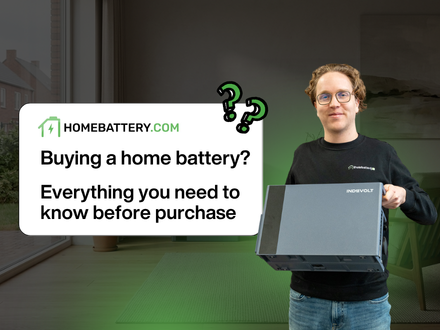
- A home battery solves a time mismatch: your solar panels produce most during the day, but you use most power in the evening
- At its core, a system is built from battery modules, a battery management system, an inverter and an energy management system
- A P1 meter, CT clamp or IR reader reads your electricity meter in real time. That is how the battery knows exactly when to charge or discharge
- Without a battery, households typically use only a fraction of their own solar power. With one, self-consumption can climb substantially
- Many regions are winding down traditional net metering. As a result, storing your own power is increasingly worth more than feeding it back to the grid
- Plug-and-play battery systems now cover most of what a fixed, hardwired installation offers, at a lower cost and without major rewiring
Home batteries are one of the most talked about topics in the energy world right now, but they also raise the most questions. What exactly is it? Do you really need one? And how do you earn it back? If you’re looking into a home battery for the first time, here’s an honest guide from A to Z through the world of energy storage. By the end, you’ll know whether it’s the right investment for your home.
Why this is relevant right now
You probably recognise this situation. You have a roof full of solar panels. The sun is shining and your panels are running at full speed, so you’d expect your energy bill to drop close to zero. Yet at the end of the month, you’re still surprised by the cost.
It comes down to a simple time mismatch. Your solar panels generate the most electricity around midday, but most of us aren’t even home then. We’re at work, the kids are at school, and only the fridge and the router are really drawing power. As a result, the electricity you generate but don’t use straight away flows back into the grid, and your supplier sells it on to your neighbours.
In the evening, the picture flips. You come home, cook and switch everything on, but the sun isn’t shining anymore. So you buy that same electricity back, usually at a premium price. On top of that, more grid operators are now charging feed-in fees for the surplus power you push back. A home battery solves exactly this problem, because it holds on to that surplus for you instead.
What’s actually inside a home battery
At its core, a home battery is a smart storage space for electricity. In other words, it’s essentially a large power bank for your entire house. A standard system is built from a handful of essential parts:
- Battery modules, the cells where electricity is physically stored. Most systems today use lithium iron phosphate (LFP) cells, a technology valued for being safe and long-lasting
- A battery management system (BMS), which constantly monitors the health and safety of the cells
- An inverter, the engine of the device. Solar panels and the mains both supply alternating current (AC). But a battery can only store direct current (DC), so the inverter converts between the two
- An energy management system (EMS), the brain that decides when to fill the battery and when to release power back to the house
- A backup outlet, found on many systems, which lets you plug in a cord to keep key appliances running during a blackout
How it knows what’s happening in your home
The main goal is to maximise your self-consumption, using as much of your own solar power as possible. Alternatively, the system can run in dynamic mode, loading up with cheap energy and releasing it when prices are high. Either way, the battery needs to know what’s happening on your electricity meter in real time. That’s the job of a P1 meter, a CT clamp or an IR reader.
A P1 meter plugs directly into a modern smart meter, and it constantly reads whether you’re buying from the grid or feeding power back. If you don’t have a smart meter yet, a CT clamp does the same job, and it works well in older homes. The instant the meter detects electricity leaving your house towards the grid, it signals the battery to capture and store that power instead. This happens continuously, so your grid meter stays as close to zero as possible.
You are essentially creating your own closed energy loop.
How a battery pays for itself
There are two main ways a home battery earns its keep. The first is simply increasing your self-consumption. Without a battery, an average household typically uses only around a third of its own solar power. With a battery, that figure often rises substantially. That’s because the surplus that used to flow back to the grid now gets stored and used in the evening instead.
The second way is combining self-consumption with dynamic management. On a contract where prices move every hour, the battery can also charge from the grid when electricity is cheap, even in winter when solar output is low. It then releases that power during the expensive evening peak.
~30%
typical self-consumption without a battery
70-80%
typical self-consumption with a battery
4-6 yrs
typical payback period for a modern system
Treat these as general ranges rather than a guarantee, since your own savings depend on your consumption, your solar output and your contract. However, a well-sized battery is generally expected to last well over a decade. So even after it has paid for itself, it keeps saving you money for years to come.
Why the timing matters
Part of the urgency comes from regulatory change. In the Netherlands, for example, the traditional net metering system is scheduled to be phased out. That system currently lets households offset summer solar surplus against winter usage. Once it ends, it becomes essential to consume or store every kilowatt-hour you generate at the moment you generate it, rather than relying on the grid to balance things out later.
Households that already have a battery tend not to notice this kind of change much, because their energy management is already set up for it. That said, rules and dates like this vary by country and can shift. So always check the current regulation where you live, rather than relying on a specific date.
Works with any existing setup
Whether you have a single-phase or three-phase fuse box, the battery and meter detect this automatically during installation. The same goes for whatever solar panel setup you already have.
Plug-and-play or a fixed installation?
A common worry is that installing a home battery means a major renovation or rebuilding your fuse box. For most modern systems, that’s no longer the case. Plug-and-play batteries can be set up yourself: you place the unit, plug it into a standard wall outlet, and connect the P1 meter, CT clamp or IR reader to your electricity meter.
If you want more discharge power, an electrician can add a dedicated circuit for a modest cost. That brings a plug-and-play system close to the performance of a permanent, fixed installation. Traditional fixed systems still exist and usually offer higher continuous power. However, they generally need a professional, multi-day install and a noticeably higher upfront cost, which can make the payback period longer.
Pros
- Self-install in a spot of your choice, no major rewiring needed
- Lower upfront cost, which generally means a shorter payback period
- Can be upgraded later with a dedicated circuit for more power
- Works with existing solar panels and most fuse box types
Cons
- Lower continuous discharge power than a large fixed system, unless you add a dedicated circuit
- A fixed installation may still suit very high-power or whole-home backup needs
- Professional fixed installs typically take a technician visit of a day or more
What size do you actually need
The most common question is how big a battery system needs to be. You don’t want to pay for capacity you’ll never use, but you also don’t want it running empty by the evening. Here’s a practical rule of thumb: check your latest energy bill for your annual consumption and your annual grid export. Take whichever of the two numbers is smaller, then divide it by 365.
For an average household, the result usually lands in a moderate range. That’s typically enough to capture your daily solar surplus and cover your evening and night-time use. You can always add a bit of extra capacity for backup power or margin. Still, for most homes, a much larger system isn’t necessary to get strong savings.
When it might not be the right time yet
A home battery isn’t automatically right for every household, or every moment. If you’re on a fixed-term energy contract that already protects you from rising fees, it can make sense to wait. You could hold off until that contract ends, or until net metering rules in your area actually change.
For homes without solar panels, a battery is still possible. You can save by trading on a dynamic tariff, but your overall savings will be lower. So it’s worth adding a few extra years to your expected payback period. Even then, some households choose a smaller battery purely for the peace of mind of backup power. That doesn’t need to be a large system, just enough to keep essentials like a fridge and freezer running during an outage.
Home batteries, common questions
What's actually inside a home battery system?
The core components are the battery modules, usually lithium iron phosphate cells, plus a battery management system. On top of that sits an inverter, which converts between AC and DC, and an energy management system that decides when to charge or discharge.
How does a battery know when to charge or discharge?
Through a P1 meter, CT clamp or IR reader connected to your electricity meter. It reads in real time whether you're buying power from the grid or feeding it back, and signals the battery accordingly.
Do I need a fixed, hardwired installation?
Not necessarily. Plug-and-play systems can be self-installed into a standard wall outlet and connected to your meter, with the option to add a dedicated circuit later for more power. Fixed installations, by contrast, offer higher continuous power but cost more and take longer to install.
How do I work out what size battery I need?
Take your annual electricity consumption and your annual grid export from your energy bill. Use whichever is smaller, then divide it by 365. That gives a rough daily figure to size your battery against, rather than guessing.
Ready to find your own battery size?
Use our free calculator for a personalised size, savings and payback estimate.
Latest articles
Read before buying energy storage system
22/10/2026

Home Batteries for Emergency Power
22/10/2026
Is the Indevolt SolidFlex 3000 AC Really 3,000W?
21/10/2026

Negative electricity prices explained
20/10/2026

Dynamic Energy Contracts: How to Actually Save
19/10/2026

Plug-In Solar Is Now Legal in the UK
16/10/2026