Portable Power Station vs Plug-In Battery
Portable power station or plug-in home battery? We compare built-in ports, backup power, solar charging and smart-meter control, so you can pick the right one for your situation.
- Power Stations
- Plug-in Batteries
- Hybrid Solar

- A power station is made to travel: light, with USB-C and a 12-volt car socket built in, and it can often charge from a car
- A plug-in battery can come along too. Many have a backup socket for an extension lead, and hybrid versions take solar panels directly and keep charging in a power cut
- A plug-in battery also connects to your smart meter and works for your home, which a power station is not made to do
- Examples in this guide: EcoFlow Delta 3 Plus, Jackery Explorer 2000 v2 and Indevolt plug-in batteries. They are examples, not recommendations
- Specs and prices come from the manufacturers and change over time, so check the current figures before you buy
Thinking about buying a portable power station? Then you’ve probably seen plug-in batteries too. They look a lot alike: a big battery with sockets on it. But here’s what most people don’t know: a plug-in battery can do a lot of what a power station does. You can take it with you, and at home it can do something that most power stations never can. So which one should you buy? Let’s compare them honestly.
What a power station is great at
A power station is great at one thing above all: it’s made to travel. Everything is built in, wall sockets, USB-C ports, a 12-volt car socket (the old cigarette lighter socket). You can charge it from the wall, from solar panels, and often from your car. That’s why people buy one for camping, a van, a boat, the garden or for a power cut.
Watts vs kilowatt-hours
Two quick words you'll hear a lot: watts tell you how much power a battery can give at once. Kilowatt-hours tell you how much energy it can store. Think of watts as how fast water flows from a tap, and kilowatt-hours as the size of the water tank.
Take the EcoFlow Delta 3 Plus as an example. It weighs twelve and a half kilograms, holds about 1 kWh and takes up to 1000 watts from solar panels.
Can a plug-in battery do the same?
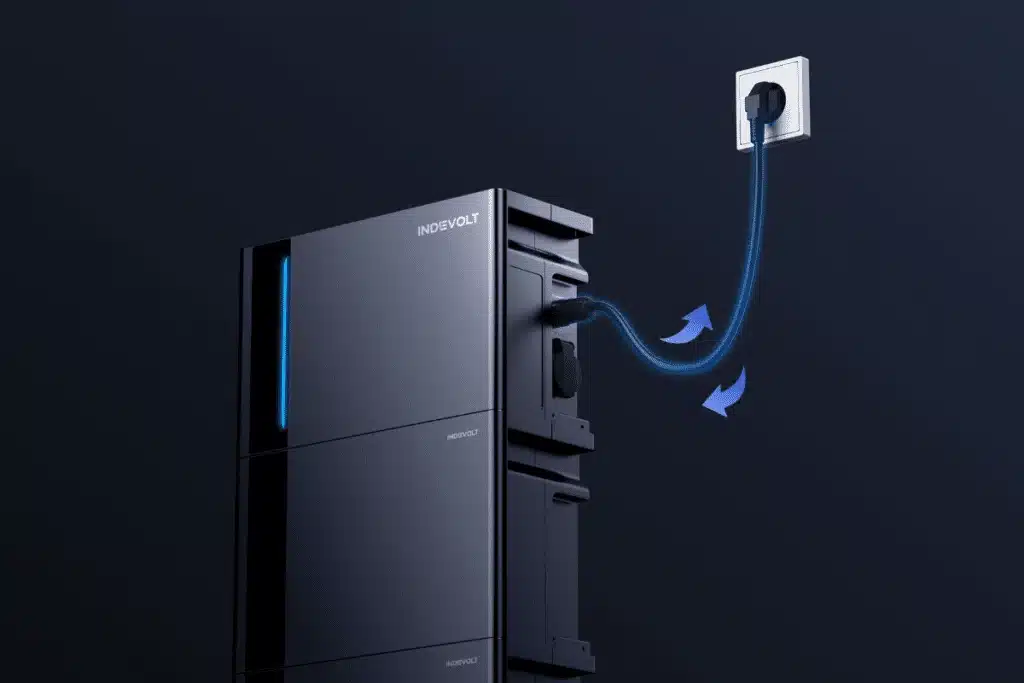
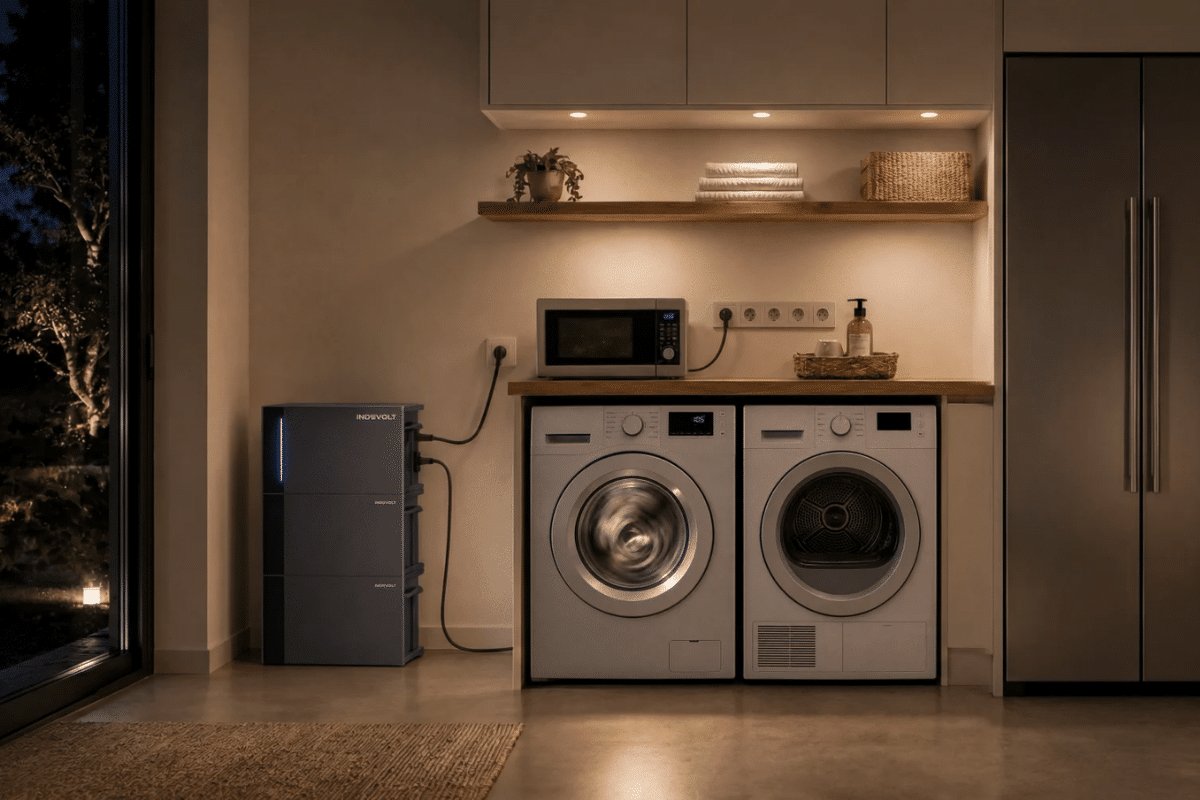
Now the surprise: a plug-in battery is made for your home, but it can do many of the same jobs. You can also take it with you. Many plug-in batteries have a backup socket, so when you plug in an extension lead with a multiplug, you can run several devices at once: lights, a fridge, a laptop, a phone charger. Take these Indevolt batteries as an example. Indevolt says its backup socket gives up to 3000 watts, depending on which one you choose and how you set it up.
For example, this setup, the base module plus an extra 3.6 kWh expansion battery, allows 3000 watts of discharge power. But if you only use the base unit, you have 2000 watts of discharge power, the same as most power stations. And if you use the smaller 1.8 kWh expansion battery, you can use 2000 watts of discharge power too.
| Indevolt setup | Discharge power |
|---|---|
| Base module only | 2000 watts |
| Base module + 1.8 kWh expansion battery | 2000 watts |
| Base module + 3.6 kWh expansion battery | 3000 watts |
So whether you have 1000, 2000 or 3000 watts, it is more than enough to power multiple devices at once:
- 1000 watts is enough for your phone and laptop charger, a television, the fridge and some lights
- 2000 watts can run your coffee machine, microwave or a large AC unit
- 3000 watts is enough for the dishwasher, electric heater and washing machine
And because the starting capacity of a plug-in battery is usually higher than the 1 kWh from the EcoFlow, for example, you have more electricity to use.
You can bring your solar panels too
Some plug-in batteries are hybrid, which means you connect solar panels straight to the battery. Indevolt says its hybrid version has four solar inputs of 600 watts each, that’s up to 2400 watts of panel input, and the battery keeps charging from those panels even during a power cut. It can work completely standalone: just the battery and solar panels, connected to nothing else. The panel charges the battery directly and you just plug in what you need, exactly like a power station.
You can use both devices outside too. The EcoFlow is rated IP65, which means dust tight and protected against rain and splashes, and Indevolt says the same for its batteries. And capacity can grow: a power station like the EcoFlow can grow to about 5 kWh with extra batteries. The Indevolt batteries can grow up to 20 kWh.
Where a power station still wins
So does that mean you don’t need a power station? Not quite, it still wins in a few places. The first one is weight.
| Model | Weight | Capacity |
|---|---|---|
| EcoFlow Delta 3 Plus | about 12.5 kg | about 1 kWh |
| Jackery Explorer 2000 v2 | about 17.5 kg | about 2 kWh |
| Indevolt power module | about 21.5 kg | about 2 kWh |
| Indevolt expansion battery | about 30 kg extra | about 4 kWh extra |
Every extra Indevolt module adds its own weight on top, so you can move a plug-in battery, but it was originally made to stay where you put it. A power station has USB-C and a 12-volt socket built in. With a plug-in battery, everything goes through the normal wall socket on the battery, so you just have to bring an extension lead and your chargers, and then it works the same, just a little less compact.
Power stations can often charge from a car’s 12-volt socket too. A plug-in battery can’t do that. So if you will mostly carry it around, hike to a camp spot or need a 12-volt socket in a van, a power station is simply the better tool for you. But if you will mostly use it in your house to store your solar energy, a plug-in battery is the better tool for you.
Never try this
A power station only powers what you plug into it. It's not made to feed your house, and please never connect one to a wall socket with a cable to try. That can be very dangerous.
Plug-in battery: pros and cons
Pros
- Connects to your smart meter and can charge or discharge by itself, not just what you plug into it
- Often a lower price per kilowatt-hour, especially in bigger sizes
- Hybrid versions keep charging from solar panels during a power cut
- Can be given a higher cycle warranty, up to 8000 cycles on some models
Cons
- Heavier, made to stay where you put it rather than travel
- No USB-C or 12-volt car socket built in, everything goes through the normal wall socket
- Can't charge from a car
- Rules for plugging it into a socket differ by country and sometimes need a separate circuit breaker
Now, the bonus
Because a plug-in battery was made for your home, it can do something most power stations can’t: it connects to your smart meter through a small device called a CT meter or P1 meter. This reads how much power your home uses, then it charges or discharges by itself. For example, it stores your solar panel’s extra power at midday and feeds it back into your home in the evening. Or, on a dynamic energy contract, where the price changes throughout the day, it charges when electricity is cheap, so you can use that energy later instead of buying power when it’s expensive.
A plug-in battery is also made to do this every day. One cycle is one full charge and empty. Indevolt gives a warranty of 8000 cycles; EcoFlow and Jackery say 4000 for these power stations. But be careful, they measure end of life differently, so don’t compare those numbers one to one.
Now, what it costs
Often the price per kilowatt-hour is lower for plug-in batteries, especially in bigger sizes. But price per kilowatt-hour isn’t the whole story: a power station has ports and portability, and you pay for that. A plug-in battery gets cheaper per kilowatt-hour as you add more modules.
The rules are different in every country
Check local regulations first
The rules for plugging a battery into a socket are different in every country. In the UK, for example, a battery that sends power into your home through a socket is not covered by the current rules, and you will need to install a separate circuit breaker to deliver energy to your house. A power station that only runs the devices you plug into it is a different thing. Always check what applies where you live.
A power station goes where you go. A plug-in battery can go with you, and it works for your home when you’re back.
So, which one do you need?
Where will it spend most of its time?
If it's mostly away from home and you want it light, with USB ports and a 12-volt socket, choose a power station.
Do you want to use more of your own solar power?
If you also want it at home to save money or take advantage of changing prices, choose a plug-in battery.
Want solar panels wired straight in?
Look at a hybrid version. You can still take it with you, but you carry the weight and give up the USB ports and the 12-volt socket. In return, you get a battery that works in your home and outside as well.
Which one should you buy?
Should I buy a power station or a plug-in battery?
Ask yourself where it will spend most of its time. If it's mostly away from home and you want it light, with USB ports and a 12-volt socket, choose a power station. If you also want it at home to use more of your own solar power and save money, or to take advantage of changing prices, choose a plug-in battery.
Can I still take a plug-in battery with me?
Yes, to some extent. Many plug-in batteries have a backup socket, so when you plug in an extension lead with a multiplug, you can run several devices at once.
What is a hybrid plug-in battery?
A hybrid plug-in battery connects solar panels straight to the battery. It keeps charging from those panels even during a power cut and can work completely standalone, just the battery and solar panels, connected to nothing else.
Can a power station power my whole house?
No. A power station only powers what you plug into it. It's not made to feed your house, and you should never connect one to a wall socket with a cable to try, that can be very dangerous.
Still weighing it up?
Browse more buying guides and comparisons on HomeBattery.com.
More articles
-

Do I need a home battery for my solar panels?
-

Home battery storage without solar panels: does it actually pay in the UK?
-

AC or DC-coupled plug-in home battery: Which setup suits your home?
-
Are home batteries safe? Fire risk and chemistry explained
-

Can you put a home battery outside?
-
How long will a home battery last in a power cut?