
Tesla vs Enphase
Two of the best-known installed home battery brands, compared in two matched pairs using only figures the makers publish, with the differences in coupling and market spelled out.
- 2 matched pairs
- Maker data only
- Checked 12 Nov 2026

- We matched two Tesla and two Enphase installed home batteries by capacity and generation: Powerwall 3 against IQ Battery 10C, and Powerwall 2 against IQ Battery 5P. They are fixed installations, not plug-in batteries.
- In the 4 rows where a higher or lower number is clearly better or exactly level, Tesla leads in 2 and Enphase in 2; 0 are level.
- The two brands are built differently. The Powerwall 3 has a solar inverter built in; the Powerwall 2 and both Enphase batteries are AC-coupled, and the Enphase batteries are designed around Enphase microinverters.
- The figures are not from the same market: Tesla's come from its UK page and datasheet, Enphase's from US store pages in inches and pounds. Enphase's pages leave more figures out: 3 cells on Tesla's side read 'not stated' against 10 on Enphase's.
- We have not tested any of these products. Where a maker does not publish a figure, we say so instead of guessing.
Not tested by us, and no prices
Every figure on this page comes from Tesla's and Enphase's own product pages and datasheets, last checked on 12 November 2026. We have not tested these batteries, so we do not score them or crown a winner. We show no prices because installed batteries are quoted by the installer and change often. Tesla's figures are for the UK and EU version; Enphase's come from its US store pages, so check the version sold where you live.
The short answer
There is no overall winner. Across our two pairs, Tesla leads in 2 of the 4 clear-cut rows and Enphase in 2, with 0 level. The 4 rows cannot decide which brand is right for a house, because the two companies sell different kinds of system.
In the first pair the Powerwall 3 holds 13.5 kWh against 10 kWh for the IQ Battery 10C, weighs 130 kg against about 144 kg, and has a solar inverter built in. Enphase's 10C states a 15-year warranty covering up to 6,000 cycles, against 10 years for the Powerwall 3, which needs a reliable internet connection for the full warranty. In the second pair the Powerwall 2 has the higher continuous power rating (5 kW against 3.84 kW) but holds 13.5 kWh against 5.0 kWh, and the IQ Battery 5P is the lighter unit at 79 kg against 114 kg.
Do not read the row count as a score. Capacity, whether you already have solar panels, and which installer you can find in your area matter more than any single row. Use the pair tables below, then check Which should you choose? for the situations where each fits better.
How we matched the models
We paired products by capacity and by generation, because that is how people shop: they pick a size, then compare brands. Each pair is the closest match in our catalogue, which holds only two products from each brand, so the match is imperfect. The first pair is 13.5 kWh against 10 kWh, and the second is 13.5 kWh against 5.0 kWh, so the second pair is a comparison of an older large battery with a small one, not of equals. The two Enphase batteries are the nearest in coupling to the Powerwall 2, which is also AC-coupled.
Two other differences matter more than the specification rows. The Powerwall 3 is the only product here with a built-in solar inverter; the other three connect to the AC side of a solar system. And the figures come from different markets: Tesla's UK and EU documents against Enphase's US store pages, which describe 120 V and 240 V versions and list sizes in inches and pounds.
| Specification | Tesla | Enphase |
|---|---|---|
| The current large pair (10 to 13.5 kWh) | Tesla Powerwall 3 | Enphase IQ Battery 10C |
| The AC-coupled pair (5 to 13.5 kWh) | Tesla Powerwall 2 | Enphase IQ Battery 5P |
Tesla and Enphase at brand level
Before the model pairs, here is how the two companies differ. See our full brand guides to Tesla and Enphase.
| Specification | Tesla | Enphase |
|---|---|---|
| Models in our catalogue | 2 | 2 |
| Coupling in our pairs | The Powerwall 3 has a built-in hybrid solar inverter; the Powerwall 2 is AC-coupled | Both are AC-coupled and built around Enphase microinverters |
| Source of our figures | Tesla's UK Powerwall page and UK datasheet (Powerwall 3) and the specification table on its UK page (Powerwall 2) | Enphase's US store pages, with sizes in inches and weights in pounds |
| Warranty in our pairs | 10 years on both; the Powerwall 3 needs a reliable internet connection for the full warranty | 15 years, up to 6,000 cycles on the IQ Battery 10C; not stated for the IQ Battery 5P |
| Expansion in our pairs | Powerwall 3: up to three Expansions (54 kWh), or up to 94.5 kWh with four units and three Expansions; Powerwall 2: up to 10 units | Not stated on either page |
| Cell chemistry in our pairs | Not stated in the sources we read for either Powerwall | Not stated on either page |
Tesla Powerwall 3 vs Enphase IQ Battery 10C
These are the newest large batteries each brand shows in our catalogue. The Powerwall 3 holds 13.5 kWh and the IQ Battery 10C holds 10 kWh. The biggest difference is not on the table: the Powerwall 3 includes a solar inverter, while the 10C is AC-coupled and works with Enphase microinverters.
The current large pair (10 to 13.5 kWh)
| Specification | 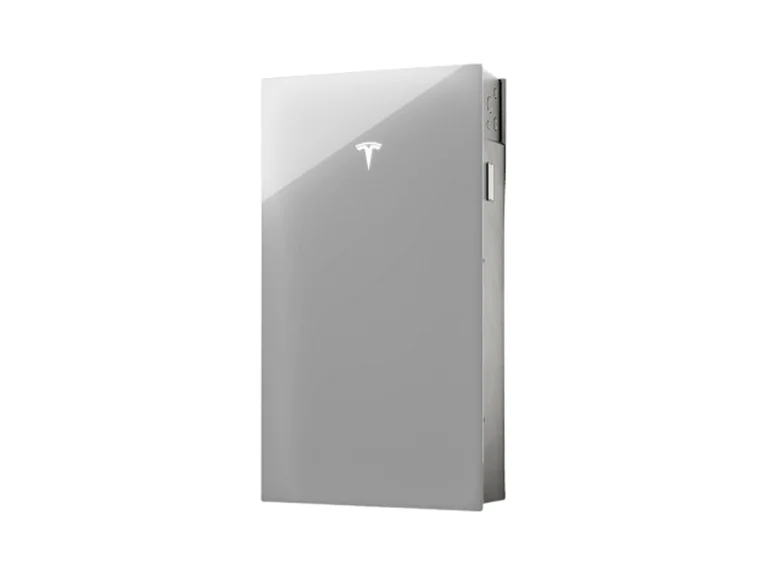 Tesla Powerwall 3 | 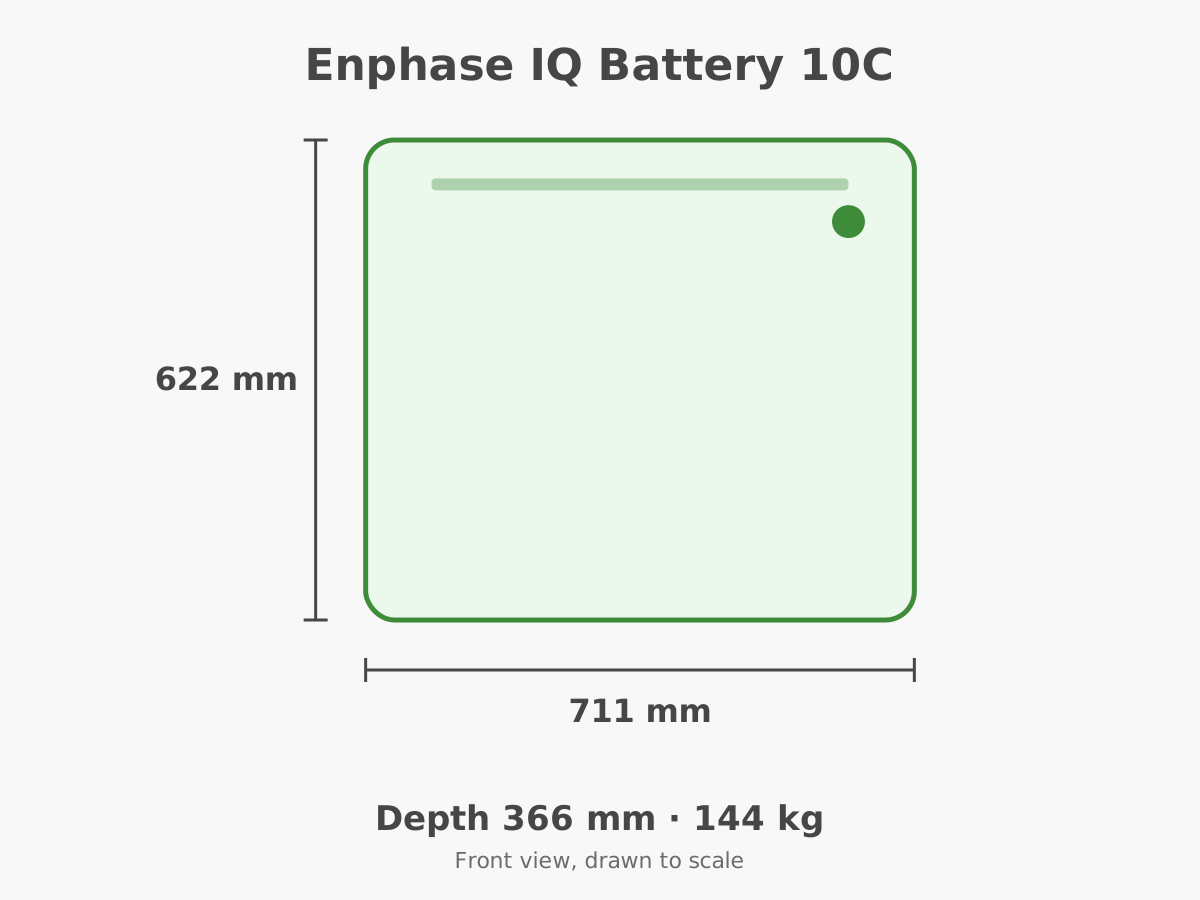 Enphase IQ Battery 10C |
|---|---|---|
| Capacity | 13.5 kWh | 10 kWh |
| Expansion | Up to three Expansion units of 13.5 kWh each (54 kWh with one Powerwall 3) | Not stated |
| AC output (continuous) | 3.68 to 11.04 kW configurable, 230 V | 7.08 kVA continuous power rating |
| Efficiency (different measures) | 97.5% solar-to-grid, no round-trip figure | 96% DC and 90% AC round-trip |
| Backup in a power cut | Yes, with a Backup Gateway 2 | Described by Enphase, with 24 A of load imbalance between L1 and L2 in backup mode |
| Solar input | Built in (hybrid) | None for panels: AC-coupled, works with Enphase IQ Series microinverters |
| Works with solar panels | Yes: built-in hybrid inverter, three MPPT inputs | Yes: AC-coupled, with Enphase IQ Series microinverters |
| Off-grid use | Partly: backup with the Backup Gateway 2 only | Partly: backup in a power cut, no stand-alone system described |
| Dimensions | 1,105 × 609 × 193 mm (H × W × D) | About 366 × 711 × 622 mm (D × W × H, converted from inches) |
| Weight | 130 kg (better value) | About 144 kg in total (317 lb) |
| Protection rating | Flood resistant up to 0.6 m; no IP rating stated | Not stated |
| Operating temperature | −20 to 50 °C | Not stated |
| Warranty | 10 years, with a reliable internet connection needed for the full warranty | 15 years, up to 6,000 cycles (better value) |
Green cells mark the clearly better value where a higher or lower number is better. Capacity is never marked, because more is not automatically better. Level rows and rows without a clear direction are not marked. Differences smaller than about a tenth are not marked.
Our read
The Powerwall 3 holds more (13.5 kWh against 10 kWh), is lighter (130 kg against about 144 kg), has a solar inverter built in and states an operating range of -20 to 50 °C that Enphase's page does not give. The IQ Battery 10C states the longer warranty (15 years, up to 6,000 cycles, against 10 years) and publishes a round-trip efficiency; Tesla gives a solar-to-grid figure instead, so the two efficiency cells are not comparable. Power is also hard to compare: Tesla quotes kW, configurable up to 11.04 kW, and Enphase quotes 7.08 kVA. Remember the Enphase figures come from its US store page, in inches and pounds, while Tesla's come from its UK page and datasheet.
Full pages: Tesla Powerwall 3 · Enphase IQ Battery 10C · Compare these two in the tool
Tesla Powerwall 2 vs Enphase IQ Battery 5P
Both are AC-coupled, so neither has a solar inverter of its own. They are the nearest match in our catalogue for an older Tesla battery, but not a like-for-like one: the Powerwall 2 holds 13.5 kWh and the IQ Battery 5P holds 5.0 kWh. Tesla now leads with the Powerwall 3 on its UK page, and does not say whether the Powerwall 2 can still be ordered.
The AC-coupled pair (5 to 13.5 kWh)
| Specification | 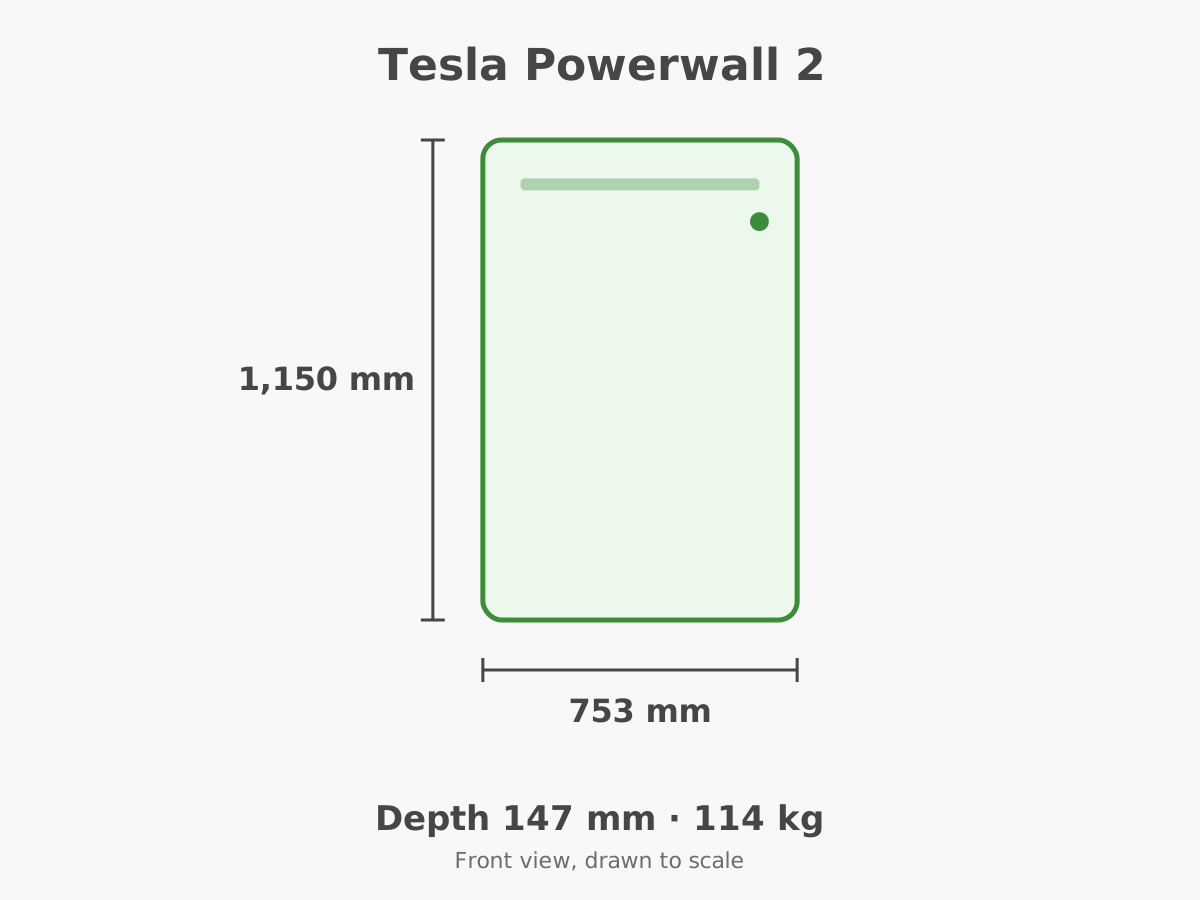 Tesla Powerwall 2 | 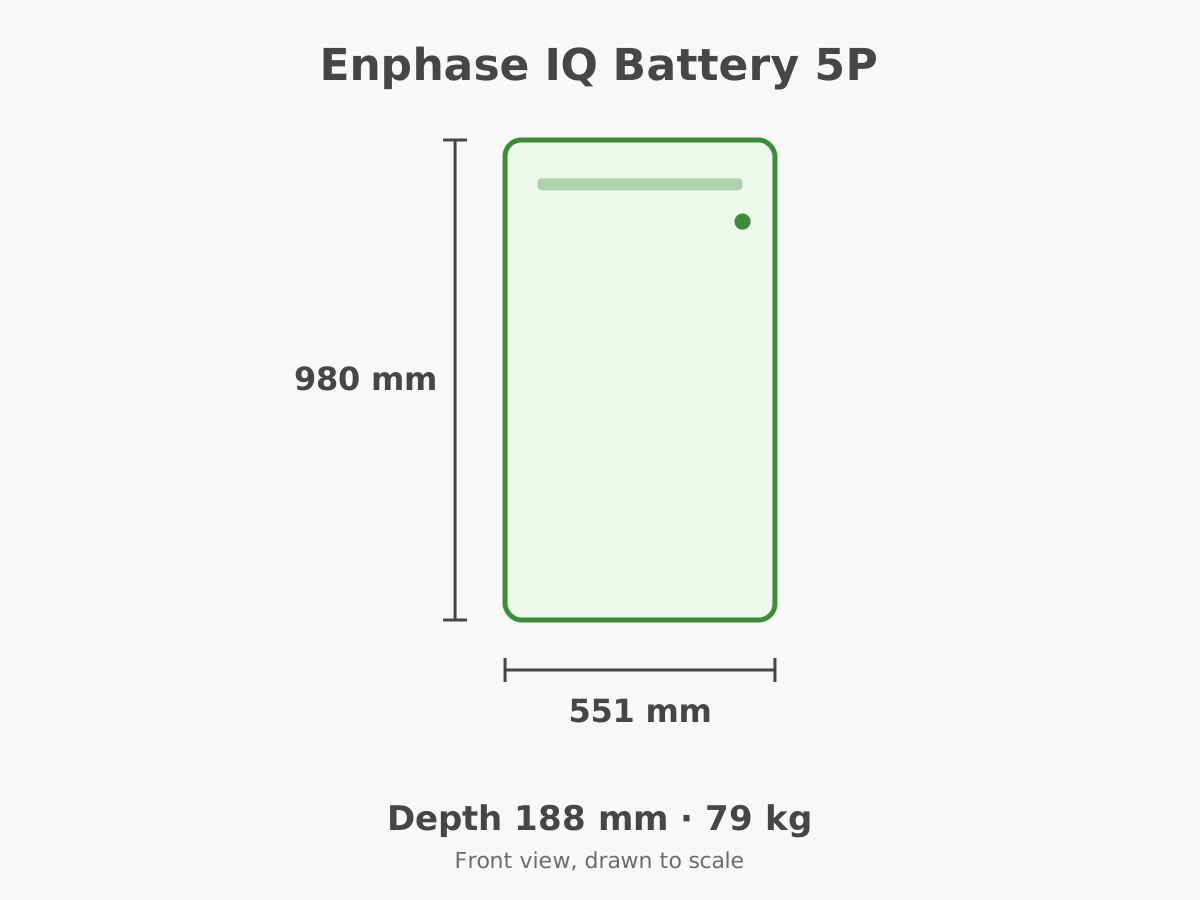 Enphase IQ Battery 5P |
|---|---|---|
| Capacity | 13.5 kWh | 5.0 kWh |
| Expansion | Up to 10 units | Not stated |
| Battery chemistry | Not stated | Not stated |
| Cycle life | Not stated | Not stated |
| AC output (continuous) | 5 kW continuous (on-grid) (better value) | 3.84 kW continuous power rating |
| Peak output | 7 kW peak backup power | 7.68 kW for 3 seconds and 6.14 kW for 10 seconds |
| Round-trip efficiency | Not stated | 96% DC and 90% AC |
| Backup in a power cut | Yes: quick backup transition | Not stated in the specifications |
| Solar input | None built in: AC-coupled, needs a separate solar inverter | None built in: AC-coupled, works with Enphase IQ Series microinverters |
| Works with solar panels | Partly: AC-coupled, relies on a separate solar inverter | Yes: AC-coupled, with Enphase IQ or M Series microinverters |
| Off-grid use | Partly: backup in a power cut, no stand-alone system described | Yes: 240 VAC output in grid-tied and backup/off-grid operation (not at 208 VAC single-phase) |
| Dimensions | 1,150 × 753 × 147 mm (H × W × D) | About 188 × 551 × 980 mm (D × W × H, converted from inches) |
| Weight | 114 kg | 79 kg (174 lb) (better value) |
| Protection rating | Water and dust resistance, no IP class stated | Not stated |
| Operating temperature | -20 to 50 °C | Not stated |
| Warranty | 10 years | Not stated |
Green cells mark the clearly better value where a higher or lower number is better. Capacity is never marked, because more is not automatically better. Level rows and rows without a clear direction are not marked. Differences smaller than about a tenth are not marked.
Our read
The Powerwall 2 has the higher continuous power rating (5 kW against 3.84 kW) and holds far more (13.5 kWh against 5.0 kWh); the IQ Battery 5P is lighter (79 kg against 114 kg) but is also much smaller, so the weight row says little about weight per unit of storage. The 5P states a round-trip efficiency (96% DC, 90% AC) and a 7.68 kW peak for 3 seconds; Tesla's UK page gives no efficiency, chemistry or cycle figure for the Powerwall 2. Enphase's page gives no warranty and no operating temperature for the 5P, where Tesla states 10 years and -20 to 50 °C. The off-grid rows disagree in tone: the 5P datasheet says 240 VAC output is supported in backup and off-grid operation, while its specification list does not describe backup, so check with an installer.
Full pages: Tesla Powerwall 2 · Enphase IQ Battery 5P · Compare these two in the tool
Side by side in words
Numbers in a table miss the bigger picture. Here is how the two brands differ on the points that matter when you choose.
| Specification | Tesla | Enphase |
|---|---|---|
| Range and sizes | Our catalogue has the Powerwall 3 (13.5 kWh, expandable) and the Powerwall 2 (13.5 kWh), both wall-mounted units. | Our catalogue has the IQ Battery 10C (10 kWh, from two 5 kWh battery units) and the IQ Battery 5P (5.0 kWh per battery). |
| Solar and coupling | The Powerwall 3 is a hybrid: it has a built-in solar inverter and three MPPT inputs, so panels can connect to it directly. The Powerwall 2 is AC-coupled and works with a separate solar inverter. | Both batteries are AC-coupled and designed to sit alongside Enphase IQ Series microinverters on the panels, with controllers such as the IQ Combiner or IQ System Controller. The 10C also integrates its own microinverters. |
| Power | The Powerwall 3 is configurable from 3.68 kW to 11.04 kW at 230 V (UK/EU datasheet). The Powerwall 2 lists 5 kW continuous and 7 kW peak backup power. | The IQ Battery 10C lists 7.08 kVA continuous. The IQ Battery 5P lists 3.84 kW continuous and 7.68 kW peak for 3 seconds. |
| Warranty | 10 years on both Powerwalls. For the Powerwall 3, Tesla says a reliable internet connection is needed to secure the full warranty. | 15 years, up to 6,000 cycles, for the IQ Battery 10C on Enphase's store page. No warranty is stated on the page we read for the IQ Battery 5P. |
| Published detail | The Powerwall 2 page gives no chemistry, cycle life or efficiency. The Powerwall 3 gives a solar-to-grid efficiency of 97.5% instead of a round-trip figure. | The Enphase pages give round-trip efficiency, but no chemistry, protection rating or operating temperature, and no expansion detail. |
| Where it is sold | Tesla's figures here are for the UK and EU version. Tesla's US page lists different values for the Powerwall 3, such as 11.5 kW and six solar inputs. | The pages we read are the US store pages. We did not find a UK or EU product page for either battery when we checked, so check availability and specifications where you live. |
Which should you choose?
Neither brand is the right answer for everyone. These are the situations where each one fits better, based on the published figures above.
Choose Tesla if
- You want a solar inverter and battery in one box: the Powerwall 3 has a built-in hybrid inverter with three MPPT inputs.
- You want more storage in one unit: the Powerwall 3 and Powerwall 2 each hold 13.5 kWh against 10 kWh and 5.0 kWh for the Enphase batteries.
- You want a lighter unit at the larger size: the Powerwall 3 is 130 kg against about 144 kg for the IQ Battery 10C.
- You want the figures in UK and EU terms: Tesla's pages give 230 V, single-phase UK/EU values, where Enphase's are US store pages.
Choose Enphase if
- You want the longer warranty on paper: Enphase states 15 years, up to 6,000 cycles, for the IQ Battery 10C against 10 years for the Powerwall 3.
- You already have, or plan, Enphase microinverters: both Enphase batteries are designed to work with Enphase IQ Series microinverters.
- You want a published round-trip efficiency: Enphase gives 96% DC and 90% AC for both batteries, where Tesla's UK page does not for the Powerwall 2.
- You want a smaller battery: the IQ Battery 5P holds 5.0 kWh and weighs 79 kg, against 13.5 kWh and 114 kg for the Powerwall 2.
What we could not compare
A comparison is only as good as its data. Here is where the published information ran out, so you know what the tables cannot tell you.
- Several cells show 'Not stated': 3 of 29 on Tesla's side and 10 on Enphase's. That means the maker's page we read gives no figure, not that the product lacks the feature.
- The brands' figures come from different markets. Tesla's are UK and EU values; Enphase's are US store pages, converted from inches and pounds, and the UK or EU versions may differ. We did not find an Enphase UK or EU product page for either battery.
- Tesla's page does not say whether the Powerwall 2 can still be ordered, and Enphase's 10C data sheet could not be read as text, so values only in that data sheet are missing.
- Power cannot be compared directly: the Powerwall 3 is a configurable kW rating, the IQ Battery 10C a kVA rating, and the Powerwall 2 and IQ Battery 5P kW ratings under different conditions (continuous and peak durations differ).
- We did not compare price, installation cost, installer availability, app quality, real-world efficiency or support. These matter and we have not tested them.
Common questions about Tesla vs Enphase
Is Tesla or Enphase better for a home battery?
Neither is better across the board. In our two matched pairs the Powerwall 3 holds more and has a solar inverter built in, while Enphase's 10C states the longer warranty and both Enphase batteries publish a round-trip efficiency. Which fits depends on your solar system, your installer and what is sold where you live.
What is the difference between the Powerwall 3 and the Enphase IQ Battery 10C?
The Powerwall 3 holds 13.5 kWh and has a built-in solar inverter, so panels connect to it directly. The IQ Battery 10C holds 10 kWh, is AC-coupled and works with Enphase microinverters. Tesla states a 10-year warranty with an internet-connection condition; Enphase states 15 years, up to 6,000 cycles.
Does a Powerwall 2 or an Enphase battery need solar panels?
Both are built to work alongside a solar system, and the Powerwall 3 has a solar inverter built in. Whether a battery without solar pays back depends on your tariff: see our guide to home batteries without solar panels.
Are these plug-in batteries?
No. All four are installed home batteries that need a qualified electrician, and in many countries you must tell your grid operator. Rules differ by country: see our country guides.
Can I buy the Enphase IQ Battery 10C or 5P in the UK?
We could only read Enphase's US store pages for these batteries and did not find a UK or EU product page when we checked, so we cannot say. Ask an Enphase installer in your country which version is sold.
Why only two pairs?
Our catalogue holds two Tesla and two Enphase batteries, so we matched each Tesla product to the closest Enphase one. If you would like a different pairing, build your own with Compare For Yourself.
Related guides
Want to size a battery for your own home?
Our calculator uses your own usage and tariff to estimate what a home battery could save, with conservative assumptions.