
EcoFlow vs BLUETTI
Two of the biggest names in portable power stations, compared in five matched pairs from small to home backup, using only figures the makers publish.
- 5 matched pairs
- Maker data only
- Checked 12 Nov 2026

- We matched five EcoFlow and BLUETTI power stations by capacity, from about 250 Wh up to home backup, and compared them using only figures the makers publish.
- In the 24 rows where a higher or lower number is clearly better, EcoFlow leads in 8 and BLUETTI in 13; 3 are level.
- BLUETTI's published solar input is higher in most pairs, and its pages state a warranty for every model in the pairs. EcoFlow's units are lighter in 3 of the 4 pairs where both weights are published.
- Neither brand wins everywhere, so the better pick depends on the size you need, how much you carry it and how much solar you plan to feed it.
- We have not tested any of these units. Where a maker does not publish a figure, we say so instead of guessing.
Not tested by us, and no prices
Every figure on this page comes from EcoFlow's and BLUETTI's own product pages, manuals and datasheets, last checked on 12 November 2026. We have not tested these units, so we do not score them or crown a winner on feel, noise in daily use or app quality. We show no prices because they change often and differ between sellers: compare the same model and bundle before you buy.
The short answer
There is no overall winner, and anyone who names one without testing both brands side by side is guessing. What the published specifications do show is a pattern, and it is a useful one.
Across the five pairs, 13 of the 24 clear-cut rows go to BLUETTI and 8 to EcoFlow. BLUETTI's pages give more solar input in most pairs, rate the largest unit for more charge cycles, and state a warranty for every model we paired. EcoFlow's units are lighter in 3 of the 4 pairs where both weights are published, and in the largest pair it offers more capacity in the box, higher mains charging and a faster stated switchover.
Do not read the row count as a score. A row about solar input matters a lot if you plan to charge from panels and not at all if you charge from the mains. Use the pair tables below for the size you need, then check Which should you choose?
How we matched the models
We paired models by capacity, because that is how people shop: they pick a size, then compare brands. Each pair is the closest match in our catalogue, not a statement that the two products are the same price or the same age. Where one brand has no model at a given size, the pair is the nearest fit and the text says so.
| Specification | EcoFlow | BLUETTI |
|---|---|---|
| The small, light pair (about 250 to 290 Wh) | EcoFlow RIVER 3 | BLUETTI Elite 30 V2 |
| The like-for-like pair (768 Wh each) | EcoFlow RIVER 2 Pro | BLUETTI AC70 |
| The one-kilowatt-hour pair (about 1,000 to 1,150 Wh) | EcoFlow DELTA 2 | BLUETTI AC180 |
| The 2 kWh pair (2,048 Wh each) | EcoFlow DELTA 2 Max | BLUETTI AC200L |
| The home backup pair (expandable systems) | EcoFlow DELTA Pro 3 | BLUETTI Apex 300 |
EcoFlow and BLUETTI at brand level
Before the model pairs, here is how the two companies differ. See our full brand guides to EcoFlow and BLUETTI.
| Specification | EcoFlow | BLUETTI |
|---|---|---|
| Models in our catalogue | 20 | 10 |
| Founded | 2017, Shenzhen | 2009, Shenzhen |
| Where it started | RIVER portable power station, launched through crowdfunding; DELTA range followed in 2019 | Portable power stations for camping, vans and emergency backup |
| Fixed home and balcony range | PowerOcean (fixed hybrid home battery) and PowerStream (plug-in microinverter) | Balco 260 and 500 balcony and home storage (launched 2026) and the EP900 home system |
| Warranty on the fixed home range | 15 years on PowerOcean battery packs, per EcoFlow's datasheet | 10 years on Balco and EP900 |
| Cell chemistry | LFP (lithium iron phosphate) across the current range | LFP across almost the entire range |
| Company claims we could not verify | Its 2025 claim to be the largest portable power station brand | More than 4 million users in over 110 countries and more than 1,400 patents |
EcoFlow RIVER 3 vs BLUETTI Elite 30 V2
Both units are small enough to carry in one hand and are aimed at phones, laptops and short backup rather than appliances. EcoFlow describes the RIVER 3 as best for light, quiet backup; BLUETTI positions the Elite 30 V2 for laptops and camping.
The small, light pair (about 250 to 290 Wh)
| Specification | 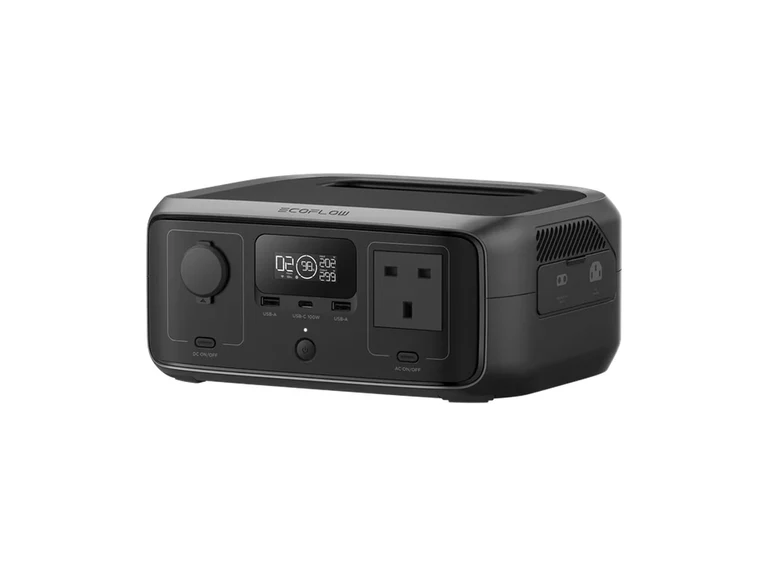 EcoFlow RIVER 3 |  BLUETTI Elite 30 V2 |
|---|---|---|
| Capacity | 245 Wh | 288 Wh |
| AC output (continuous) | 300 W, 1 outlet | 600 W (better value) |
| AC output (surge) | 600 W | 1,500 W (better value) |
| AC charging | 305 W | 980 W (better value) |
| Mains charging time | 0-100% in 60 minutes | 70 minutes; 80% in 45 minutes with TurboBoost |
| Solar input | 110 W max | 200 W (better value) |
| Weight | 3.55 kg (better value) | 4.3 kg |
| Backup switchover (EPS) | Under 20 ms (under 10 ms on the UPS version) | 10 ms or less |
| Noise level | Below 30 dB at 0.5 m | Below 30 dB under light loads |
| Expansion | Not stated for this model | Not supported |
| Warranty | Not stated | 5 years |
Green cells mark the clearly better value where a higher or lower number is better. Capacity is never marked, because more is not automatically better. Level rows and rows without a clear direction are not marked.
Our read
On paper the Elite 30 V2 gives more of almost everything: 600 W of output against 300 W, 980 W of mains charging against 305 W and 200 W of solar input against 110 W. The price of that is a little more weight, 4.3 kg against 3.55 kg. BLUETTI states a 5-year warranty; the EcoFlow page text we read does not state one for the RIVER 3, so check the seller's listing. Neither can be expanded: BLUETTI says so for the Elite 30 V2, and EcoFlow does not state expansion for the RIVER 3 (its RIVER 3 Plus is a different model that does expand).
Full pages: EcoFlow RIVER 3 · BLUETTI Elite 30 V2 · Compare these two in the tool
EcoFlow RIVER 2 Pro vs BLUETTI AC70
Both hold exactly 768 Wh, so this is the cleanest comparison on the page: the same amount of stored energy, from two different design choices.
The like-for-like pair (768 Wh each)
| Specification | 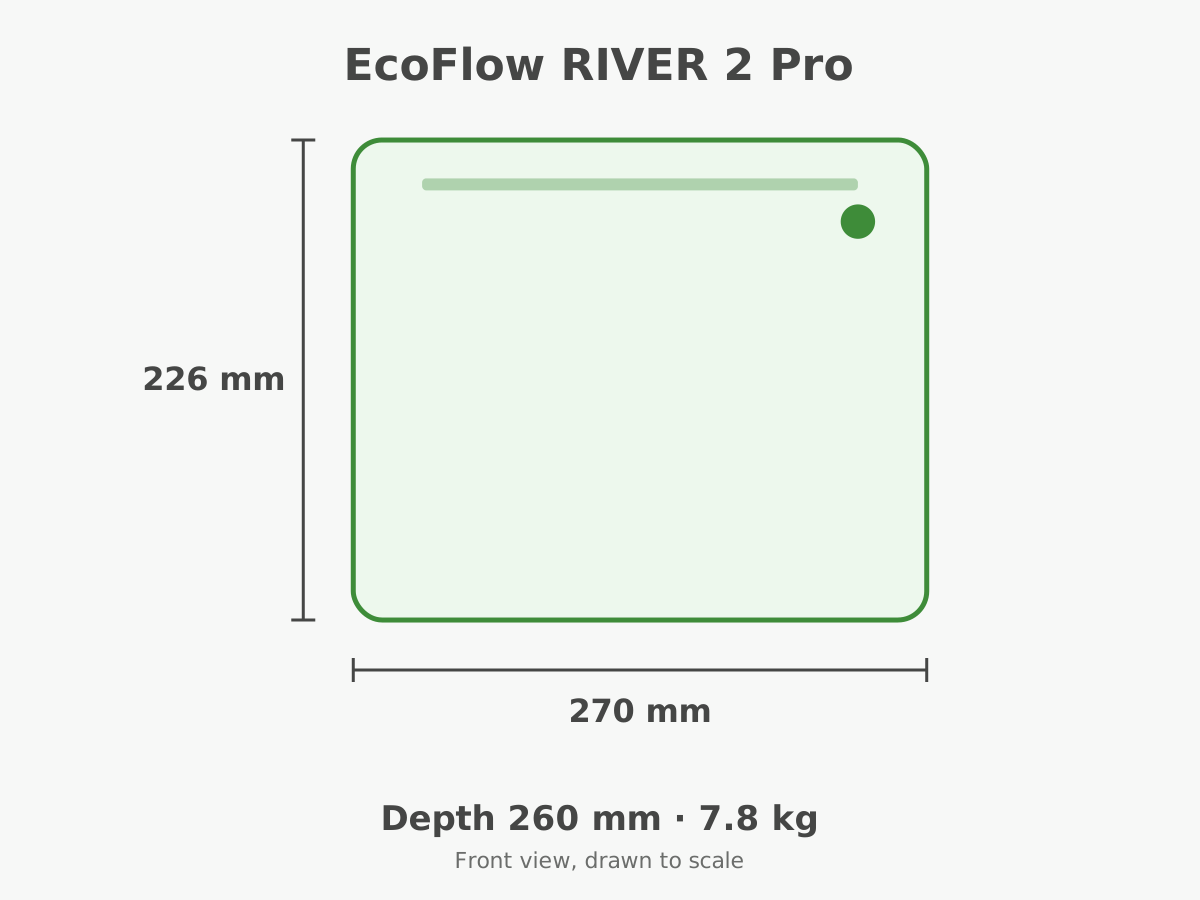 EcoFlow RIVER 2 Pro |  BLUETTI AC70 |
|---|---|---|
| Capacity | 768 Wh | 768 Wh |
| AC output (continuous) | 800 W | 1,000 W (better value) |
| AC output (surge) | 1,600 W | Not stated |
| AC charging | 870 W (the charging-time line says 940 W) | 950 W Turbo Charging (better value) |
| Mains charging time | 0-80% in 56 minutes; 0-100% in 70 minutes | 80% in 45 minutes |
| Solar input | 220 W max | 500 W max (better value) |
| Weight | About 7.8 kg | Not stated |
| Backup switchover (EPS) | No time stated ('AC Always-On' mode) | 20 ms |
| Noise level | Up to 62 dB at high wattage | Not stated |
| Expansion | Not stated | B80 (806 Wh), B230 (2,048 Wh), B300 (3,072 Wh) |
| Warranty | Not stated | 5 years |
Green cells mark the clearly better value where a higher or lower number is better. Capacity is never marked, because more is not automatically better. Level rows and rows without a clear direction are not marked.
Our read
At identical capacity the AC70 leads on the numbers both makers publish: 1,000 W against 800 W of output, 500 W against 220 W of solar input, slightly higher mains charging and a stated 5-year warranty, plus a choice of expansion batteries. The RIVER 2 Pro publishes a weight of about 7.8 kg; BLUETTI's page text gives none for the AC70, so we cannot say which is lighter. BLUETTI does not state a surge rating for the AC70, and EcoFlow gives no switchover time for the RIVER 2 Pro beyond describing an 'AC Always-On' mode.
Full pages: EcoFlow RIVER 2 Pro · BLUETTI AC70 · Compare these two in the tool
EcoFlow DELTA 2 vs BLUETTI AC180
The classic 1 kWh match-up: the same 1,800 W of continuous output, the same 5-year warranty and a similar size. The differences are in the details.
The one-kilowatt-hour pair (about 1,000 to 1,150 Wh)
| Specification | 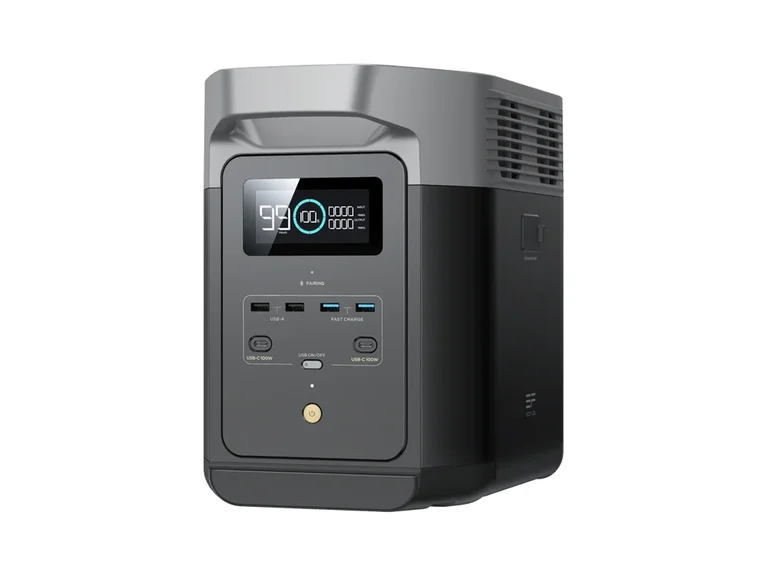 EcoFlow DELTA 2 | 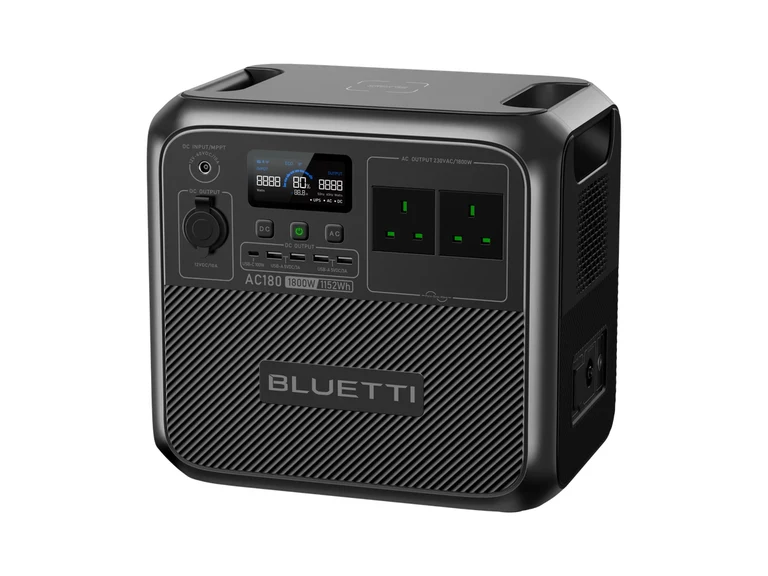 BLUETTI AC180 |
|---|---|---|
| Capacity | 1,024 Wh | 1,152 Wh |
| AC output (continuous) | 1,800 W, 4 outlets | 1,800 W, 2 outlets |
| Surge or boost | 2,700 W surge | 2,700 W in Power Lifting Mode (heating devices) |
| AC charging | 1,200 W | 1,440 W (better value) |
| Mains charging time | 0-80% in 50 minutes; 0-100% in 80 minutes | 0-80% in 45 minutes |
| Solar input | 500 W max | 500 W max |
| Cycle life | 3,000 cycles to 80+% | 3,500+ cycles to 80% (better value) |
| Weight | 12 kg (better value) | About 16 kg |
| Backup switchover (EPS) | Within 30 ms | Not published by BLUETTI |
| Expansion | 2,048 Wh with a DELTA 2 extra battery; 3,040 Wh with a DELTA Max extra battery | Sold with a B80 battery (1,958 Wh in total) |
| Warranty | 5 years | 5 years |
Green cells mark the clearly better value where a higher or lower number is better. Capacity is never marked, because more is not automatically better. Level rows and rows without a clear direction are not marked.
Our read
A close match. The AC180 has more capacity (1,152 Wh against 1,024 Wh), faster mains charging and a higher cycle rating. The DELTA 2 is the lighter unit at 12 kg against about 16 kg, has four AC outlets against two, and publishes a 30 ms switchover where BLUETTI's page gives none. The two boost figures are not the same thing: EcoFlow's 2,700 W is a surge rating, while BLUETTI's 2,700 W is a Power Lifting Mode meant for heating devices such as space heaters, so check the label of the device you want to run.
Full pages: EcoFlow DELTA 2 · BLUETTI AC180 · Compare these two in the tool
EcoFlow DELTA 2 Max vs BLUETTI AC200L
Identical capacity and identical continuous output. This pair is about the details: surge, solar, weight and what each maker states.
The 2 kWh pair (2,048 Wh each)
| Specification | 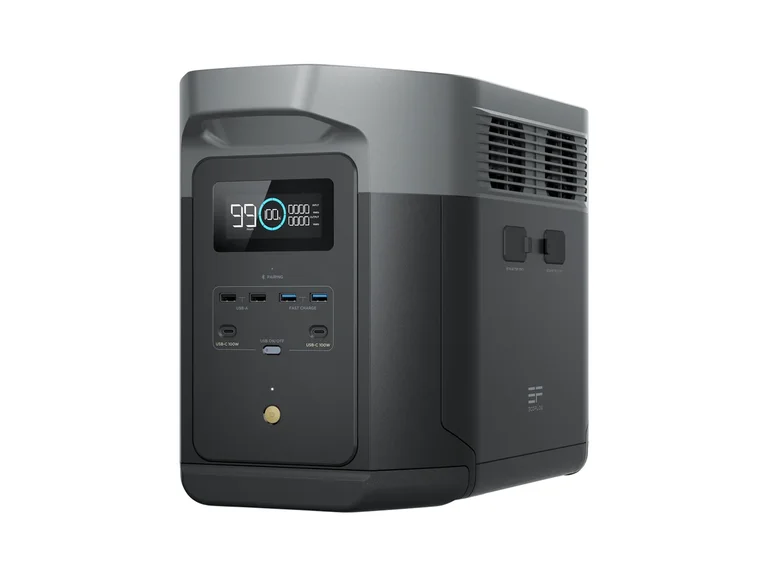 EcoFlow DELTA 2 Max | 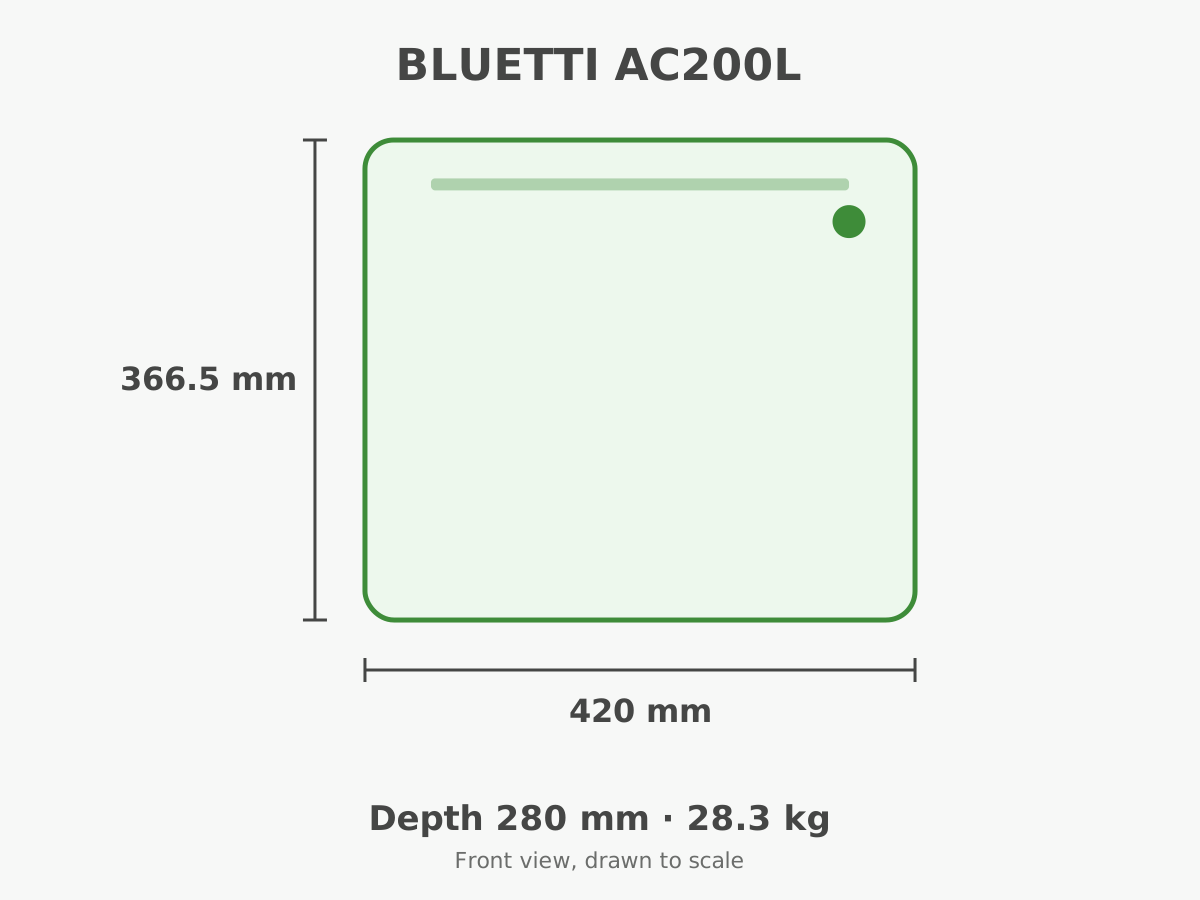 BLUETTI AC200L |
|---|---|---|
| Capacity | 2,048 Wh | 2,048 Wh |
| AC output (continuous) | 2,400 W, 4 outlets | 2,400 W |
| AC output (surge) | 4,800 W (better value) | 3,600 W |
| AC charging | 2,300 W (X-Stream) | 2,400 W max (better value) |
| Mains charging time | 80% in 53 minutes | 1.5 hours; 80% in 45 minutes |
| Solar input | 500 W on one port, 1,000 W on two ports | 1,200 W max (better value) |
| Cycle life | 3,000 cycles to over 80% | 3,000+ cycles to 80% |
| Weight | 23 kg (better value) | 28.3 kg |
| Backup switchover (EPS) | No time stated ('AC Always On' mode) | 20 ms or less |
| Noise level | 30 dB at low input and 500 W output | 50 dB maximum |
| Expansion | Up to two Smart Extra Batteries, 6,144 Wh in total | Up to two B210 or two B300, or one B230 |
| Warranty | 5 years | 5 years |
Green cells mark the clearly better value where a higher or lower number is better. Capacity is never marked, because more is not automatically better. Level rows and rows without a clear direction are not marked.
Our read
EcoFlow gives higher surge (4,800 W against 3,600 W) and is about 5 kg lighter. BLUETTI gives more solar input (1,200 W against 1,000 W when EcoFlow's two ports are both used) and a stated 20 ms switchover where EcoFlow gives no time. Mains charging is nearly the same. The noise figures are measured differently (30 dB at 500 W against a 50 dB maximum), so do not set them against each other. The AC200L figures come from BLUETTI's manual and differ between the European and US versions, so check which version is sold where you live.
Full pages: EcoFlow DELTA 2 Max · BLUETTI AC200L · Compare these two in the tool
EcoFlow DELTA Pro 3 vs BLUETTI Apex 300
These are the largest units in each brand's portable range and both are pitched at home backup. They are built differently: EcoFlow puts more energy in one box, while BLUETTI sells a smaller, modular base unit that you add batteries to.
The home backup pair (expandable systems)
| Specification | 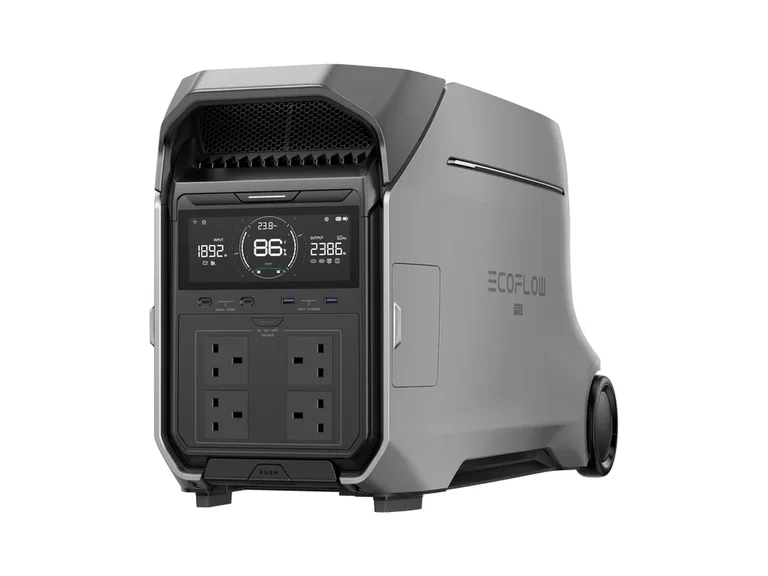 EcoFlow DELTA Pro 3 |  BLUETTI Apex 300 |
|---|---|---|
| Capacity | 4,096 Wh | 2,764.8 Wh (base unit) |
| AC output (continuous) | 4,000 W max, 5 outlets (better value) | 3,840 W |
| Surge or boost | 8,000 W surge | 7,680 W lifting power |
| AC charging | 2,900 W max (better value) | 2,300 W standard; 3,840 W with the Hub A1 |
| Mains charging time | 0-80% in one hour | 80% in 45 minutes with the Hub A1 (15-25 °C) |
| Solar input | 2,600 W across two ports (better value) | 2 × 1,200 W |
| Cycle life | 4,000 cycles to 80% | 6,000+ cycles to 80% (better value) |
| Weight | 51.5 kg | About 38 kg (better value) |
| Backup switchover (EPS) | 10 ms (better value) | 20 ms |
| Protection rating | IP65 battery pack; IP20 main unit | IP20 |
| Expansion | Up to two Smart Extra Batteries (4,096 Wh each), up to 12 kWh | Up to 6 × B300K, B300S or B300 per unit |
| Warranty | 5 years | 5 years |
Green cells mark the clearly better value where a higher or lower number is better. Capacity is never marked, because more is not automatically better. Level rows and rows without a clear direction are not marked.
Our read
EcoFlow offers more capacity in the box (4,096 Wh against 2,764.8 Wh), slightly more output, higher standard mains charging and a faster switchover (10 ms against 20 ms). BLUETTI rates its cycles higher (6,000+ against 4,000), and its base unit is lighter at about 38 kg against 51.5 kg, although you need to add batteries to match EcoFlow's capacity. BLUETTI's 3,840 W fast charge needs its optional Hub A1; EcoFlow's 2,900 W does not. Both are portable power stations, not fixed home batteries: feeding house circuits from either is electrical work for a qualified electrician.
Full pages: EcoFlow DELTA Pro 3 · BLUETTI Apex 300 · Compare these two in the tool
Side by side in words
Numbers in a table miss the bigger picture. Here is how the two brands differ on the points that matter when you choose.
| Specification | EcoFlow | BLUETTI |
|---|---|---|
| Range and sizes | RIVER models start around 245 Wh. DELTA models run up to 4,096 Wh in the DELTA Pro 3, with extra batteries for the larger ones. A separate fixed home range (PowerOcean, PowerStream) sits alongside. | The range starts around 268 Wh with the EB3A and runs through the Elite and AC lines to the modular Apex 300, which takes up to six B300-series batteries per unit. A separate balcony and home range (Balco, EP900) sits alongside. |
| Warranty | 5 years on the DELTA 2, DELTA 2 Max, DELTA 3 Plus, DELTA Pro 3, RIVER 2 and RIVER 2 Max; 3+2 years on the DELTA 3 Classic. The page text we read gives no warranty length for the RIVER 3, RIVER 2 Pro or DELTA Pro. | 5 years on the Elite 30 V2, AC70, AC180, AC200L, Elite 200 V2, Apex 300 and Elite 400; 4 years on the AC300; 2 years on the EB3A. The Elite 100 V2 page lists a 'Global Warranty' without a length. |
| Fast charging | EcoFlow calls its fast mains charging X-Stream. The DELTA 2 Max charges at 2,300 W and reaches 80% in 53 minutes; the DELTA Pro 3 charges at up to 2,900 W and reaches 80% in one hour. | BLUETTI calls it TurboBoost or Turbo mode. The Elite 200 V2 charges at 2,300 W and reaches 80% in about 1.1 hours; the AC180 and AC70 each quote 80% in 45 minutes. These are the makers' own test figures. |
| Solar input | From 110 W on the RIVER 3 to 500 W on the DELTA 2, 1,000 W on the DELTA 2 Max (two ports) and 2,600 W on the DELTA Pro 3 (two ports). | From 200 W on the Elite 30 V2 and EB3A to 500 W on the AC70 and AC180, 1,000 W on the Elite 100 V2 and Elite 200 V2, 1,200 W on the AC200L and 2 × 1,200 W on the Apex 300. |
| Surge and boost modes | EcoFlow publishes surge ratings: 600 W on the RIVER 3, 2,700 W on the DELTA 2, 4,800 W on the DELTA 2 Max and 8,000 W on the DELTA Pro 3. | BLUETTI describes a Power Lifting Mode for resistive heating devices: 1,500 W on the Elite 30 V2, 2,000 W on the AC70, 2,700 W on the AC180 and Elite 100 V2, 3,900 W on the Elite 200 V2 and 7,680 W on the Apex 300. It is a mode for some devices, not a general surge rating. |
| App and smart home | The EcoFlow app over Wi-Fi and Bluetooth. The DELTA 3 Plus adds time-of-use and storm-warning features, and EcoFlow lists extra batteries and its Wave portable air conditioner in the same ecosystem. | The BLUETTI app over Wi-Fi and Bluetooth for remote control and monitoring. BLUETTI says its ecosystem also connects with Google Home, Amazon Alexa and Home Assistant. |
| Beyond power stations | PowerOcean is a professionally installed whole-home battery system; PowerStream is a plug-in microinverter rated up to 800 W in the UK, for balcony solar. | The Balco range targets apartments and small homes, but at launch it was sold only in the Netherlands, Germany and France. The EP900 is a larger home system. |
Which should you choose?
Neither brand is the right answer for everyone. These are the situations where each one fits better, based on the published figures above.
Choose EcoFlow if
- You want the lighter unit at a given size: in the pairs where both weights are published, EcoFlow is lighter in 3 of 4.
- You want more energy in one box for home backup: the DELTA Pro 3 holds 4,096 Wh against 2,764.8 Wh for the Apex 300 base unit.
- You care about high surge ratings or a faster stated switchover on the largest units (DELTA 2 Max surge, DELTA Pro 3 at 10 ms).
- You may later want EcoFlow's fixed home range (PowerOcean) or its plug-in microinverter in the same app.
Choose BLUETTI if
- You plan to charge from solar: BLUETTI's published solar input is higher in three of the five pairs and level in one.
- You want a warranty length stated on the product pages: BLUETTI states one for every model in the pairs, while EcoFlow's page text we read is silent for two.
- You want the highest cycle rating at the top end: the Apex 300 is rated 6,000+ cycles against 4,000 for the DELTA Pro 3.
- You want a modular base unit that you add batteries to over time, or a Power Lifting Mode for heating devices.
What we could not compare
A comparison is only as good as its data. Here is where the published information ran out, so you know what the tables cannot tell you.
- Several cells show 'Not stated': 6 of 57 on EcoFlow's side and 4 on BLUETTI's. That means the maker's page text we read gives no figure, not that the product lacks the feature.
- Warranty is the biggest gap for EcoFlow: the page text we read gives no length for the RIVER 3 and RIVER 2 Pro. Check the seller's listing, which may state it.
- The AC200L figures come from BLUETTI's manual and differ between regional versions. Check which version is sold where you live.
- Noise, surge and switchover figures use different test conditions from maker to maker, so we show them but do not rank them unless both makers measured the same way.
- We did not compare price, real-world run time, noise in daily use, app quality or after-sales support. These matter and we have not tested them.
Common questions about EcoFlow vs BLUETTI
Is EcoFlow or BLUETTI better?
Neither is better across the board. In our five matched pairs BLUETTI's published solar input is higher in most pairs and its pages state a warranty for every model, while EcoFlow's units are lighter in most pairs and it offers more capacity in the single largest unit. Pick by the size you need and what you will use it for, not by brand.
Which brand has the longer warranty?
Where both state one, the two are level at 5 years on the models in our pairs. BLUETTI states a warranty for all five models we paired. For EcoFlow, the page text we read states one for three of the five (DELTA 2, DELTA 2 Max, DELTA Pro 3) but not for the RIVER 3 or RIVER 2 Pro, so check the seller's listing.
Which charges faster from the mains?
In four of the five pairs BLUETTI's published mains charging power is higher, although in the RIVER 2 Pro and AC70 pair the difference is small. EcoFlow's is higher in the largest pair, where BLUETTI's higher 3,840 W figure needs its optional Hub A1. These are the makers' own figures under their own test conditions.
Can an EcoFlow or BLUETTI power station run my whole home?
Both brands pitch their largest units, the DELTA Pro 3 and the Apex 300, for home backup, but they are portable power stations, not fixed home batteries. Connecting either to house circuits is electrical work for a qualified electrician, and the rules differ by country: see our country guides.
Are these plug-in batteries?
No. A power station is a box you plug devices into. A plug-in battery connects to your home circuits through a socket and works with solar panels. In Great Britain, plug-in batteries were excluded from the August 2026 plug-in solar rules. See our guide to plug-in and installed home batteries.
Why these five pairs?
We matched each EcoFlow model to the closest BLUETTI model in capacity from the models in our catalogue, because people shop by size first. If you would like a different pairing, build your own with Compare For Yourself.
Related guides
Want to size a battery for your own home?
Our calculator uses your own usage and tariff to estimate what a home battery could save, with conservative assumptions.