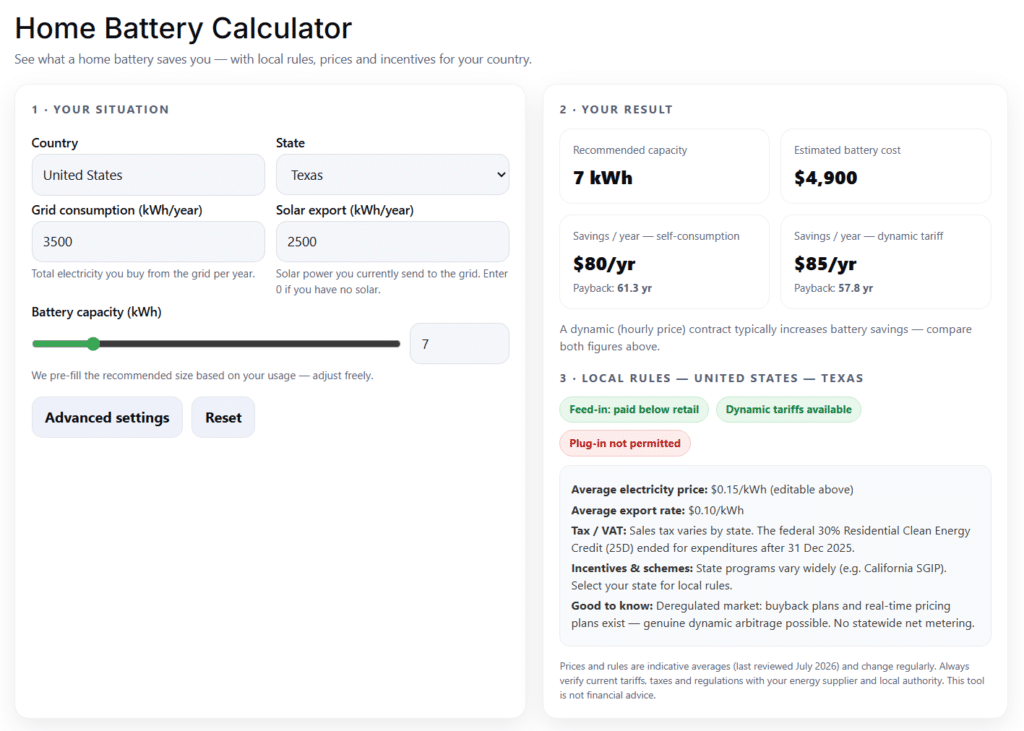
One of the most important factors to consider when comparing home batteries is storage capacity. Should you choose a 5 kWh, 10 kWh, or 15 kWh battery? And would a 20 kWh home battery be a sensible option if you plan to install a heat pump or EV charger in the coming months?
In this guide, HomeBattery.com answers these questions and helps you determine the right battery size for your home. Follow our practical step-by-step approach to calculate the ideal home battery capacity based on your household’s energy consumption, solar production, and future energy needs.
Choosing your battery is important, it needs to be based on your energyconsumption and Solar energy output. But whats even more important is choosing the right battery brand and platform that can scale with you, when you need it. It’s important to think about this before you chooche a home battery brand and product.

Battery capacity is the amount of energy a battery can store. It is usually measured in watt-hours (Wh) or kilowatt-hours (kWh). The higher the capacity, the more energy the battery can hold.
Capacity does not tell you how quickly the battery can charge or discharge. Charging and discharging power are measured in watts (W) or kilowatts (kW). This power is controlled by the inverter, which manages how much electricity can flow into and out of the battery.
A swimming pool is a useful comparison. Imagine a pool that can hold 100,000 litres, or about 25,000 gallons. This total volume represents the battery’s capacity in kWh. Now imagine that the pool’s filtration system can process 5,000 litres, or about 1,250 gallons, per hour. The filtration rate represents the inverter’s power in kW.
In simple terms, battery capacity tells you how much energy can be stored, while inverter power tells you how quickly that energy can enter or leave the battery.


There are a lot of ways how you can explain capacity for example 12V car battery’s shows it in Ah, most home battery’s show it in kWh and your phone storage is explained in mAh. Al these different terms make it a lot more complicated. And to be honest it is not needed. You can only have kWh and that will be fine. I will show you some examples in the gaphic below.
To calculate watt-hours (Wh), simply multiply the voltage (V) by the ampere-hours (Ah).
| What? | Voltage | Ah | mAh | kWh |
| Iphone battery 17 | 3,9V | 3,692 | 3692 | 0,014 |
| 12V car battery | 12V | 60 | 6000 | 0,72 |
| Homebattery | 40V | 125 | 125000 | 5 |
As you can see with only Ah or mAh you cant really know anything of how big the capacity of a battery is. Because if the voltage is only 2V it is totally different capacity than from a 400V Battery. Thats why Wh is the most accurate. Sometimes you see kWh, instead of Wh. one kWh is 1000 Wh, this makes it easyer for brands, installers or webshops to show the capacity so instead of 66.000 Wh they show 66 kWh.
The most used capacity for a homebattery is around 20 kWh for a plug in battery you see 5 or 10 kWh. The biggest home battery’s on the market can be as big as 60 kWh or even bigger, these systems are for houses with huge demands.
Most battery systems that are currently sold and that we advise are easily increased with extra battery units. So you can smart smaller but can evantually scale up. For example an Indevolt Powerflex system can start from a 2 kWh battery but can scale to 66 kWh falling in the range of 99% of all household needs.
Choosing the right battery capacity is important. If the battery is too small, you will still need to purchase a significant amount of electricity from the grid, which increases your energy costs. If the battery is too large, it may rarely become fully charged or may never discharge below 50%. Both situations are possible, depending on your solar generation and household energy consumption.
The basic function of a smart home battery is to increase self-consumption. This means that the battery charges when your solar panels produce more electricity than your household needs. When your solar panels are not producing enough electricity, the battery supplies stored energy to your home.
A battery that is too small will become fully charged very quickly. When there is little or no solar generation, it will also run out of stored energy quickly. As a result, more electricity must be purchased from the grid.
Choosing a smaller battery can still make sense because smaller systems are generally more affordable. You may also have a limited budget when making the initial investment. With a suitable modular battery system, this is not necessarily a major problem, as you can increase the storage capacity later by adding another battery module.
A battery that is too large may not discharge fully because your household does not consume enough electricity. This is usually not a major technical problem, but it can be a financial one. You may have invested more money than necessary, which can reduce your return on investment.
Additional battery modules may also consume a small amount of energy for monitoring, temperature control, and other internal systems. Although this consumption is usually limited, it can still slightly increase your overall energy losses.
A battery can also be too large in relation to the output of your solar panels. In this case, there may not be enough excess solar energy available to charge the battery fully.
It is also important to consider seasonal differences. In most parts of the world, solar panels produce significantly less electricity during winter than during summer. A battery that is regularly fully charged in summer may remain only partially charged during winter.
The ideal battery capacity should therefore be based on your household’s annual electricity consumption, solar generation, daily energy profile, and future energy needs.

| Annual Electricity Consumption | Household Situation | Recommended Battery Capacity |
|---|---|---|
| Less than 2,000 kWh | Single/two-person household or small apartment | 3–5 kWh |
| 2,000–4,000 kWh | Family without an EV or heat pump | 5–10 kWh |
| 4,000–6,000 kWh | Family with an EV or heat pump | 10–15 kWh |
| More than 6,000 kWh | Large family with an EV and heat pump | 15–25 kWh |
Choosing the right home battery capacity is essential if you want to reduce grid consumption, increase the use of your own solar energy, or keep essential appliances running during a power outage. A battery that is too small may empty quickly, while an oversized system can increase the purchase price without delivering enough additional savings.
The ideal home battery size depends on your daily electricity consumption, solar production, usage pattern, local electricity tariffs and the reason you are buying the battery. The steps below will help you estimate how many kilowatt-hours of battery storage your home needs.
Start by checking how much electricity your household uses in one year. Divide your annual consumption by 365 to calculate your average daily use.
For example:
4,000 kWh per year ÷ 365 days = approximately 11 kWh per day
This figure provides a useful starting point, but average consumption does not show when you use electricity. Two homes may consume the same amount annually while having very different battery requirements.
A household that uses most of its electricity during daylight hours may need less battery storage because solar power is consumed directly. A household that uses more electricity in the evening may benefit from a larger battery that stores excess daytime generation.
Remember to include any recent or planned changes, such as:
These additions can significantly increase your future electricity demand.
The right home battery capacity also depends on your main objective.
Many homeowners use a battery to store excess solar electricity during the day and use it later in the evening or at night.
In this situation, the battery should be large enough to store a meaningful part of your typical daily solar surplus. Your electricity meter, solar inverter or energy-monitoring app can help you determine how much electricity is normally exported to the grid.
In regions with variable electricity prices, a smart home battery can charge when grid electricity is cheaper and discharge when prices are higher.
A larger battery may be useful if you want to combine solar storage with electricity price optimisation. However, the potential savings depend on local tariffs, taxes, grid fees, export payments and the battery’s charging efficiency.
A battery used for backup power should be sized according to the appliances you want to operate and how long they need to run.
Essential loads may include:
Whole-home backup usually requires considerably more battery capacity than keeping only essential appliances running for several hours.
Home batteries are usually advertised using their nominal capacity, but not all of that energy may be available for everyday use.
The usable capacity depends on the battery chemistry, battery management system and permitted depth of discharge. Modern lithium-based batteries often allow a large percentage of their nominal capacity to be used, but the exact figure varies by manufacturer and model.
You can estimate the required nominal capacity with this formula:
Required usable energy ÷ usable capacity percentage = required nominal capacity
For example, suppose you need 9 kWh of usable storage and the battery allows 90% of its nominal capacity to be used:
9 kWh ÷ 0.90 = 10 kWh nominal capacity
Always check the manufacturer’s specifications for:
The following example shows how to estimate the required battery capacity.
Average daily electricity use: 10 kWh
Target stored energy: 70% of daily use
Required usable storage: 7 kWh
Usable battery percentage: 90%
Calculation:
7 kWh ÷ 0.90 = 7.8 kWh
In this example, a battery with approximately 8 kWh of nominal capacity could be a suitable starting point.
This calculation is only an estimate. A professional battery assessment should also consider hourly electricity consumption, seasonal solar production, inverter power, battery efficiency and local electricity prices.
Your solar system must produce enough surplus electricity to charge the battery.
A rough starting point is to consider around 1 to 1.5 kWh of battery capacity for every 1 kWp of installed solar capacity. A 5 kWp solar system could therefore be paired with approximately 5 to 7.5 kWh of battery storage.
This is not a universal rule. The best ratio depends on:
A large battery offers limited value if the solar installation rarely produces enough surplus energy to charge it.
If you already have solar panels, your export data can provide one of the best indicators of the battery capacity you need.
Suppose your system generates 5,000 kWh per year and 60% is exported to the grid. This means approximately 3,000 kWh is available annually for potential storage.
That equals an average of:
3,000 kWh ÷ 365 = approximately 8.2 kWh per day
A battery does not need to store every exported kilowatt-hour. Solar production varies throughout the year, and some days will produce far more energy than others. However, this figure helps show the typical amount of surplus energy that may be available.
When you use electricity is just as important as how much you use.
You may need a smaller battery when:
You may benefit from a larger battery when:
Smart appliances and energy-management systems can sometimes reduce the required battery size by moving electricity consumption to periods of high solar production.
Solar generation can vary significantly between summer and winter. A battery that charges fully almost every day in summer may remain partly empty during winter.
For this reason, sizing a battery based only on peak summer solar production can result in an oversized system. Review at least twelve months of electricity and solar data whenever possible.
In regions with strong seasonal differences, grid charging, variable tariffs or a modular battery system may provide more flexibility.
A modular battery allows you to start with a smaller capacity and add extra battery modules later. This can be useful when:
Before choosing a modular system, confirm that future expansion is supported and check whether additional modules must have the same age, capacity or firmware version.
There is no single battery size that is suitable for every household. The best home battery capacity balances daily electricity use, solar surplus, usable storage, future demand and financial return.
For many homes, the most reliable approach is to use detailed consumption and solar-production data rather than relying only on annual totals. A correctly sized battery should regularly charge and discharge without spending most of its time either completely full or nearly empty.

Battery capacity is one of the most important specifications when comparing home energy storage systems, but it should never be considered in isolation. The right home battery must also match your electrical installation, inverter, solar system, household energy profile and local grid requirements.
Installation method, charging power, smart energy-management features, backup capability and future expandability can all affect how useful the battery will be in practice. A well-sized system should not only store enough energy, but also charge and discharge at the right speed and integrate safely with your home.
The installation method depends on the type of home battery you choose.
Most fixed home batteries are permanently connected to the home’s electrical system. Installation should normally be completed by a qualified electrician or certified battery installer.
A professional installation may include:
Installation rules vary between countries, electricity networks and local authorities. Always check whether the installer and equipment comply with the electrical standards that apply in your region.

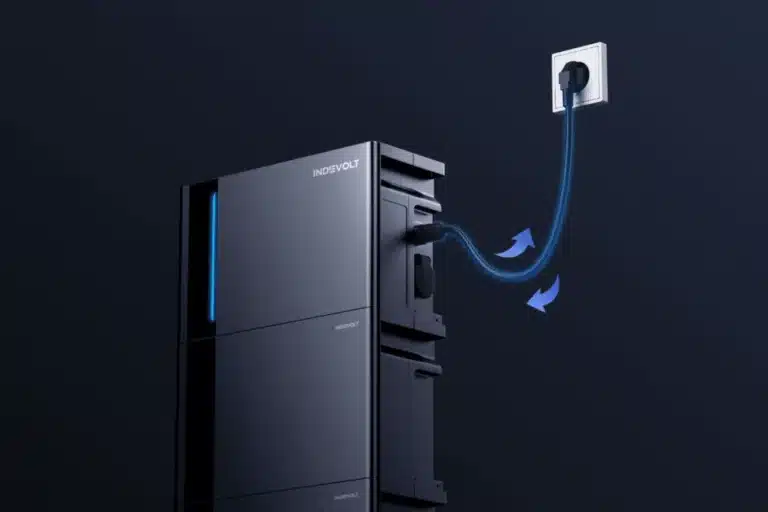
Some markets also offer plug-in batteries that connect through a standard electrical outlet. These systems are generally easier to install and may not require major electrical work.
However, a plug-in battery is not automatically suitable for every home. Before choosing one, check:
Installation convenience can be valuable, but safety, certification and local compliance should remain the priority.
Modern home batteries often include smart software that decides when the battery should charge, discharge or remain idle.
These features can improve battery performance and reduce electricity costs.
The battery stores surplus solar energy instead of exporting it immediately. That stored energy can then be used later in the day when solar production is lower.
In regions with variable electricity prices, the battery may charge when electricity is cheaper and discharge when prices are higher.
The potential benefit depends on:


Not every home battery can supply electricity during a grid outage. Some systems automatically shut down when the grid fails unless they include a dedicated backup function.
When comparing backup batteries, check:
A smaller battery may be sufficient for essential loads such as refrigeration, lighting, internet equipment and phone charging. Whole-home backup usually requires more capacity and significantly more inverter power.
Choosing the right home battery involves more than selecting a capacity in kWh. The system must also match your home’s electrical connection, inverter, solar installation and energy usage. Important factors include installation requirements, charging and discharging power, backup functionality, efficiency, smart energy management and compatibility with devices such as EV chargers and heat pumps. Local regulations, grid requirements and product certifications should also be checked before installation.
It is also important to consider long-term value. Compare the battery’s warranty, expected lifespan, standby consumption, monitoring features and total installed cost. A modular battery can be useful if you expect your energy needs to increase, but future expansion depends on inverter limits, module compatibility and manufacturer rules. The best home battery is therefore not simply the largest one, but the system that offers the right balance of capacity, power, flexibility and financial return.

At HomeBattery.com, we are here to guide people through the changing world of energy storage. Whether someone is just starting to learn about home batteries or is already comparing different solutions, we want to provide the information and insights they need to move forward with confidence.