
DJI Power 1000
A 1,024 Wh LFP portable power station with 2,200 W of stable output, 4,400 W peak, two 140 W USB-C ports and SDC ports for DJI drone charging.
- Best for high-power tools
- Power station
- 1,024 Wh
- 2,200 W
- Made by DJI.
- Capacity: 1,024 Wh with LFP cells that keep over 70% capacity after 4,000 cycles.
- Output: 2,200 W stable, 2,600 W for 30 to 60 seconds and 4,400 W peak, across 2 AC outlets.
- Charges from the mains at up to 1,200 W (80% in 50 minutes) and takes up to 58.4 V at 60 A on the SDC port.
- Weighs about 13 kg. DJI offers up to 5 years of warranty when bought from the DJI Store.
Not tested by us
We have not tested the DJI Power 1000. The figures on this page come from the sources listed at the end of the page, checked on 11 November 2026, and we do not show prices. "Best for" is based on what the maker says the product is designed for, not on our own tests.
Key figures
1,024 Wh
Capacity
2,200 W
Stable AC output
50 min
0-80% charge from the mains
Specifications
Last checked on 11 November 2026. The grey text under each name explains what the value means.
| Specification | Value |
|---|---|
| Storage | |
| CapacityHow much energy the battery stores. Bigger means longer runtime or more of your own solar power used later. | 1,024 Wh |
| Battery chemistryLFP (lithium iron phosphate) cells are known for long life and stable behaviour with heat. | LFP (lithium iron phosphate) |
| Cycle lifeHow many full charge and discharge cycles the cells are rated for before they hold less than the stated share of their original capacity. | Over 70% capacity after 4,000 cycles (DJI lab test at 25 °C, 1,000 W discharge) |
| ExpansionExtra battery units that add storage to the same system. | Not stated for batteries. DJI lists SDC and SDC Lite ports for accessories |
| Output | |
| AC output (continuous)The power it can deliver all the time. Add up the watts of what you want to run at once and stay below this. | 2,200 W at 220-240 V, 50/60 Hz (model DYM1000H); 2 AC outlets. The 100-120 V model gives the same rating |
| AC output (surge)A short burst above the continuous rating, for appliances that draw more power when they start. | 2,600 W for 60 seconds (230 V model, 30 seconds for 120 V) and 4,400 W peak |
| USB-APorts for phones, tablets and small devices. | 2 ports, 5 V 3 A, 9 V 2 A, 12 V 2 A, 24 W max each |
| USB-CPorts for laptops, phones and tablets. Power delivery up to 100 W can charge most laptops. | 2 ports, up to 140 W each (28 V 5 A EPR). The device and cable must support PD 3.1 EPR |
| DC5521A small round DC connector used by routers, cameras and LED lights. | Not stated |
| Wireless chargingA pad on the unit that charges a compatible phone without a cable. | Not stated |
| Charging | |
| AC chargingHow fast it charges from a wall socket. Higher means a shorter wait. | 1,200 W at 220-240 V. To reach it, the battery must be at least 60% and the room 20 to 35 °C |
| Time to charge from the mainsHow long a full charge takes from a wall socket. | 80% in 50 minutes and full in 70 minutes, according to DJI's product page |
| Solar inputHow much solar panel power it accepts. A higher figure fills the battery faster on a sunny day. | Through the SDC port: 32-58.4 V, up to 60 A; SDC Lite: 32-58.4 V, up to 8 A. DJI's pages say solar charging is supported but give no panel wattage or charge time |
| Pass-through chargingWhether it can power devices while it is itself being charged. | Bypass mode: 2,200 W at 220-240 V (10 A) |
| Backup switchover (EPS)What happens when the grid fails. EPS means it takes over automatically. | Not stated |
| Housing and warranty | |
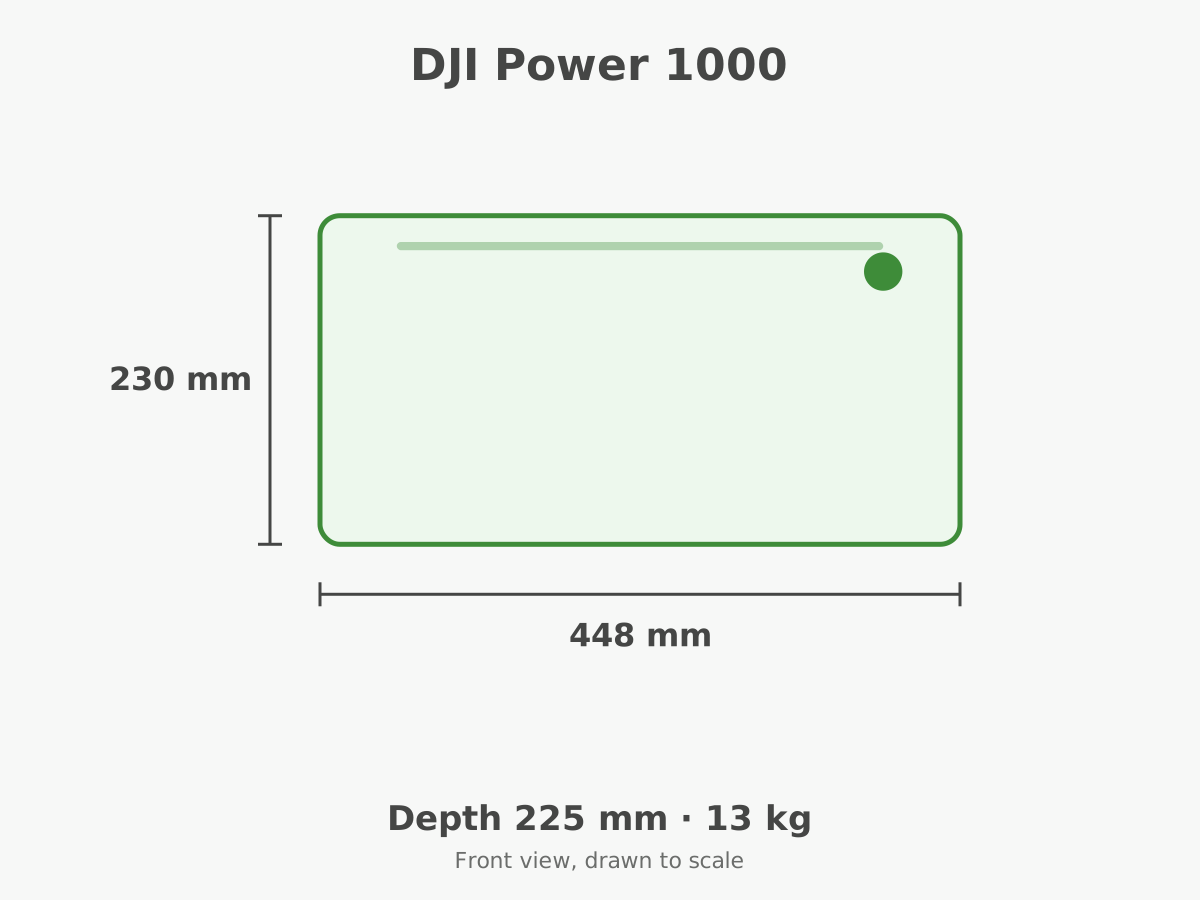
| Dimensions (L × W × H)Check the space before you buy, including room around it for airflow and cables. | 448 × 225 × 230 mm |
| WeightMatters for lifting, wall mounting and moving it. | About 13 kg |
| Operating temperatureThe range it is rated to work in. Cold and heat can reduce performance. | Discharging -10 to 45 °C; recharging 0 to 45 °C |
| Noise levelFan noise while working. | As low as 23 dB, according to DJI's product page |
| Protection ratingIP ratings show protection from dust and water. IP55 and IP65 are rated for outdoor-style exposure; check the installation guidance. | Not stated |
| WarrantyThe period the maker covers. Read the terms: conditions and capacity guarantees differ. | Up to 5 years when bought from the DJI Store. The conditions are not on the page text |
How long will it run your devices?
Choose how many of each device you want to run at the same time. The wattages are typical figures, so check the label on your own devices.
| Device | Typical power | How many |
|---|---|---|
| 10 W | ||
| 10 W | ||
| 15 W | ||
| 60 W | ||
| 80 W | ||
| 80 W | ||
| 40 W | ||
| 1,000 W | ||
| 2,000 W | ||
| 1,000 W | ||
| W |
The estimate assumes 85% of the rated capacity is usable after conversion losses. DJI does not state this figure, so we use a cautious assumption. Real running times vary with temperature, battery age and how each device draws power.
Compatible with
What DJI says this product works with. Anything not listed here is not confirmed.
- Extra batteries
- Not stated on DJI's pages.
- Solar panels
- SDC input 32-58.4 V up to 60 A, SDC Lite 32-58.4 V up to 8 A.
- DJI drones
- The SDC port fast-charges DJI drone batteries, according to DJI.
Rules where you live
A portable power station is not wired into your home, so it is simple to use almost anywhere. Connecting one to your home circuits to power the house is different, and the rules for that vary by country. See our country guides for the rules, incentives and prices where you live.
Strengths and things to check
Strengths
- 2,200 W stable output, 4,400 W peak
- Two 140 W USB-C ports
- 1,200 W mains charging: 80% in 50 minutes
- LFP cells rated for over 4,000 cycles to 70%
- Quiet, as low as 23 dB
Worth checking before you buy
- About 13 kg, heavy for a 1 kWh unit
- Solar panel limits and charge time are not stated in watts
- Maximum AC charging needs 60% battery and a 20 to 35 °C room
- Protection rating and EPS switchover time are not stated
- Not a home battery: not for running a house
Change log
We record changes to this page here, so you can see when figures such as the warranty were last updated.
- 11 November 2026
- Page published. Warranty at publication: up to 5 years when bought from the DJI Store (DJI product page). DJI's UK address redirected to the Netherlands page.
Where this information comes from
We have not tested the Power 1000. Figures come from DJI's Power 1000 specifications page and product page, last checked on 11 November 2026. DJI's UK address redirected to its Netherlands pages, whose AC data covers both the 120 V and 230 V models. A value DJI does not state is shown as not stated.
We do not show prices, because they change often and differ between sellers.
- Manufacturer DJI Power 1000 specifications
- Manufacturer DJI Power 1000 product page
Spotted an error?
Tell us through the contact form on our About Us page.
Common questions about DJI Power 1000
What can the Power 1000 run?
DJI rates it at 2,200 W stable output, so a kettle, power tool or small heater is within reach, though a 1,024 Wh battery empties quickly at that load.
Does the Power 1000 charge drones?
DJI says the SDC port fast-charges DJI drone batteries.
Is the Power 1000 the same as a home battery?
No. It is a portable power station that you plug devices into. An installed home battery is wired into your electrics by an electrician. See our guide to plug-in and installed home batteries.
Related guides
Need a home battery rather than a portable one?
Our calculator uses your own usage and tariff to estimate what a home battery could save, with conservative assumptions.