
Anker SOLIX C300
A 288 Wh LFP portable power station with 300 W of AC output (600 W SurgePad), two 140 W USB-C ports and a 5-year warranty.
- Best for small, quiet backup
- Power station
- 288 Wh
- 5-year warranty
- Capacity: 288 Wh with LFP cells.
- Output: 300 W with a 600 W surge (Anker's 'SurgePad'), plus two 140 W two-way USB-C ports.
- Charges from the mains to 80% in 50 minutes, or from solar at up to 100 W.
- Weighs about 4.1 kg, runs at 25 dB at 1 m and has a 5-year warranty.
Not tested by us
We have not tested the Anker SOLIX C300. The figures on this page come from the sources listed at the end of the page, checked on 10 November 2026, and we do not show prices. "Best for" is based on what the maker says the product is designed for, not on our own tests.
Key figures
288 Wh
Capacity
300 W
AC output (600 W surge)
5 years
Warranty
Specifications
Last checked on 10 November 2026. The grey text under each name explains what the value means.
| Specification | Value |
|---|---|
| Storage | |
| CapacityHow much energy the battery stores. Bigger means longer runtime or more of your own solar power used later. | 288 Wh |
| Battery chemistryLFP (lithium iron phosphate) cells are known for long life and stable behaviour with heat. | LFP (lithium iron phosphate) |
| Cycle lifeHow many full charge and discharge cycles the cells are rated for before they hold less than the stated share of their original capacity. | Not stated. Anker's page says 'a decade' of power from LFP cells, with no cycle count |
| ExpansionExtra battery units that add storage to the same system. | Not stated |
| Output | |
| AC output (continuous)The power it can deliver all the time. Add up the watts of what you want to run at once and stay below this. | 300 W. The UK page does not give the number of AC outlets (7 charging ports in total); Anker's US page lists 3 AC outlets for the 120 V model |
| AC output (surge)A short burst above the continuous rating, for appliances that draw more power when they start. | 600 W ('SurgePad') |
| USB-APorts for phones, tablets and small devices. | 1 port, 12 W (US page) |
| USB-CPorts for laptops, phones and tablets. Power delivery up to 100 W can charge most laptops. | 2 ports, 140 W two-way each (UK page); the US page also lists a 140 W + 140 W output set |
| Car outletA 12 V socket like the one in a car, for car accessories. | 1 outlet, 120 W (US page) |
| Charging | |
| AC chargingHow fast it charges from a wall socket. Higher means a shorter wait. | 330 W (US page, 120 V model) |
| Time to charge from the mainsHow long a full charge takes from a wall socket. | 80% in 50 minutes |
| Solar inputHow much solar panel power it accepts. A higher figure fills the battery faster on a sunny day. | 100 W max, XT60 connector, up to 28 V (US page) |
| Solar charging timeHow long a full charge takes from solar panels, in the conditions the maker names. | Not stated |
| Car chargingCharging from a car's 12 V or 24 V socket while driving. Slow, but useful on the road. | 1 x 140 W USB-C or the car socket; no time given for the UK model |
| Backup switchover (EPS)What happens when the grid fails. EPS means it takes over automatically. | Not stated |
| Housing and warranty | |
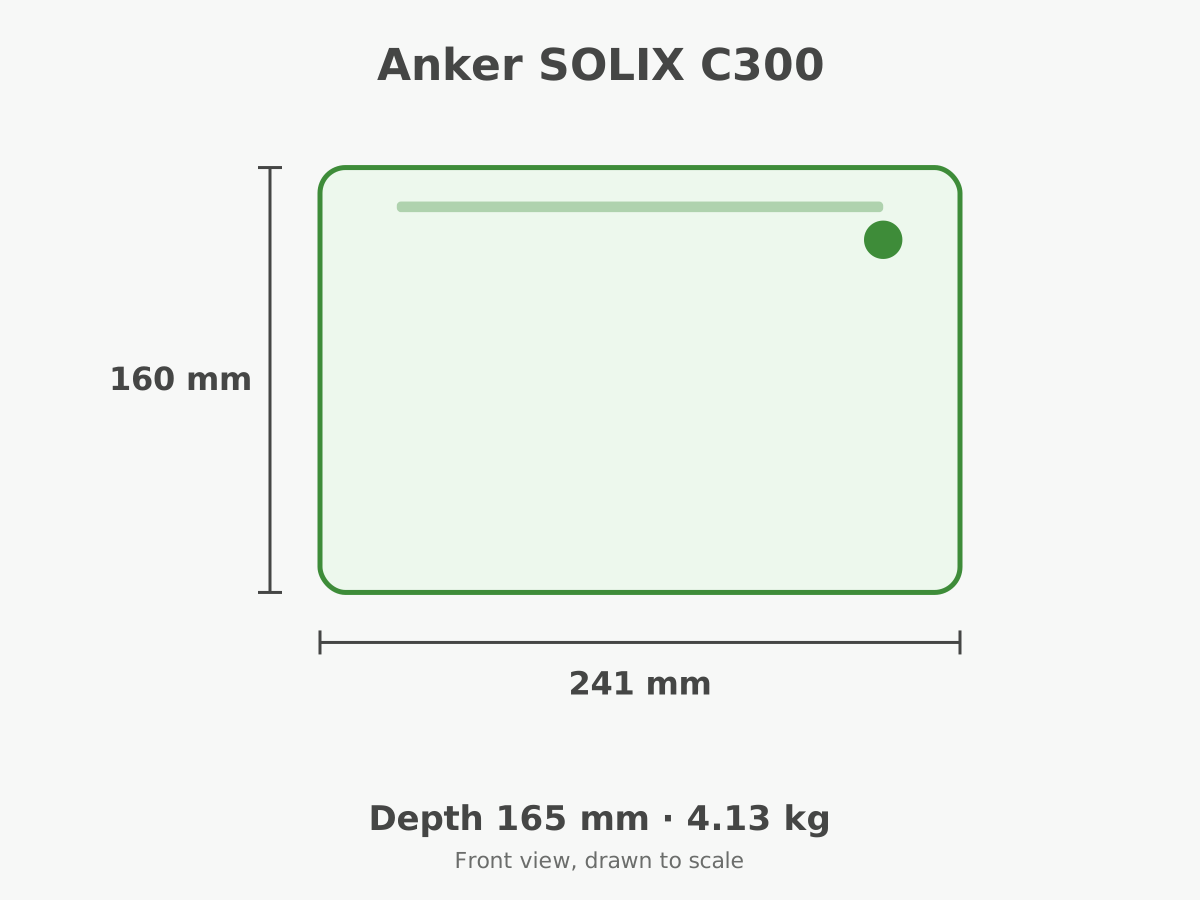
| Dimensions (L × W × H)Check the space before you buy, including room around it for airflow and cables. | About 165 × 160 × 241 mm (6.5 × 6.3 × 9.5 in, from Anker's US page; Anker does not say which number is which axis, and the UK page gives no size) |
| WeightMatters for lifting, wall mounting and moving it. | About 4.1 kg (9.1 lb, US page) |
| Operating temperatureThe range it is rated to work in. Cold and heat can reduce performance. | Not stated |
| Noise levelFan noise while working. | 25 dB at 1 m |
| Protection ratingIP ratings show protection from dust and water. IP55 and IP65 are rated for outdoor-style exposure; check the installation guidance. | Not stated |
| WarrantyThe period the maker covers. Read the terms: conditions and capacity guarantees differ. | 5 years |
How long will it run your devices?
Choose how many of each device you want to run at the same time. The wattages are typical figures, so check the label on your own devices.
| Device | Typical power | How many |
|---|---|---|
| 10 W | ||
| 10 W | ||
| 15 W | ||
| 60 W | ||
| 80 W | ||
| 80 W | ||
| 40 W | ||
| 1,000 W | ||
| 2,000 W | ||
| 1,000 W | ||
| W |
The estimate assumes 85% of the rated capacity is usable after conversion losses. Anker SOLIX does not state this figure, so we use a cautious assumption. Real running times vary with temperature, battery age and how each device draws power.
Compatible with
What Anker SOLIX says this product works with. Anything not listed here is not confirmed.
- Extra batteries
- Not stated: Anker's page lists no expansion battery for the C300.
- Solar panels
- Up to 100 W. Anker names its SOLIX 100 W solar panel as compatible and says 5 V 3 A USB-C panels are not.
- Anker SOLIX C300 DC
- The C300 DC is a different, DC-only model. Anker's UK page lists it as an add-on in bundles.
Rules where you live
A portable power station is not wired into your home, so it is simple to use almost anywhere. Connecting one to your home circuits to power the house is different, and the rules for that vary by country. See our country guides for the rules, incentives and prices where you live.
Strengths and things to check
Strengths
- Small and light at about 4.1 kg (Anker's US figure)
- Two 140 W two-way USB-C ports
- 80% charge in 50 minutes (Anker's figure)
- 25 dB at 1 m
- 5-year warranty
Worth checking before you buy
- 300 W continuous: not for kettles or heaters
- 288 Wh is a small battery
- The UK page gives no dimensions, weight or operating temperature
- Not stated as expandable
- Not a home battery: do not connect it to your home circuits in a way that lets it feed the house
Change log
We record changes to this page here, so you can see when figures such as the warranty were last updated.
- 10 November 2026
- Page published. Warranty at publication: 5 years (Anker SOLIX UK page).
Where this information comes from
We have not tested the C300. The AC model C300 (A1722) is described by Anker's UK product page; sizes, weight and port details come from Anker's US comparison page, which lists the 120 V version, last checked on 10 November 2026. The C300 DC (A1726) is a different, DC-only model and is not covered here. A value that Anker does not state is shown as not stated.
We do not show prices, because they change often and differ between sellers.
- Manufacturer Anker SOLIX UK C300 page (2x C300 bundle, lists the single unit specifications)
- Manufacturer Anker SOLIX C300 DC / C300 page (UK)
Spotted an error?
Tell us through the contact form on our About Us page.
Common questions about Anker SOLIX C300
What can the Anker SOLIX C300 run?
It is rated at 300 W continuous with a 600 W surge, so laptops, routers, lights and small fans are fine; a kettle is not. Divide 288 Wh by the device's draw for a rough running time.
What is the difference between the C300 and the C300 DC?
The C300 has AC outlets and a 300 W AC output. The C300 DC is a DC-only model without AC outlets. This page covers the C300.
Is the Anker SOLIX C300 the same as a home battery?
No. It is a portable power station that you plug devices into. An installed home battery is wired into your electrics by an electrician. See our guide to plug-in and installed home batteries.
Related guides
Need a home battery rather than a portable one?
Our calculator uses your own usage and tariff to estimate what a home battery could save, with conservative assumptions.