
How to Earn Money With a Home Battery on a Dynamic Electricity Tariff (2026)
Your electricity price probably changes throughout the day whether you notice it or not. Most households ignore this and pay a flat rate. Households with a battery and a dynamic electricity tariff do the opposite — they buy power when it’s cheap (sometimes free, sometimes even paid to take it) and use it when it’s expensive. That’s called energy arbitrage, and in 2026 it’s one of the strongest financial cases for owning a home battery.
This guide explains how it works, what you can realistically earn, and the setup you need to actually capture it.
What is a dynamic tariff?
A dynamic tariff passes the real-time wholesale electricity price straight through to you, instead of averaging it into one fixed rate. Prices update hourly — or, on some markets, every 15 or 30 minutes — following the day-ahead spot market.
The volatility is the opportunity. Overnight and during sunny, windy afternoons, wholesale prices drop sharply, occasionally going negative. During the evening peak, they spike. A flat tariff hides all of this. A dynamic tariff lets your battery exploit it.
How battery arbitrage works
The strategy is simple to state:
- Charge the battery during the cheapest hours — typically the early hours of the morning, midday solar surplus, or any negative-price window.
- Discharge it during the expensive evening peak, running your home off stored cheap power instead of buying at the top of the curve.
The gap between those two prices is your margin. Do it every day and the numbers add up fast.
What can you realistically earn?
Real-world figures from 2025–2026 give a useful range:
- Across continental Europe, a well-run battery on a dynamic tariff delivers roughly €50–90 per year for every kWh of battery capacity in arbitrage value — on top of any solar self-consumption savings. For a 10 kWh battery, that’s several hundred euros annually.
- In the UK, where the price spread between cheap overnight and peak-evening rates is unusually wide, a 10 kWh battery on a smart tariff commonly saves in the region of £550–£700 per year from timing alone, and combined solar-plus-battery households often report four-figure annual benefits.
- The upside is concentrated in volatile moments. On one notable night in Germany, prices swung from negative in the early hours to well over 40 cents in the evening — a single well-timed cycle captured close to a whole month’s typical arbitrage value.
A crucial reality check: automation is what makes this work. Owners who try to watch prices manually almost always stop within a few months. Software that reads the day-ahead price and schedules charging automatically is what turns the theory into consistent savings.
The three things you need
1. A smart meter. No smart meter, no dynamic tariff — your consumption has to be measured in short enough intervals. Coverage varies wildly: the Nordics and Austria are near-universal, while Germany still sits at only around 10% of eligible homes. If you don’t have one, request an upgrade from your metering operator before anything else.
2. A battery (and inverter) that supports grid charging. This is the mistake that quietly kills returns. Your battery must be able to charge from the grid on a time-of-use schedule — look specifically for “AC grid charging (TOU mode)” on the spec sheet. Some inverters only allow solar charging, in which case you can self-consume but you cannot arbitrage, and the promised savings never materialise.
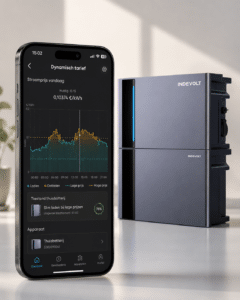
3. A dynamic tariff and control software. Providers like Tibber (Germany, the Netherlands, the Nordics), aWATTar (Austria and Germany), and Octopus Agile (UK) price against the wholesale market. Pair one with your battery’s own optimisation app, or a platform like Home Assistant / evcc, and the software handles the timing.
Get the sizing right
Bigger is not better here. Oversized batteries rarely complete a full charge-discharge cycle on shorter shoulder-season days, so the extra capacity sits idle and drags down your per-kWh return.
- 7–12 kWh usable is the sweet spot for most European households.
- 12–18 kWh makes sense if you have an EV and a heat pump.
- Above that band, each additional kWh barely earns its keep on arbitrage alone.
Manual vs automated: what’s the difference?
You don’t strictly need full automation. Most batteries let you program several charge and discharge windows by hand — for example, charging around 01:00–05:00 and during any midday solar surplus, then discharging across the morning and evening peaks. Done consistently, a manual schedule captures a large share of the available value.
But automation captures the rest — the negative-price spikes, the shifting daily curve, the days that don’t fit your fixed schedule — and, more importantly, it never gets bored and stops. If arbitrage is a core reason you’re buying a battery, prioritise a system with genuine automated price optimisation.
Frequently asked questions
Do I need solar panels to benefit? No. A standalone battery can profit purely by hoarding cheap overnight grid power and using it during expensive peaks. Solar simply adds a second savings layer on top.
Is arbitrage still worth it in winter? Often more so. Grid prices tend to be more volatile in winter, which widens the buy-low/sell-high gap even when solar generation is minimal.
What’s the catch? Three, mainly: you need a smart meter, your hardware must support scheduled grid charging, and rollout timelines for meters and metering upgrades can be slow in some regions. Check all three before you count on the savings.
Dynamic tariff or simple time-of-use? A time-of-use plan has known, fixed price bands and can be run with
a basic timer. A dynamic tariff has wider, market-driven swings — more upside, but it rewards automated control to capture it fully.
A home battery is only as smart as the tariff and software behind it. Explore our tariff and battery comparison guides to match the right system to your market.