
Balcony Power Plant With Storage: The Complete 2026 Buyer’s Guide
You don’t need a house, a roof, or a certified installer to make your own electricity anymore. A balcony power plant with storage — one or two solar panels plus a plug-in battery that sits on your balcony floor — has quietly become one of Europe’s fastest-growing consumer products. Germany alone passed one million registered plug-in solar systems, and a growing share now ship with a battery attached.
This guide explains exactly what these systems do, how to size one for your home, what separates a good unit from a bad one, and what you can realistically expect to save.
What is a balcony power plant with storage?
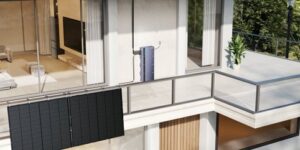
A balcony power plant (in German, Balkonkraftwerk) is a small photovoltaic system designed to plug straight into a normal wall socket. Add storage and you get a compact battery — almost always lithium-iron-phosphate (LFP/LiFePO4) — that captures the solar power your panels generate during the day so you can use it in the evening instead of pushing it to the grid for nothing.
The appeal is simple: no rooftop, no permits in most countries, and no electrician. You unbox it, mount the panels on your railing or wall, plug the battery unit into a standard socket, and register it online.
Why the storage version matters
Without a battery, a plug-in solar system can only power your home in the exact moment the sun is shining. The problem is that midday — when your panels produce the most — is usually when nobody’s home. That surplus disappears into the grid uncompensated.
A battery flips the equation. It banks the midday surplus and releases it during the evening peak, when your household actually draws power and grid electricity is most expensive. For a typical apartment, that’s the difference between using maybe 30% of your solar output and using 70–80% of it.
How much can you actually save?
Output depends on three things: how much sun your balcony gets, how much of that energy you use yourself, and your local electricity price.
- A standard two-panel setup generates roughly 600–900 kWh per year in Central Europe.
- A south-facing balcony produces meaningfully more than an east- or west-facing one — expect 20–30% less if you don’t face south.
- At an electricity price around €0.30–0.35/kWh, a battery-equipped system that lifts your self-consumption can shave a real chunk off your annual bill, with payback periods for the whole kit often landing under three years.
The single biggest lever is self-consumption. The more of your own solar you use rather than export, the faster the system pays for itself — and that’s precisely what the battery is for.
What to look for when buying
Not all plug-in batteries are equal. Before you buy, check these six things:
1. Usable capacity (kWh), not just headline capacity. A 2 kWh unit suits a small apartment; a 5 kWh+ unit fits a household that cooks, works from home, or runs an EV charger. Match capacity to your evening consumption, not to the biggest number on the box.
2. Expandability. The best systems let you start small and add battery modules later — useful if you buy an e-bike, add appliances, or move to a bigger place. Look for a base unit that scales.
3. Weatherproofing (IP65 minimum). Anything living on an outdoor balcony needs an IP65 rating at minimum. That guarantees full protection against dust and water jets — non-negotiable in a climate with rain, snow, and temperature swings.
4. Cold-weather behaviour. LiFePO4 cells lose performance below roughly 0°C. A built-in heating function fixes this but draws a little power itself. If you get real winters, make sure the unit has it.
5. AC- vs DC-coupled. AC-coupled systems are the most flexible and easiest to retrofit onto an existing balcony setup, but each conversion step loses a few percent of energy. DC-coupled designs are slightly more efficient. For most plug-in buyers, AC-coupled convenience wins — just be aware of the trade-off.
6. App and monitoring. A good app shows live production, battery charge, and savings. Beyond the satisfaction of watching your meter slow down, it’s how you’ll spot problems and fine-tune usage.
Installation and registration, country by country
The hardware is genuinely plug-and-play: position the unit (ideally under an overhang), connect your panels, plug into a Schuko socket, and switch on. The legal side varies:
- Germany: Systems up to 800 W of inverter output qualify for simplified registration via the Marktstammdatenregister — about ten minutes online. Rules around storage have been loosening through 2026, making battery integration far simpler than it used to be.
- Netherlands, Austria, France, Italy, Spain: All have seen surging demand and are broadly following Germany’s lead, though registration details differ. Always check your national grid operator’s current requirements before buying.
The direction of travel across Europe is clearly toward fewer barriers, not more — but never skip the registration step, as it’s what keeps your system legal and insured.
Common mistakes to avoid
- Buying more capacity than you’ll cycle. An oversized battery that never fully empties on a cloudy shoulder-season day is wasted money.
- Ignoring orientation. Your balcony’s direction and panel tilt affect output more than almost anything else. A well-angled south railing beats a bigger system pointed the wrong way.
- Assuming all “800 W” systems are identical. Battery quality, app reliability, warranty, and cold-weather handling vary enormously.
- Skipping registration. It’s quick, and it matters.
FAQ – Frequently asked questions
Do I need an electrician? For most plug-in systems within the simplified limits, no. That’s the whole point. Larger or hard-wired systems can require professional installation depending on your country.
Can I add a battery to a system I already own? Often yes — many units connect to an existing balcony setup through a microinverter interface without major changes. Confirm compatibility first.
How long will the battery last? LiFePO4 cells are typically rated for thousands of charge cycles, translating to roughly 10–16 years of daily use.
Is it worth it if my balcony doesn’t face south? Usually still yes, just with lower output. Run the numbers with a 20–30% reduction and check the payback still works for you.
A balcony power plant with storage is the lowest-barrier way to join the energy transition — no roof required. Explore our comparison guides to find the right system for your home.