
Sungrow SBH
A modular high-voltage lithium iron phosphate battery built from 5 kWh modules: 10 to 40 kWh per unit, up to 160 kWh with four units, rated IP55.
- Best for large modular storage
- Installed battery
- 10-40 kWh
- IP55
- Made by Sungrow.
- Made by Sungrow. The SBH100 to SBH400 range uses 5 kWh modules (45 kg each): 2 to 8 modules per unit, 10 to 40 kWh usable.
- Up to four units in parallel for 160 kWh. Up to 50 A continuous charge and discharge; Sungrow says power exceeds 25 kW.
- A battery only: it connects to a compatible Sungrow hybrid inverter. IP55, indoor or outdoor, floor stand.
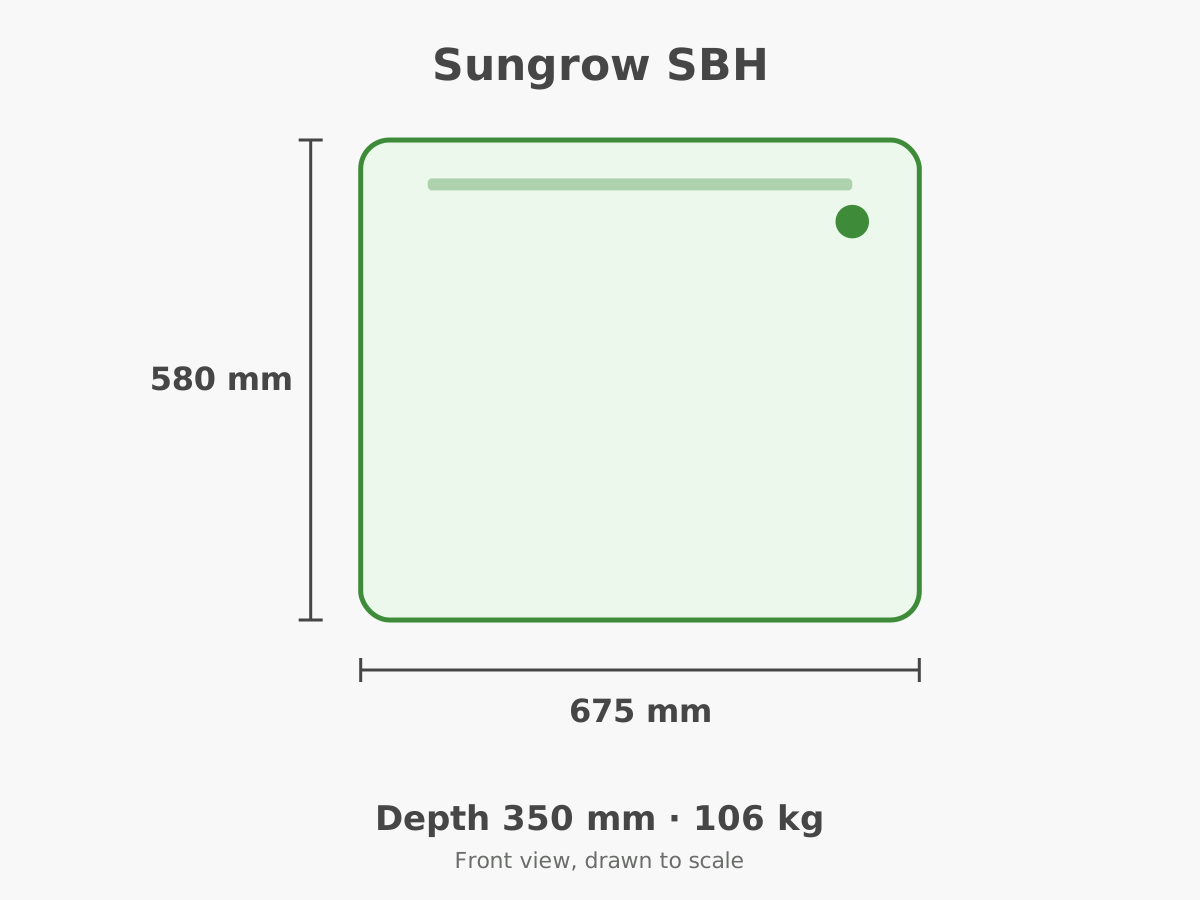
- Dimensions and weight in the specs are for the smallest unit, the SBH100 (2 modules).
Not tested by us
We have not tested the Sungrow SBH. The figures on this page come from the sources listed at the end of the page, checked on 11 November 2026, and we do not show prices. "Best for" is based on what the maker says the product is designed for, not on our own tests.
Key figures
10-40 kWh
Usable per unit
160 kWh
Max. with 4 units
10 years
Warranty (datasheet)
Specifications
Last checked on 11 November 2026. The grey text under each name explains what the value means. To see it next to other products, compare it in our comparison tool.
| Specification | Value |
|---|---|
| Storage | |
| CapacityHow much energy the battery stores. Bigger means longer runtime or more of your own solar power used later. | 5.0 kWh usable per module. SBH100 10.0 kWh (2 modules), SBH150 15.0, SBH200 20.0, SBH250 25.0, SBH300 30.0, SBH350 35.0, SBH400 40.0 kWh (8 modules). Test conditions: 25 °C, 100% depth of discharge, 0.2C |
| Battery chemistryLFP (lithium iron phosphate) cells are known for long life and stable behaviour with heat. | Lithium iron phosphate (LiFePO4), prismatic cells |
| Depth of dischargeHow much of the battery can be emptied without harming it. 90% means 10% is kept in reserve. | Maximum 100%, settable |
| Cycle lifeHow many full charge and discharge cycles the cells are rated for before they hold less than the stated share of their original capacity. | Not stated on the datasheet or product page |
| ExpansionExtra battery units that add storage to the same system. | 2 to 8 modules per unit and up to 4 units in parallel (160 kWh). Plug and play, no cables between modules |
| Power | |
| Charge and discharge powerHow fast the battery can take in and give out energy. It sets how many devices it can serve at once. | Maximum continuous current 50 A. Nominal voltage 140.8 V (SBH100) to 563.2 V (SBH400); Sungrow says maximum power exceeds 25 kW |
| Round-trip efficiencyThe share of the energy you put in that comes back out. The rest is lost as heat. | Not stated on the datasheet |
| Backup in a power cutWhether it can keep selected circuits running during a grid outage. | Not stated: backup depends on the Sungrow inverter system it is connected to |
| Solar | |
| Solar inverterTurns the DC power from solar panels into AC for the home. Built in means no separate solar inverter is needed. | None: this is the battery only. Sungrow says it works with various hybrid inverter types and its SHT system; models are not listed here |
| Solar and off-grid | |
| Works with solar panelsWhether you can charge it from solar panels. Yes means a built-in solar input or a compatible solar setup; read the detail for the voltage and power limits. | Partly: DC-coupled to a compatible Sungrow hybrid inverter; the battery has no panel input of its own. |
| Off-grid useWhether the maker describes it running with no grid connection at all, for example in a cabin, van or off-grid home. Backup only means it covers power cuts but needs the grid the rest of the time. | Partly: backup during a power cut depends on the connected Sungrow inverter system; Sungrow's page does not describe stand-alone off-grid use. |
| Connection and housing | |
| Grid connectionThe supply type it is built for. Check it matches your home's supply. | Not applicable: the battery connects to an inverter (high-voltage DC) |
| Dimensions (W × H × D)Width, height and depth of the unit, so you can check that it fits. | SBH100: 675 × 580 × 350 mm; the height grows with the module count (SBH400: 675 × 1,540 × 350 mm) |
| WeightMatters for lifting, wall mounting and moving it. | SBH100: 106 kg; SBH150 151 kg; SBH200 196 kg; SBH400 376 kg (module 45 kg) |
| Protection ratingIP ratings show protection from dust and water. IP55 and IP65 are rated for outdoor-style exposure; check the installation guidance. | IP55; indoor or outdoor; floor-stand mounting; natural convection cooling; humidity 0 to 95% without condensation; altitude up to 2,000 m |
| Operating temperatureThe range it is rated to work in. Cold and heat can reduce performance. | Charging 0 to 50 °C; discharging -20 to 50 °C |
| Battery heatingA built-in heater that lets the battery charge in cold weather. | Not stated |
| ConnectivityHow you monitor and control it, usually through an app. | CAN communication; SOC and status indicators on the unit |
| CertificationsSafety and grid standards the maker says the product meets. | CE, CEC, IEC 62619, IEC 62040, UN 38.3, VDE 2510-50, IEC 62477, IEC 63056 |
| Warranty | |
| WarrantyThe period the maker covers. Read the terms: conditions and capacity guarantees differ. | 10 years, subject to the conditions in Sungrow's battery warranty letter |
Compatible with
What Sungrow says this product works with. Anything not listed here is not confirmed.
- Inverters
- Sungrow says the SBH works with various hybrid inverter types and with its SHT system. The pages we read do not list individual models.
- Expansion
- 2 to 8 modules per unit, up to 4 units in parallel.
- Monitoring
- iSolarCloud app.
- Regions
- Sungrow lists the SBH for EU, Middle East and Africa, Australia and South-East Asia.
Rules where you live
An installed battery normally needs a qualified electrician, and in many countries you must also tell your grid operator, especially if it can export. This is not a plug-in battery. Rules, incentives and tax treatment differ by country: see our country guides for what applies where you live.
Strengths and things to check
Strengths
- Modular: 10 to 40 kWh per unit, up to 160 kWh
- Up to 50 A continuous charge and discharge
- IP55 for indoor or outdoor floor-stand use
- Discharges down to -20 °C
- 10-year warranty per the datasheet
Worth checking before you buy
- A battery only: you need a compatible Sungrow inverter
- Heavy and floor-standing: 106 kg for the smallest unit
- No cycle life, efficiency or backup details on the datasheet
- Charging is only allowed from 0 °C
Change log
We record changes to this page here, so you can see when figures such as the warranty were last updated.
- 11 November 2026
- Page published. Warranty at publication: 10 years (Sungrow SBH datasheet, Version 4, 2024). The product page and datasheet are not dated after 2024, so check for a newer version.
Where this information comes from
We have not tested this battery. Every figure above comes from Sungrow's SBH100-400 datasheet (Version 4, 2024) and its product page, last checked on 11 November 2026. The datasheet was read as extracted text and its warranty line refers to a separate warranty letter that we have not read. A value that the sources do not state is shown as not stated.
We do not show prices, because they depend on the installer's quote.
- Manufacturer Sungrow SBH100-400 datasheet (Version 4, 2024)
- Manufacturer Sungrow SBH100-400 product page
Spotted an error?
Tell us through the contact form on our About Us page.
Common questions about Sungrow SBH
How much does the Sungrow SBH store?
Each module stores 5 kWh. A unit holds 2 to 8 modules (10 to 40 kWh), and up to four units can be linked for 160 kWh.
Does it include an inverter?
No. It is a high-voltage battery and connects to a compatible Sungrow hybrid inverter. Ask your installer which inverter pairs with it.
How long is the warranty?
The datasheet states 10 years, subject to Sungrow's warranty letter. Confirm the terms with your installer before you buy.
Related guides
Does a modular battery fit your home?
Our calculator uses your own usage and tariff to estimate what a home battery could save, with conservative assumptions.