
If you look at home battery marketing today, one term appears everywhere: AI. Some brands present it as a breakthrough that will automatically cut your bill and make your home energy system future-proof. In reality, AI smart charging is usually much more practical than that. It is software that helps a battery decide when to charge, when to discharge, and when to hold energy back based on data such as electricity prices, solar generation, household demand, and sometimes weather forecasts.
That makes the topic important for consumers. A smart home battery can be genuinely useful, but only when the software fits the local electricity system and your own household pattern. The same battery can perform very differently in two countries because the tariff structure, export rules, and flexibility options are not the same everywhere.
For HomeBattery.com, this is exactly the kind of topic that deserves a clear explanation. The platform presents itself as a place for independent, accessible information about home batteries and energy storage, aimed at helping homeowners make informed choices rather than chasing hype.
What AI smart charging actually means
At consumer level, AI smart charging usually means that a home battery does more than simply store excess solar power. A standard battery setup may charge whenever your solar panels produce more than your home uses, then discharge later when demand rises. A smarter system adds software that looks at more variables and adjusts the charging strategy automatically.
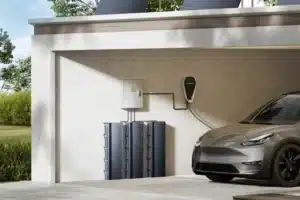
In practice, that software can use several inputs:
- Real-time or day-ahead electricity prices.
- Your home’s historical consumption pattern.
- Solar production forecasts.
- Battery state of charge and reserve settings.
- Grid export limits or zero export settings.
- Sometimes EV charging or heat pump demand.
This is why it helps to demystify the term AI. Many systems marketed as AI-driven are not using advanced artificial intelligence in the way consumers may imagine. They are often rule-based or prediction-based control systems that optimize charging and discharging with the help of connected data sources. That does not make them bad. It simply means the value lies in the quality of the control logic, not in the label itself.
How a smart home battery makes decisions
A home battery with smart charging needs data before it can make useful decisions. In most setups, the battery or inverter receives information from a smart meter, CT clamp, or gateway that measures import, export, and home consumption. It may also pull electricity prices from the cloud and combine those with expected solar generation and battery limits.
A simple example makes this easier to understand. Imagine a battery that sees low electricity prices overnight, strong solar output expected at midday, and high household consumption in the evening. The software may choose to leave some battery capacity free for solar later in the day, or it may charge overnight if the price spread is large enough to make that worthwhile. The right choice depends on how the tariff works and whether exporting power is rewarded or penalized in that market.
This is also where internet access matters. Some battery systems can still operate locally without an internet connection, but advanced functions such as dynamic tariff optimization usually require live data from outside the home. Without that connection, the battery may still charge and discharge, but it loses part of the intelligence that makes smart charging valuable.
Why the value differs by country
This is the most important part of the article for an international platform. AI smart charging is not only about what the battery can do. It is also about what the electricity market allows, rewards, or limits. That is why country differences matter so much.
1. Tariff structure
In some countries, households can access dynamic electricity tariffs with hourly or near-hourly price changes. In those markets, a battery can potentially buy electricity when prices are low and reduce grid use when prices are high. Research on residential battery economics shows that dynamic tariffs can improve the net gains of battery systems compared with fixed tariffs, although the outcome depends on local conditions and battery setup.
In markets dominated by flat or mostly fixed tariffs, smart charging has less room to optimize for price. There, the main benefit is often improving self-consumption of solar power rather than trading around daily price swings.
2. Export and feed-in rules
Another major difference is what happens when your solar system exports electricity to the grid. If exported electricity is paid well, the need to store every surplus kilowatt-hour becomes smaller. If export compensation is low, capped, or reduced by supplier charges, then local storage becomes more attractive and smart charging may add more value.
This is one reason a universal article should avoid country-specific promises. A battery that looks financially attractive in one market may be far less convincing in another once export rules are taken into account.
3. Grid congestion and local limits
In parts of Europe, rising solar adoption is increasing pressure on local grids. The European Commission notes that market design is increasingly focused on integrating renewables, protecting consumers, and unlocking flexibility in the electricity system. In practical terms, that means households may face new incentives to shift consumption, reduce exports at peak moments, or use storage more actively.
For consumers, the takeaway is simple: in a constrained grid area, a smart battery may help more with reducing strain and managing self-use than with pure price arbitrage. That changes how the value should be explained in a buying guide.
4. Access to flexibility markets
Some countries are moving faster than others in allowing distributed energy devices to support grid balancing through aggregators or flexibility platforms. Where that access exists, a battery may do more than optimize behind the meter. It may also participate in services that support the wider power system. In other countries, that route may barely exist yet for households.
That difference matters because the phrase AI smart charging can describe two very different realities: one battery simply shifting household demand, and another battery responding to wider market signals through a service platform.
What consumers should look for before buying
A clear consumer article should move from theory to practical checks. Most readers do not need an engineering lecture. They need to know what to ask before trusting smart charging claims.
Data and internet connection
If the system depends on live tariff data, cloud control, or remote optimization, you need a stable internet connection. Without it, the battery may still function, but the advanced charging strategy may stop or fall back to basic behavior.
Metering and compatibility
Many smart charging functions rely on accurate metering through a smart meter, CT clamp, P1 meter, or inverter integration. If the hardware cannot see your real consumption and export profile, the battery cannot optimize effectively.
Dynamic tariff access
Not every consumer can benefit equally from smart charging. In many cases, you need a dynamic electricity contract before price-based charging makes real sense. Without dynamic pricing, the battery may still help with self-consumption, but the AI story becomes smaller.
Backup expectations
Consumers also need to separate smart charging from backup power. A battery can have clever software and still offer no meaningful emergency power during an outage. Backup depends on hardware and system design, not just software settings.
Subscription and platform risk
Some smart features depend on a vendor platform, app, or paid service. That raises a fair consumer question: if the company changes the software model, closes features behind a paywall, or reduces support in a region, what happens to the value of your system? This is a useful point to include because software dependency is easy to overlook when battery products are sold mainly on hardware specs.
When AI smart charging makes sense
The best candidates are usually households with some combination of solar panels, dynamic tariffs, strong daily price swings, and flexible demand such as EV charging or a heat pump. In those cases, software can do more than store excess solar. It can choose better moments for importing and using electricity.
It can also make sense for people who want less manual control. Instead of setting charging windows by hand, the system can react automatically to changing prices and expected consumption. Some manufacturers and service providers position this as a major convenience feature, and that is a fair benefit as long as the reader understands the limits.
When the benefits may be limited
The article should also be honest about the weaker cases. Smart charging may deliver modest results when a household has a flat tariff, little solar surplus, low day-to-night price spread, or a battery that is too small or too restricted in power to respond effectively.
The same is true if local rules make exporting power relatively attractive. In that case, storing every surplus unit is not always the best financial choice. Smart charging software can still be useful, but the payback story becomes more nuanced.
There is also a language problem in the market. Some products use AI mainly as a marketing shortcut for features that are closer to automation than real learning. For consumers, that makes it even more important to look at actual functions: what data does the battery use, what choices can it make, and what happens when conditions change?