
5 kWh Home Battery: The right capacity for your home
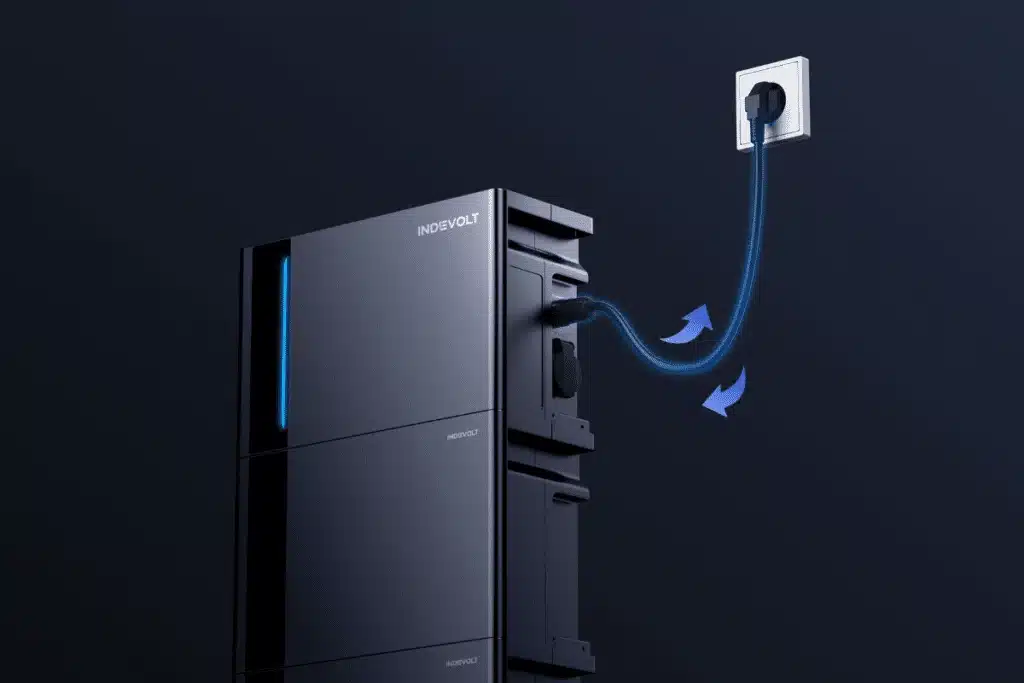
A 5 kWh home battery suits smaller households with a modest solar array, typically around 8 to 10 panels. Go smaller and you rarely fill the evening gap. Jump straight to 10 kWh and you may pay for capacity your panels never produce. Most modular systems let you add a module later if your needs grow.
How much capacity do you actually need?
Three figures decide almost everything: how much electricity your household uses in a year, how much surplus solar power you send back to the grid, and how much of that you actually use after sunset. If you have a smart meter, the first two are usually in your energy supplier’s app. Without one, your latest annual statement lists both.
Annual consumption
Divide it by 365 to get your average day. At 3,500 kWh a year that is roughly 9.6 kWh per day.
Exported solar energy
This is the surplus a battery could have stored. Divide the annual figure by 365 for a daily average.
Evening demand
How much you use after sunset decides how much of that stored energy you actually get back out.
The smallest of those three numbers sets the useful ceiling. There is no point storing 8 kWh of surplus if you only use 4 kWh after sunset, and no point buying capacity your panels never fill. Run the figures through our configurator for a capacity range and an estimate of what you would save.
What does 5 kWh cover in a real home?
Nominal capacity and usable capacity are not the same thing. Most lithium iron phosphate batteries release 90 to 95% of their nominal capacity, so a 5 kWh battery gives you roughly 4.5 kWh in daily use. The table below shows what that buys you.
| Appliance | Typical use | Share of 4.5 kWh usable |
|---|---|---|
| Fridge-freezer, 24 hours | 1.0-1.5 kWh | About 28% |
| Lighting, router and standby, one evening | 0.5 kWh | About 11% |
| Cooking on induction, one meal | 0.5-0.8 kWh | About 14% |
| Washing machine, 40 °C cycle | 0.6-0.9 kWh | About 17% |
| Dishwasher, eco cycle | 0.8-1.1 kWh | About 21% |
| TV and laptop, four hours | 0.3 kWh | About 7% |
| Electric oven, one hour | 1.5-2.0 kWh | About 39% |
| Heat pump, winter day | 6-12 kWh | Exceeds capacity |
| Charging an electric car, full | 50-80 kWh | Exceeds capacity |
In practice a full 5 kWh battery carries a small household through a normal evening and night: dinner, lights, entertainment, one appliance cycle and the fridge running until morning. Add electric heating or car charging and it is empty within a couple of hours.
How much does a home battery cost per kWh?
The price of a home battery depends mostly on its storage capacity. To make sizes easier to compare, the table below shows the estimated total cost and the average cost per kilowatt-hour. Across the range this lands at roughly €250 to €300 per kWh.
| Capacity | Cost | Cost per kWh |
|---|---|---|
| 5 kWh (this page) | €1,250 – €1,500 | €250 – €300 |
| 10 kWh | €2,500 – €3,000 | €250 – €300 |
| 15 kWh | €3,750 – €4,500 | €250 – €300 |
| 20 kWh | €5,000 – €6,000 | €250 – €300 |
| 30 kWh | €7,500 – €9,000 | €250 – €300 |
| 50 kWh | €12,500 – €15,000 | €250 – €300 |
| 60 kWh | €15,000 – €18,000 | €250 – €300 |
Two things this table does not show. First, the control unit and inverter are a fixed cost, so the price per kWh of a very small system usually sits at the top of the range. Second, payback depends far more on your electricity contract than on the purchase price: a household on a dynamic tariff that charges cheaply at night and discharges during the evening peak recovers the investment considerably faster than one on a flat tariff with generous export payments.
Is a 5 kWh home battery right for you?
Pros
- Your annual electricity use is below around 3,500 kWh
- You want to cover standby use and your evening electricity peak
- You have up to around 8 to 10 solar panels
- You do not charge an electric car at home, or you charge it elsewhere
- You want to start small and add a module later
- You have a dynamic contract and want to shift a few hours of consumption
Cons
- You use more than 3,500 kWh a year
- You have a heat pump or electric water heating
- You charge an electric car at home, even occasionally
- You have more than ten panels and export a lot in summer
- You want backup for the whole house instead of essential loads
- The house is empty by day and nearly all consumption is after sunset
Mike's take
At this size the platform matters more than the capacity. Pick a brand that lets you add a module in two years without replacing the inverter. That choice is far harder to undo than the number of kilowatt-hours you start with.
Suitable for smaller homes with a few solar panels
A 5 kWh battery works particularly well with a smaller solar array of around 3,000 W, roughly eight to ten panels. It stores the extra solar power your home does not use during the day and makes it available in the evening, when electricity use is usually higher. That directly reduces the amount you send back to the grid.
A practical rule of thumb is 1 to 1.5 kWh of storage per 1 kWp of installed solar capacity. Above ten panels the midday surplus in summer regularly exceeds what a 5 kWh battery can absorb, so part of your generation is exported anyway. Expect a clear seasonal difference too: the battery cycles fully most days in summer, but may only charge partly in winter, which is exactly why sizing on peak summer production alone leads to an oversized system.
A 5 kWh battery without solar panels
A home battery can also be useful with no solar panels at all. With a dynamic energy contract, electricity prices change throughout the day. The battery charges when prices are low, usually at night, and supplies your home when prices are high. That reduces your energy costs without a single panel on the roof.
What decides the benefit
- The gap between cheap and expensive hours
- Grid charges and taxes on imported power
- Round-trip efficiency of the battery
One cycle a day
Price arbitrage normally means one charge and one discharge per day. With 4.5 kWh usable, your saving is the daily price spread multiplied by roughly 4.5 kWh.
Check before you switch
Not every battery supports automatic price-based charging, and rules on grid charging differ per country and network operator.
Is 5 kWh enough for backup power?
A 5 kWh home battery can provide backup power for several hours, but the runtime depends entirely on what you connect. During a power cut you can run essential appliances such as your fridge, lights, internet router and a few sockets from the backup connection. Basic loads last much longer than high-power devices like an electric stove, oven, kettle or washing machine.
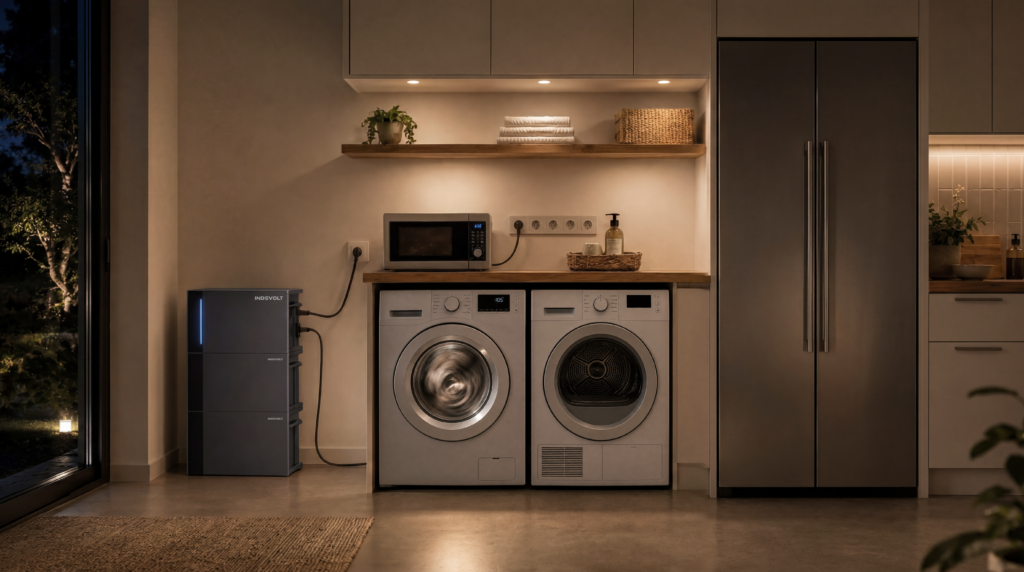
This is why you should always check two specifications, not one: the storage capacity in kWh and the maximum backup power in kW. A battery with plenty of stored energy but a 0.8 kW backup output still cannot start a washing machine.
| Connected load | Power | Runtime on 4.5 kWh |
|---|---|---|
| Fridge, lights, router, phone charging | 150-250 W | 18-30 hours |
| The above plus TV and a laptop | 350-450 W | 10-13 hours |
| Add a small heater or kettle in bursts | 1,000-1,500 W | 3-4 hours |
| Electric oven or induction hob | 2,000-3,000 W | Under 2 hours, if supported at all |
Discover smarter home energy with HomeBattery.com
A short introduction to how home batteries store solar energy, respond to electricity prices and fit into an ordinary household.
Can you use a 5 kWh battery to charge an electric car?
Charging an electric car is very different from powering a fridge or a few lights. Car batteries are many times larger than 5 kWh and need high charging power. A 5 kWh home battery can add a small amount of driving range, but it is not suitable for fully charging a car.
In numbers: a typical electric car holds 50 to 80 kWh, and a home charger delivers 3.7 to 11 kW. A fully charged 5 kWh battery would cover roughly 20 to 30 kilometres of range and would be empty in under an hour and a half at 3.7 kW. Households that regularly charge at home need a much larger battery, and above all more charging and discharging power.
What to check before you buy a 5 kWh battery
Capacity is only one specification. These are the figures that decide whether a system performs well in your home.
| Specification | Why it matters | Typical at 5 kWh |
|---|---|---|
| Usable capacity | What you actually get out of the battery each cycle | 4.3-4.8 kWh |
| Charging and discharging power | Decides how fast the battery fills and how much it can supply at once | 1.5-2.5 kW |
| Cycle life and warranty | The real measure of lifespan, more than the number of years | 10 years or 6,000-8,000 cycles |
| Expandability | Whether you can add a module instead of replacing the system | Up to 12-15 kWh per phase |
| Backup function | Whether the battery keeps working during a power cut | Optional, often one socket or circuit |
| Protection rating | Required for outdoor placement | IP65 for outdoor use |
| Standby consumption | Energy the system uses for monitoring and temperature control | A few watts, continuously |
Plug-in batteries
Connect through a standard socket and an energy meter, so no major electrical work is needed. Check whether plug-in systems are permitted where you live, how much power the circuit can safely carry, and how the system prevents incorrect export to the grid.
Fixed installations
Wired permanently into the consumer unit by a qualified electrician, usually with a hybrid inverter. More power, better backup options and full integration with solar, but a higher installed cost and local registration requirements in many countries.
5 kWh or 10 kWh?
This is the most common decision homeowners face. The honest test is not which battery is better, but whether you have enough surplus solar and enough evening consumption to fill the extra space every day.
| 5 kWh | 10 kWh | |
|---|---|---|
| Usable capacity | About 4.5 kWh | About 9.0 kWh |
| Indicative price | €1,250 – €1,500 | €2,500 – €3,000 |
If you are hesitating and the system is modular, starting at 5 kWh is a defensible choice: you can add a module once you see your real usage data, instead of paying now for capacity you might never fill.
Frequently asked questions
How long does a 5 kWh home battery last?
That depends on how much electricity you use. Running only small appliances, lights and your internet router, a full battery lasts well over a day. Covering a normal evening with cooking and an appliance cycle, it is closer to a single evening and night. As a rule, 4.5 kWh usable divided by the connected load in kilowatts gives the runtime in hours.
Can you expand a 5 kWh home battery later?
Many home batteries are modular, which means you can add extra battery modules later. Always check whether the model you choose can be expanded, up to which total capacity, and whether new modules have to match the age, capacity or firmware of the existing ones.
What warranty do you get with a 5 kWh battery?
The warranty differs by brand and model. Many manufacturers offer around 10 years or a set number of charging cycles, commonly 6,000 to 8,000. The cycle count is the more meaningful figure, because a battery in daily use completes a little under one cycle per day.
How much can you save with a 5 kWh battery?
The amount depends on your electricity use, your energy contract and your solar panels. A battery helps you use more of your own solar power, or charge when electricity prices are lower. The saving is roughly the number of kilowatt-hours you shift each day multiplied by the price difference between the cheap and expensive hours.
Is 5 kWh a lot for a home battery?
No, it sits at the lower end of the market. Plug-in systems start at around 2 kWh and large modular installations reach 60 kWh and beyond. At 5 kWh you are buying an entry-level system aimed at households with modest consumption.
How many solar panels do you need for a 5 kWh battery?
Roughly eight to ten panels, or about 3,000 W. With more panels than that, a 5 kWh battery often cannot absorb the full midday surplus in summer and part of your generation is exported to the grid.
Can a 5 kWh battery power a heat pump?
Not through a winter day. A heat pump typically uses 6 to 12 kWh in cold weather, which is more than a 5 kWh battery holds. It can cover part of the demand, but a household with a heat pump is usually better served by 10 kWh or more.